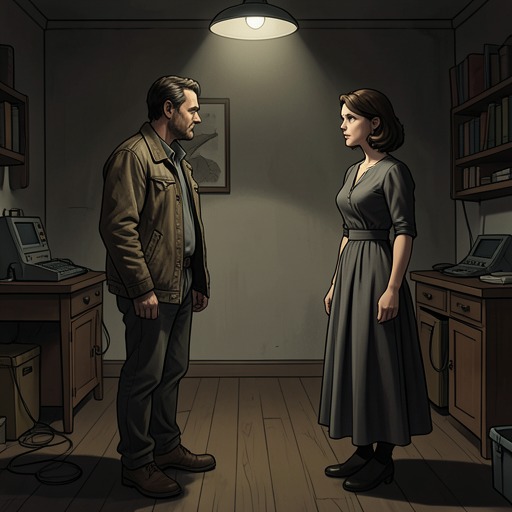
Arthur Road Prison
ShantaramArthur Road Prison is the Bombay jail where Lin’s detention turns an uncharged arrest into months of confinement, punishment, and uncertainty. Its overcrowded rooms and coercive internal order make imprisonment a struggle not only to survive but to preserve contact, identity, and purpose; Lin leaves alive, but unable to resume the life he had before entering it.
Setting and Arrival
Lin reaches Arthur Road Prison after three weeks in the Colaba Police Station lock-up. During that time, he and Mahesh endure confinement and try to find a way to send word outside. The transfer takes place in an old blue prison truck packed with eighty men, although thirty would already have been too many. At the prison, guards make the men wait for hours while they are processed one by one. Lin is left until last, and a watch commander tests whether he understands Marathi by repeatedly ordering him to stand and squat. Lin eventually refuses to continue obeying the commands, and the encounter ends in a hostile silence.
The next passage into the prison is not a routine intake. Guards direct Lin through an archway and around a sharp turn, where about twenty men are waiting in a corridor with bamboo sticks. The arrangement recalls the punishment corridor in the Australian prison from which he escaped: Arthur Road becomes another place where confinement is enforced through organized violence. That parallel makes the new prison feel less like a fresh ordeal than a return to a system Lin had already risked everything to leave.
Overcrowding and Internal Hierarchy
Arthur Road’s population is described by prisoners as far larger than official figures suggest: one man estimates that twelve thousand are inside. Lin’s own dormitory holds prisoners in a density that shapes nearly every part of daily life. Men gather in circles to sing, tapping their upturned aluminium plates like drums; songs pass from group to group, and the shared music gives prisoners a way to sustain companionship and feeling amid the institution’s pressures.
The prison’s internal spaces are not socially equal. Overseers command a privileged end of the room, supported by a dozen flunkies who perform chores and receive scraps of food, cigarettes, and fewer beatings in return. The overseers eat a varied meal of rice, lentils, chutneys, bread, fish, meat, and sweets, while other prisoners remain hungry. The contrast makes the prison’s hierarchy visible in ordinary routines: those with power control not only movement and punishment but also food, labor, and relative safety.
That order is reinforced by the prospect of arbitrary violence. Lin’s attempts to seek help from men approaching release fail after two young prisoners carry a message for him. The overseers beat them, return them to the room, and extend their sentences by six months as a public warning. Afterward, no one is willing to risk helping Lin. The episode closes off one of his few possible links to the outside world and demonstrates how punishment reaches beyond its immediate targets to discipline everyone watching.
Lin’s Confinement and Resistance
For two months, Lin waits without knowing how long he will remain imprisoned. He fears that a fingerprint report will identify him as an escaped Australian prisoner and expose him to the ten-year sentence he left behind. The uncertainty becomes a recurring source of distress. Meanwhile, his body weakens: he loses about twelve kilograms, develops sores from insect bites, and bears bruises from the overseers’ blows. His deteriorating condition and fear of discovery leave him increasingly isolated.
Writing briefly gives Lin a means of holding himself together. He has been shaping a short story in his mind, repeating its lines over several weeks as a private exercise in concentration. When he finally gets a pencil stub and discarded sugar-ration wrappers, he begins to put it on paper. Big Rahul, an overseer who has singled him out, interrupts and strikes him with a baton. Lin fights back, and the confrontation becomes a turning point in the prison’s treatment of him.
The overseers answer the fight with hours of punishment. They had allowed another prisoner to attack Lin, expecting the assault to overwhelm him; when Lin defeats that man, their plan fails and the violence against Lin intensifies. The overseers then recognize that his condition has become dangerous and order a subordinate to wash him. The washing, the first Lin receives in the prison, eases the effects of infected wounds enough to help keep him alive. The episode binds brutality and survival together: the prison’s violence nearly destroys him, while a small act carried out under orders unexpectedly aids his recovery.
Communication, Intervention, and Release
Lin’s efforts to get a message to Abdel Khader Khan continue after he is transferred. At the end of his second week, two young men due for release agree to carry a note with Khader Khan’s name and address. Their punishment makes the risk plain, and leaves Lin without a willing intermediary. Weeks later, as his condition worsens, he is summoned to a prison official’s office, where the official and a plain-clothes policeman are seated with Vikram Patel. Vikram’s reaction to Lin’s appearance draws attention to the severity of what has happened inside.
The underlying circumstances of Lin’s imprisonment are eventually clarified. Someone arranged with senior police officers to have him arrested and imprisoned without charge, and also arranged for him to be beaten. The police discovered through the fingerprint check that Lin had escaped from Australia, but the person who arranged the arrest did not know that. Some officers recognized the possibility of profiting by concealing Lin’s identity, and his file remained shelved until Vikram approached them on Khader Khan’s behalf. The prison is thus part of a wider system in which detention, official silence, and personal influence intersect.
Arthur Road also remains a place Lin revisits after his release. In its visiting area, two cyclone-wire partitions separate prisoners from visitors, with an empty gap between them. During one visit, Lin comes to see Anand, who admits that he knowingly killed Rasheed and insists on accepting his punishment. Anand asks Lin not to write about him and instead to report on the Blue Sisters. The prison’s architecture shapes the exchange: they can speak, but the barriers make their separation tangible, even as Lin tries to persuade his friend that he must help.
Aftermath and Significance
After his release, Lin stays in a room at the India Guest House at Khader Khan’s expense. A clean shower and a soft mattress help his wounds heal, but the move also marks his inability to return to the slum. His months in Arthur Road have damaged his spirit; he is also burdened by shame over deaths during the cholera epidemic, including his neighbor Radha and two boys from his English class. The prison experience and his sense of failure combine until he cannot bear to live or sleep in the community where he had worked as a doctor.
His friends continue to welcome him at gatherings and in daily life, without pressing him to talk about prison. Lin still visits them and helps at the clinic, but he no longer has the confidence and innocence that had sustained his earlier service. Arthur Road therefore changes not only his health but also his relation to the people and work that gave his life meaning. As a setting, it concentrates the novel’s concerns with coercive power and survival: its locked spaces and punishments leave marks that persist beyond release, while friendship, writing, and the efforts of others offer only partial routes back to the world outside.