Cuffe Parade Slum
ShantaramCuffe Parade Slum is a sprawling settlement of roughly 7,000 huts and 25,000 people, pressed beside Bombay’s World Trade Centre. Its first appearance establishes a stark divide between commercial wealth and insecure poverty; for Lin, the settlement becomes a refuge from a fate he considers worse and, soon after his arrival, the place where he begins treating its injured residents.
Setting and conditions
The settlement occupies about ten acres beside the World Trade Centre. Across two neighboring plots, the contrast is immediate: the modern, air-conditioned commercial building contains shops and displays of jewels, silks, carpets, and crafts, while the slum has no electricity, running water, or toilets. Its residents live in tiny huts, and the authorities might clear the settlement at any time. The disparity is not simply between two kinds of buildings: it is between a place furnished with neon lights and fountains and a community whose continued presence is uncertain.
At the entrance, a latrine screened by weeds and reed mats makes the settlement’s lack of sanitation unavoidable. Farther inside, breezes from the coast disperse its smell, while the scents of spices, cooking, and incense become more prominent. The huts are assembled from scraps of plastic and cardboard, bamboo poles, and reed mats, often on bare earth. The settlement’s physical conditions are harsh, but its lanes are also lived-in social spaces, where neighbors emerge from doorways and children gather to see the newcomer.
Lin’s arrival and first home
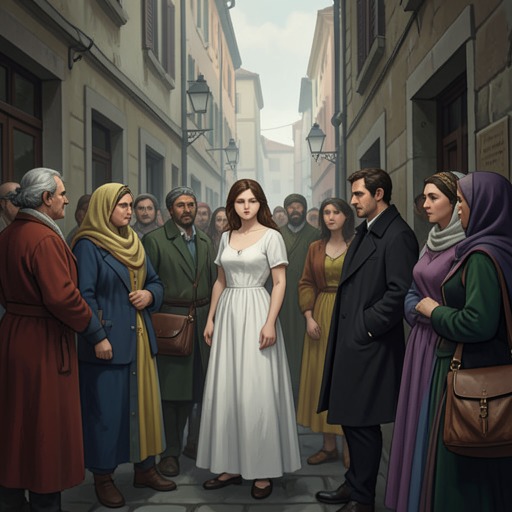
Lin reaches the settlement with Prabaker. As news spreads that a foreigner is coming, children crowd around the pair, laughing nervously and dancing; residents fill doorways and side lanes to stare. Lin initially reads their grave expressions as hostility. He later understands that they are trying to make sense of his fear: he takes the place to be threatening, while they know it as shelter from fates worse than life in the slum. That reversal makes the settlement a refuge in the story before it becomes a home in any ordinary sense.
Prabaker presents one of the huts as Lin’s house. Made from a black-plastic roof, bamboo poles tied with coconut-fibre twine, woven reed walls, and a plywood door, it is about four paces long and two wide. Its low ceiling forces Lin to stoop. The room’s resemblance to a prison cell is especially pointed because Lin has escaped prison, surrendering his former life to get away from it. He sets his guitar and First-aid kit inside: the hut is at once a modest place to live and the base from which he will begin helping others.
Community care and the open-air clinic
As evening falls, Qasim Ali Hussein has lamps brought from the settlement’s surroundings so residents can be treated by their light. Lin uses his First-aid kit to establish a small open-air clinic. Johnny Cigar and Prabaker help as translators and nurses, tending to burns, cuts, deep gashes, and smoke inhalation. The clinic is improvised, but it depends on cooperation: Lin’s medical supplies become useful through the labor of people who know the community and can work alongside him.
Qasim Ali Hussein soon turns to the wider emergency, overseeing shelters, the rationing of remaining water, food preparation, and other tasks that continue through the night. Care also reaches Lin. Radha brings him tea, then insists that her husband, Jeetendra, and two other young men pull him away from his patients so he can eat. After midnight, Jeetendra leads Lin to his hut, where a hand-crocheted blanket has been spread over the bare earth. The sequence gives the settlement a significance beyond deprivation: amidst precarious housing and scarce resources, its residents organize practical relief and make room for a newcomer.