Sunder village
ShantaramSunder village is where Lin’s journey with Prabaker Kharre turns from a visit to a transformation: the villagers receive him not as a stranger to be inspected, but as someone whose loneliness and future belong to their concern. In the village’s welcome, shared household life, and decision to name him Shantaram, Lin encounters a form of kinship that lets him begin to become the peaceful man they already believe him to be.
Setting and Arrival
The journey to Sunder village unfolds through a landscape that changes the scale of the world around Lin. After a bus ride slowed by the driver’s efforts to display the foreign passenger to people along the road, Lin and Prabaker Kharre leave the vehicle near the village and walk on. Fields of maize and banana give way to millet taller than a person; among its rows, the broad sky narrows to a small arc and the path disappears into curves of green and gold. The journey is prolonged and indirect, and the fields briefly turn the road into a passage through a living maze.
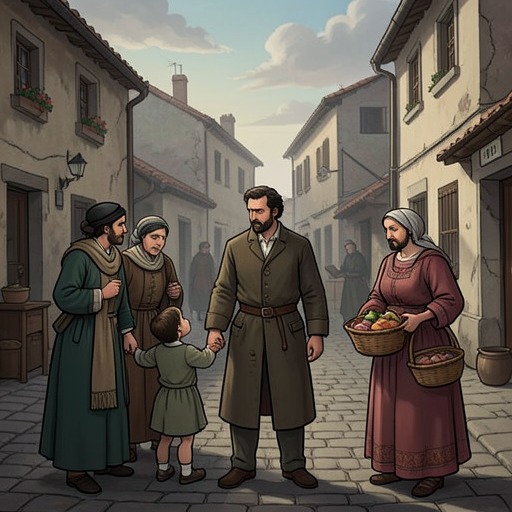
The village appears along a single wide street of swept, pressed river sand. Its round, pale-brown mud houses have round windows, curved doors, and small domes of thatched grass; none faces another directly across the street. Word of Lin’s arrival has drawn villagers from nearby settlements as well as Sunder’s own two hundred residents. When Kishan Mango Kharre drives the ox-cart up to his home, the crowd numbers about six hundred. Lin and Prabaker step down into a silence filled with stares and whispers, so close-packed that Lin can feel the breath of the people around him. The scene makes his arrival a public occasion, but the attention is not the suspicion of a city crowd: Prabaker, too, is awed by the wall of wonder and expectation.
Welcome and Household Life
The welcome begins in practical, shared acts. Before reaching the village, Lin and Prabaker sort out the presents they have brought for Prabaker’s family, setting aside a full bag of clothes, soaps, sewing needles, incense, perfume, shampoo, and other household goods. At Kishan Mango Kharre’s home, Lin showers with Prabaker, learns how to wrap a lungi over wet shorts, and joins the family for dhal, rice, and homemade flatbreads. Prabaker’s parents and sisters open their gifts; over tea, the family and visitors spend two hours asking Lin about his home and family.
Lin answers as truthfully as he can, withholding the central fact that, as a hunted exile, he does not expect to see his home or family again. That silence marks the difference between the welcome he receives and the life he has fled: the villagers make room for him as a guest, while he cannot yet tell them how completely cut off he feels from his former home. Their care is no less concrete for what remains unsaid. Kishan gives Lin his own coconut-wood bed, with its mattress of woven coconut-fibre rope, and sleeps beside his son on the floor while a replacement is made. When Lin tries to refuse, the family’s gentle insistence prevails.
The hospitality extends beyond the household. Prabaker explains that his family and neighbours worry Lin will be lonely in an unfamiliar place, away from his family. They sit beside him in a vigil on his first night, remaining until they are sure he is asleep. Their care is presented as reciprocal rather than exceptional: Prabaker asks Lin to imagine that people in Lin’s own village would sit with him in the same way if he were far from home. Sunder village thus welcomes him through the ordinary obligations of family and neighbourhood, even as Lin’s exile makes those obligations newly consequential.
Naming Lin
Sunder village changes not only Lin’s circumstances but the name through which the community understands him. Rukhmabai Kharre, Prabaker’s mother, calls a meeting of the village women and proposes a Maharashtrian name for him. Since Lin is living in Prabaker’s household, he is to take the family name Kharre; since Kishan Mango Kharre is Prabaker’s father and Lin’s adoptive father, tradition assigns Lin Kishan as his middle name. The women choose Shantaram for his first name because they judge his nature to carry peaceful happiness. The full name is Shantaram Kishan Kharre, meaning a man of peace or of God’s peace.
The name is a communal interpretation of Lin, not a label he arrives with. Before Sunder, he has spent his life ready to fight for what he loves or against what he despises, until his body and manner have become a warning to others. In the village, that warning goes unread: the residents have no other foreigners to use as a reference, and they take him as peaceful even when he is stern. They see a man who works, jokes, plays with children, sings, dances, and laughs openly. Their reading gives Lin space to inhabit a self that his former manner concealed.
Transformation and Significance
Lin understands the naming as both recognition and possibility. The villagers may have discovered a peace already present in him, or planted the idea like a wishing tree; either way, their name marks the point at which he begins, slowly and belatedly, to become the better man they believe him to be. The flood-game stakes, learned on the same day as the naming, become an image for this moment: the farmers have driven their stakes into his life and marked the place where his inner river had seemed to stop.
Sunder village’s significance therefore lies not simply in its contrast with the city, but in the kind of belonging it makes possible. In Bombay, the people-market exposes children displaced by calamity and reduced to objects of purchase, while the Cuffe Parade Slum places thousands of residents beside glittering wealth without water, toilets, or secure tenure. Sunder offers another social arrangement: a crowd that receives a visitor, a family that yields its bed, and neighbours who keep watch so he will not be alone. The village does not erase Lin’s exile or restore the family he has lost; instead, it gives him a chosen family and a name that can guide the person he is still becoming.