Early in the story
The New Dachang outbreak
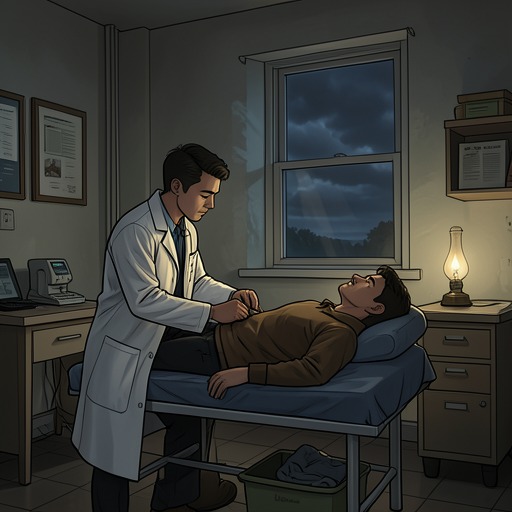
In [New Dachang](entity:location-recall-location-new-dachang-928cd8aa276b) near the Three Gorges Reservoir, [Kwang Jingshu](entity:character-recall-character-kwang-jingshu-236643c9ef9d) discovers seven villagers suffering from fever, strange bites, coma, and violent reanimation. A twelve-year-old boy, bitten while moon fishing among the drowned ruins, has no pulse, gray skin, and unnatural strength; his severed arm continues moving after his body tears it free.
The [Ministry of State Security](entity:organization-recall-organization-ministry-of-stat-ded8ebccc457) rapidly seals the village, arrests Kwang Jingshu, and suppresses the incident. His colleague [Gu Wen Kuei](entity:character-recall-character-gu-wen-kuei-c7c682139ea9) recognizes the pattern and warns him that this is not an isolated medical event, establishing the first hidden breach of the [Walking Plague](entity:state-recall-state-walking-plague-5cc2e236f25e).
Soon after the first Chinese outbreaks
The smuggling exodus
[Nury Televaldi](entity:character-recall-character-nury-televaldi-df339762c4bf) explains that rumors of the infection transform Chinese human smuggling into a booming industry. Desperate families, professionals, and officials flee by land, air, and sea, often concealing infected relatives in cars, crates, or cargo holds while corrupt border officials profit from the traffic.
Flight 575 becomes a decisive warning when advanced infection reaches international air travel, helping seed outbreaks abroad. The episode reveals how fear, repression, false hope, and commerce turn a local disaster into a global transmission network.
Early spread period
The Kyrgyzstan cave massacre
[Stanley MacDonald](entity:character-recall-character-stanley-macdonald-0986fead38a8) and Canadian troops investigating an opium-smuggling cave in Kyrgyzstan find slaughtered traders, torn pack animals, shattered barricades, and corpses that appear to have fought their way out of an infirmary. An undead survivor attacks MacDonald from beneath a collapsed tunnel, forcing him to destroy its brain.
Authorities later dismiss the encounter as chemical exposure and post-traumatic stress. The cover-up isolates MacDonald and demonstrates how military institutions protect their preferred explanations even when their own soldiers have witnessed the impossible.
Before the Great Panic
The infected heart transplant
[Fernando Oliveira](entity:character-recall-character-fernando-oliveira-826015f1fb31) assists Doctor Silva in transplanting a heart obtained through an illegal Chinese organ network into Herr Muller, whose rare reversed anatomy requires an exact match. Muller reanimates in the clinic, kills Silva, and is destroyed only when Oliveira accidentally shoots through his head.
Oliveira realizes that infected organs might transmit the plague without any bite, especially through hospitals and black-market transplants. His speculation widens the suspected routes of spread beyond immigration and exposes the lethal consequences of treating human bodies as commercial inventory.
Before Israel’s declaration
The Cape Town outbreak
[Jacob Nyathi](entity:character-recall-character-jacob-nyathi-9e7656010b7d), walking home through Khayelitsha, encounters gunfire, burning shanties, and the first South African wave of dead attackers. He kills one with a cooking pot and escapes only after police fire on him and transport him to Groote Schuur Hospital.
The hospital staff argue over the supposed rabies outbreak while patients die and reanimate. The event becomes one of the crucial independent warnings that eventually reaches Israeli intelligence, proving that the infection is already spreading through ordinary communities.
After the Cape Town outbreak
The Warmbrunn-Knight Report
[Jurgen Warmbrunn](entity:character-recall-character-jurgen-warmbrunn-1597a5cdbd60) combines decrypted Chinese messages, South African testimony, Canadian military records, Brazilian medical reports, and [World Health Organization](entity:organization-recall-organization-world-health-org-e8717df8dcd9) data into a global pattern. He and [Paul Knight](entity:character-recall-character-paul-knight-dad8fa95976f) independently conclude that the dead are hostile, contagious, and stoppable only through destruction of the brain.
Their report recommends urgent international preparation, but its warnings are buried by competing crises, bureaucratic inertia, and intelligence failures. The report becomes a tragic measure of how much governments knew before they were willing to believe it.
Months before the Great Panic
Israel’s Voluntary Quarantine
Israel publicly announces voluntary quarantine and offers asylum to Jews, foreign-born Israelis, and Palestinians with qualifying family ties. [Saladin Kader](entity:character-recall-character-saladin-kader-408e6855b8c3)’s family flees Kuwait through Egypt and the Sinai, crossing the Israeli border through a dog-screened inspection process.
The dogs identify infected travelers who are removed to quarantine, while uninfected refugees enter the Yeroham resettlement system. What Kader initially interprets as ethnic persecution is gradually revealed as a practical defense against the plague.
After Israel’s quarantine declaration
The Israeli Civil War
While traveling through Beer Sheba, Kader’s family is caught in an armed conflict between Israeli government forces and ultra-Orthodox rebels. He initially mistakes the fighting for an uprising against Israel, but then watches soldiers destroy infected attackers emerging from a burning van with precise headshots.
The revelation shatters his adolescent political certainties. He recognizes that the real enemy is neither Jew nor Arab but the living dead, and his former hatred is replaced by a reluctant understanding of the people who prepared first.
Immediately before public acknowledgment
The Chinese deception
[Bob Archer](entity:character-recall-character-bob-archer-75e72b4ce4fd) explains that China disguises nationwide plague-control sweeps as a political crisis in the Taiwan Strait. The Taiwan National Independence Party victory, military threats, disappearances, executions, and reserve mobilization all divert foreign intelligence away from the actual outbreak.
The [Central Intelligence Agency](entity:organization-recall-organization-central-intellig-55def823fc61), weakened by political purges and focused on conventional threats, follows the deception. China’s maskirovka succeeds because familiar authoritarian violence provides a convincing explanation for every warning sign.
Before the Great Panic
The American warning failure
[General Travis D’Ambrosia](entity:character-recall-character-general-travis-d-am-ab2cf9d8ee5d) recalls that American military leaders privately discuss the Israeli warning and develop a two-phase response. Alpha teams are sent into outbreak zones to investigate, isolate, and eliminate infected targets, but the larger mobilization required for Phase Two is never funded or politically accepted.
War weariness, depleted recruitment, public distrust, and the financial burden of the previous conflict leave the United States unable to convert an emergency response into national preparation. The failure ensures that the country meets the coming catastrophe with elite stopgaps rather than a complete defense.
Before the Great Panic
Phalanx deception
[Breckinridge Scott](entity:character-recall-character-breckinridge-scott-ce5c1547ebf2) and his associates exploit public fear by selling [Phalanx](entity:object-recall-object-phalanx-f0d741d52a7f) as a rabies vaccine. Government officials, the [Federal Drug Administration](entity:organization-recall-organization-federal-drug-adm-a82262fefb03), doctors, investors, and the media all benefit from the reassuring fiction, while the drug provides no protection against the [Walking Plague](entity:state-recall-state-walking-plague-5cc2e236f25e).
The false cure briefly boosts the economy and calms the public, but it also delays recognition of the true threat. When the deception collapses, the resulting loss of confidence accelerates the Great Panic.
Before the Great Panic
The political denial
[Grover Carlson](entity:character-recall-character-grover-carlson-c9aca34d31c2) admits that the White House receives the [Warmbrunn-Knight Report](entity:object-recall-object-warmbrunn-knight-repor-a6f03dd5130c) but treats it as another exaggerated threat. Officials authorize limited public education and the Alpha teams while refusing to tell citizens that the disease reanimates corpses, fearing riots, economic collapse, and electoral ruin.
The administration relies on a mixture of secrecy and media self-censorship. By making the threat appear manageable, it preserves short-term political stability at the cost of leaving millions unprepared when containment becomes impossible.
Beginning of the Great Panic
The suburban breach
[Mary Jo Miller](entity:character-recall-character-mary-jo-miller-4ad6ce061cca)’s family discovers the dead entering their California home. Her husband fights one attacker while another seizes their daughter, forcing Miller to tear the creature away and flee with the children as gunfire and panic erupt around them.
The attack marks the moment when the plague ceases to be distant news and becomes domestic reality. Her family’s dependence on [Phalanx](entity:object-recall-object-phalanx-f0d741d52a7f), medication, consumer comforts, and an unused gun embodies the widespread illusion that ordinary life can continue behind a thin layer of preparation.
Early Great Panic
The highway exodus
[Gavin Blaire](entity:character-recall-character-gavin-blaire-51fcf006b48e) surveys an immense traffic jam on the Great Plains: cars, buses, trucks, tractors, and desperate pedestrians all moving without a coherent destination. The stalled lines become killing grounds when zombies flow between vehicles and trapped drivers cannot escape.
The exodus reveals panic as a social contagion. People join a line because others have joined it, carrying possessions that cannot help them and following roads toward already-infested cities.
Early Great Panic
The Alang maritime flight
Ajay Shah reaches Alang, expecting a functioning shipyard, and instead finds stranded hulks surrounded by refugees. Boats charge money, food, or women for passage, while drowning infected swimmers rise in shallow water and attack rescuers.
A Canadian cutter saves Shah, but he watches other ships burn or become floating slaughterhouses. The scene demonstrates that the ocean, initially imagined as an escape route, becomes another vast theater of infection and exploitation.
Early Great Panic
The church siege
[Sharon](entity:character-recall-character-sharon-c1e11e522a83) remembers taking shelter in a church with her mother, children, supplies, and frightened adults waiting for authorities. When the dead break through the doors and windows, the congregation collapses into panic, violence, and desperate attempts to protect children.
Sharon survives only because someone carries her away through the chaos. Her fragmented recollection preserves the psychological destruction of civilians who have no battle plan, no reliable leadership, and no way to distinguish rescue from abandonment.
During the early Great Panic
The Russian quarantine sweeps
[Maria Zhuganova](entity:character-recall-character-maria-zhuganova-e3aa9716fed5)’s unit in North Ossetia is placed under communication blackout and ordered to search villages for missing people, bites, and unexplained attacks. A civilian known as Rat Face directs the execution of an apparently reanimated girl, confirming that the army already understands more than it admits.
The soldiers grow suspicious and terrified as orders become increasingly brutal. The blackout, inspections, and disappearances reveal Russia preparing for internal containment while denying its own troops the information needed to understand their mission.
After the first military mutinies
The Russian Decimation
When Arkady exposes an undead prisoner and demands to know why soldiers are being kept from their families, the unit erupts in revolt. [Russian Spetsnaz](entity:organization-recall-organization-russian-spetsnaz-d9c1853594fa) crushes the rebellion, then forces the soldiers into groups of ten to vote on one member’s execution and personally kill the chosen victim with stones.
[The Russian Decimation](entity:action-recall-action-the-russian-decimation-051aaa8b9226) restores obedience through shared guilt rather than loyalty. Maria concludes that the soldiers have surrendered moral agency, learning to survive by insisting that someone else gave the order.
During the Great Panic
The Iranian bridge bombing
Ahmed Farahnakian bombs the Ketch River Bridge to block refugee traffic from Pakistan into Iran. The attack is intended as a defensive measure, but Pakistan retaliates against an Iranian border post after diplomatic communications collapse.
Without functioning channels to de-escalate the incident, conventional clashes expand into the Iran–Pakistan Nuclear War. The episode shows how the plague magnifies ordinary mistrust until state systems destroy themselves while trying to survive.
Shortly after the bridge bombing
The nuclear exchange
Iran and Pakistan trade attacks on cities and military facilities, with Tehran, Islamabad, Qom, Lahore, Bandar Abbas, and other locations struck by nuclear weapons. Neither government appears to possess a coherent objective; rage, confusion, and broken communications drive the escalation.
The exchange spreads radiation and ash across Asia and beyond, worsening the global climate crisis. It becomes one of the war’s most devastating examples of human institutions remaining dangerous even while civilization is collapsing.
As the plague spreads beyond China
The Kwang arrest
[Kwang Jingshu](entity:character-recall-character-kwang-jingshu-236643c9ef9d) is imprisoned without formal charges after warning his daughter and attempting to expose the outbreak. He eventually escapes, but by then the infection has crossed China’s borders and the authorities’ strategy of suppression has failed.
His personal fate becomes a symbol of the cost of secrecy. The state preserves its image briefly, yet sacrifices the very physicians and witnesses who might have helped the public respond in time.
Three months into the Great Panic
The Battle of Yonkers
[Todd Wainio](entity:character-recall-character-todd-wainio-a899e14b0b23)’s unit assembles at [Yonkers](entity:location-recall-location-ca9b4fc4b1dd) for a highly publicized conventional battle intended to restore national confidence. Tanks, artillery, aircraft, electronic systems, and reporters are deployed against a horde that cannot be frightened, suppressed, or stopped by ordinary center-mass fire.
The bombardment destroys bodies without reliably destroying brains, ammunition runs short, communications spread panic, and zombies break through the line from the rear. [The Battle of Yonkers](entity:event-recall-event-the-battle-of-yonkers-0f8a1cd2539e) becomes a catastrophic psychological defeat, teaching the world that superior technology is useless when doctrine misunderstands the enemy.
After Yonkers and before the continental retreat
The Redeker Plan
[Paul Redeker](entity:character-recall-character-paul-redeker-d3c69fdc9c7e) proposes a ruthless survival strategy based on consolidating military forces inside a defensible safe zone and deliberately abandoning most civilians as living bait. The plan preserves a labor force, protects governmental legitimacy, and keeps zombie hordes fixed away from the retreating army.
South African leaders initially recoil, but [Nelson Mandela](entity:character-recall-character-nelson-mandela-b9cffcd0605a) recognizes that the plan may save the nation. Redeker’s logic transforms a moral horror into official policy and becomes the template for several countries’ wartime withdrawals.
After the Great Panic reaches South Africa
South Africa’s safe zone
South Africa implements the [Redeker Plan](entity:rule-recall-rule-redeker-plan-a7162bb7832b), withdrawing forces and selected civilians into defensible zones while leaving others behind as bait. Xolelwa Azania works with Redeker during the retreat and later assumes a role in explaining and administering the strategy.
The government’s survival comes at the price of mass abandonment, creating a permanent moral wound. Redeker disappears into psychiatric custody, where the state preserves both his expertise and his dangerous secrecy.
During the European retreat
The German sacrifice
[Philip Adler](entity:character-recall-character-philip-adler-3f6a820e05b5) commands a [Hamburg](entity:location-recall-location-da109bb5ffb9) garrison ordered to withdraw north while leaving refugees behind. He obeys under threat of treason, despite hearing civilians accuse the soldiers of cowardice and abandonment.
At the rally point, Adler discovers that [General Lang](entity:character-recall-character-general-lang-6fb9d21a4b66) has killed himself after completing the [Prochnow Plan](entity:rule-recall-rule-prochnow-plan-f38d123a8664)’s orders. The episode exposes the unbearable conflict between military obedience and conscience, showing that even a strategically rational retreat can destroy those who carry it out.
During the Ukrainian evacuation
The Kiev gas attack
[Bohdan Taras Kondratiuk](entity:character-recall-character-bohdan-taras-kondra-8e2c18b94566)’s unit tries to control the [Patona Bridge](entity:location-recall-location-366be8f9c30b) while civilians flee Kiev. With the bridge clogged and infected refugees impossible to screen, military aircraft release RVX nerve agent over the crowd, killing the uninfected and reanimating hidden victims.
Kondratiuk realizes the chemical strike is intended to separate the infected from the living through mass death. He withdraws his company, abandoning the collapsing city and carrying the knowledge that his own command has turned civilians into a weapon against the plague.
After the American retreat west
The northern refugee camps
[Jesika Hendricks](entity:character-recall-character-jesika-hendricks-7d6e180f45c7) and her parents follow the repeated instruction [Go north](entity:expression-recall-expression-go-north-8c7a42aa8fcf), joining a huge migration into Canada and the subarctic wilderness. Refugees consume fuel, timber, fish, and food without understanding how they will survive the winter, while the government withholds the practical information needed for long-term survival.
When supplies fail and the cold deepens, the camps deteriorate into violence, starvation, cannibalism, and abandonment. [The First Gray Winter](entity:event-recall-event-the-first-gray-winter-f8876ffdfdf5) kills millions and leaves behind the frozen dead who will awaken when spring returns.
During the Indian collapse
The Himalayan retreat
[Sardar Khan](entity:character-recall-character-sardar-khan-8ea799fb2e0f) is ordered to drive a detonator to a Himalayan pass and destroy the road against the approaching undead. Refugees still clog the route, and [General Raj-Singh](entity:character-recall-character-general-raj-singh-619c7c882fa7) arrives to insist that the pass must be destroyed immediately despite the human cost.
When the charges fail, Raj-Singh runs into the crowd and reaches them by hand as the dead arrive. The resulting explosion severs the road, saving the mountain safe zone while killing or trapping countless refugees and turning the general into a symbol of sacrificial command.
During the first stalemate months
The Great Panic’s psychological toll
[Roy Elliot](entity:character-recall-character-roy-elliot-861ed74d2ef8) discovers that [Asymptomatic Demise Syndrome](entity:state-recall-state-asymptomatic-demise-syn-6b897ebdcb7c) is killing survivors who simply lose the will to continue. He films [The Battle of the Five Colleges](entity:event-recall-event-the-battle-of-the-five-b1de04c0d009), showing students defending Scripps Women’s College against thousands of zombies, and distributes the film through refugee camps and transport networks.
The movie reduces deaths in communities that see it, proving that morale is a strategic resource. Elliot then produces further films, including propaganda about advanced weapons, because carefully chosen lies can restore hope after the older lies of denial have collapsed.
After the Rocky Line stabilizes
The American reconstruction
Arthur Sinclair builds the [Department of Strategic Resources](entity:organization-recall-organization-department-of-st-5e548934f3ee) into the machinery of survival. Refugees are assigned work, F-6 citizens receive practical training, and the [National Reeducation Act](entity:rule-recall-rule-national-reeducation-act-c7d5b92c6e28) redirects a service-based population toward farming, repair, construction, and munitions production.
The [Community Self-Sufficiency Program](entity:rule-recall-rule-community-self-sufficien-7882cfef6890) teaches survivors to create rather than consume, while recycling abandoned consumer goods supplies factories. The transition restores a war economy and demonstrates that victory depends less on technological abundance than on labor, resources, and logistics.
During the American stalemate
The Continental Airlift
[Gavin Blaire](entity:character-recall-character-gavin-blaire-51fcf006b48e) describes the air force’s conversion from high-performance combat aviation to propeller-driven resupply. [The Continental Airlift](entity:action-recall-action-the-continental-airlif-e02fa963bb90) links isolated Blue Zones, Red Zones, and Purple Zones, delivering tools, spare parts, food, specialists, and survival infrastructure across infested territory.
The operation keeps scattered communities alive while prioritizing self-sufficiency over dependency. Blaire’s crash in Louisiana and survival through the guidance of the mysterious Mets Fan reveal the personal cost of maintaining those fragile connections.
During the global collapse
The Japanese evacuation
[Doctor Komatsu Yukio](entity:character-recall-character-doctor-komatsu-yuki-33247409f316) concludes that Japan’s dense population, limited military experience, and fragile transport network make national survival impossible. The government begins evacuating citizens northward and overseas while the plague overwhelms Japanese cities.
[Kondo Tatsumi](entity:character-recall-character-kondo-tatsumi-7ff636a42713), an isolated otaku in [Kokura](entity:location-recall-location-0f9a569798e6), initially treats the evacuation as an information puzzle rather than a human emergency. When communications fail and the dead invade his apartment block, he is forced out of cyberspace and into physical survival.
During the Japanese evacuation
Kondo’s descent
Kondo escapes his apartment by tying bedsheets into ropes, descending floor by floor through abandoned flats and suicide scenes. He scavenges clothing, medicine, food, and improvised equipment, but nearly dies when a zombie attacks him from a balcony.
In a dead neighbor’s room, Kondo finds a wartime Japanese sword preserved in a chest. The weapon gives him both a practical means of defense and a symbolic connection to a life beyond his isolated digital identity.
After Japan’s evacuation
The gardeners of Hokkaido
[Tomonaga Ijiro](entity:character-recall-character-tomonaga-ijiro-b0dc8073bc92), a blind hibakusha living in Hokkaido, flees civilization rather than burden others. In the [Hidaka Mountains](entity:location-recall-location-d602f9aeb86d), a bear retreats from an approaching zombie, allowing Tomonaga to hear and destroy the attacker with his gardening stick.
Tomonaga interprets the encounter as a divine command to preserve Japan’s land until its people return. He adopts a disciplined nocturnal life, kills approaching zombies one by one, buries their bodies, and eventually convinces Kondo to join the work.
During the global war
Cuba’s transformation
[Seryosha Garcia Alvarez](entity:character-recall-character-seryosha-garcia-alv-a79e85810b90) explains how Cuba survives through early containment, geographic isolation, medical expertise, and strict internal controls. Millions of refugees arrive by sea and are placed in the [Quarantine Resettlement Program](entity:rule-recall-rule-quarantine-resettlement-c2e4928cf463), where their labor initially sustains agriculture and security.
As the war economy expands, refugees become indispensable workers, engineers, and citizens. Cuba evolves from a deprived authoritarian state into a wealthy democratic power, demonstrating that crisis can destabilize an old order as effectively as it destroys cities.
During China’s collapse
The Chinese submarine exodus
[Admiral Xu Zhicai](entity:character-recall-character-admiral-xu-zhicai-4aa66b6bab36) recounts how [Captain Chen](entity:character-recall-character-captain-chen-897be9f2b9ec) and the crew of the Admiral Zheng He secretly load relatives and supplies before escaping China aboard a ballistic-missile submarine. They abandon a homeland consumed by the undead, hoping to preserve a fragment of Chinese civilization.
The crew later encounters refugee fleets, infected ships, and a Chinese hunter-killer submarine. In the [Manihi](entity:location-recall-location-61e3e3e17f54) engagement, Captain Chen’s boat destroys the attacking submarine, only to learn afterward that it was commanded by his son, [Commander Chen Zhi Xiao](entity:character-recall-character-commander-chen-zhi-b0aaa3b55da3).
After the Manihi engagement
The Xilinhot strike
[Captain Chen](entity:character-recall-character-captain-chen-897be9f2b9ec)’s submarine reunites with [Commander Chen Zhi Xiao](entity:character-recall-character-commander-chen-zhi-b0aaa3b55da3)’s rebel vessel and learns that China’s civil war began after the [Three Gorges Dam](entity:object-recall-object-three-gorges-dam-0e188f5db878) Collapse. The surviving rebels ask the submarine to end the Politburo’s resistance before the country’s remaining forces are wasted against one another.
Captain Chen accepts responsibility and launches a multi-megaton warhead at the hardened bunker in Xilinhot. The strike ends the internal conflict, allowing loyalist and rebel forces to reunify against the undead, but the captain is emotionally destroyed by the possibility that he killed his own son.
During the global collapse
The orbital vigil
[Terry Knox](entity:character-recall-character-terry-knox-6d5865869df8) and the [International Space Station](entity:location-recall-location-6f0a920472b1) crew remain in orbit after replacement launches fail and evacuation becomes impossible. They conserve oxygen, water, and food while using the [Jules Verne Three](entity:object-recall-object-jules-verne-three-4c1640c2dccc) to refuel vital satellites and preserve the communications and surveillance network.
From orbit they witness battles, refugee movements, nuclear detonations, the Japanese evacuation, zombie holes, and the [Three Gorges Dam](entity:object-recall-object-three-gorges-dam-0e188f5db878) Collapse. The station becomes a lonely technical outpost preserving the infrastructure needed for humanity’s eventual recovery.
After the defensive stalemate
The Honolulu Conference
[Ernesto Olguin](entity:character-recall-character-ernesto-olguin-c1dd618d778b) attends the [Honolulu](entity:location-recall-location-6c52a3c05c7e) Conference aboard the [USS Saratoga](entity:object-recall-object-uss-saratoga-e1dc1135cf1f), where surviving nations debate whether to remain behind defenses or launch a worldwide offensive. Some delegates argue that time and decomposition favor humanity; others insist that unresolved White Zones remain an existential threat.
The American president argues that humanity must reclaim its confidence and future rather than accept permanent retreat. The vote is far from unanimous, but enough nations commit to attack, turning survival from passive endurance into an organized attempt to recover the planet.
Opening of the counteroffensive
The Battle of Hope
[Todd Wainio](entity:character-recall-character-todd-wainio-a899e14b0b23) participates in the first major test of the rebuilt American army at [Hope, New Mexico](entity:location-recall-location-a7fb8ecfaefa). The new force fights in disciplined ranks with the [Standard Infantry Rifle](entity:object-recall-object-standard-infantry-rifl-3c32cb30735e), Lobotomizers, trained dogs, range markers, recharge teams, and [Cherry PIE ammunition](entity:object-recall-object-cherry-pie-ammunition-5998f7e0bf71).
The [Chain Swarm](entity:concept-recall-concept-chain-swarm-e4356a70b3d2) reaches the firing line, but careful pacing, abundant ammunition, and psychological support allow the troops to destroy it without collapse. The victory proves that a simple, purpose-built doctrine can defeat the dead where expensive modern systems failed.
During the counteroffensive
The military working dogs
[Darnell Hackworth](entity:character-recall-character-darnell-hackworth-40002a2d2495) describes the creation of the [K-9 Corps](entity:organization-recall-organization-k-9-corps-078cf71fd9c7), whose dogs detect infected people, scout ruins, lure zombies into kill zones, and identify hidden threats. Selective training separates pups capable of controlling their terror from those who become unmanageable.
Hackworth’s partnership with Maze illustrates the emotional and tactical value of the program. After earlier commanders treat dogs as replaceable assets, handler casualties and the Eckhart incident force the army to recognize the animal-human team as a single fighting unit.
The three years after Hope
The American continental offensive
The [American Army Groups](entity:organization-recall-organization-american-army-gr-d598ba9c4c2b) advance east in parallel lines, clearing every tract of land rather than racing toward symbolic cities. [Force Appropriate Response](entity:rule-recall-rule-force-appropriate-respon-e532a4cecdb0) units handle isolated contacts while the main line continues forward, and winter operations repeatedly expose new threats beneath the frozen terrain.
The campaign faces zombies, quislings, ferals, [F-lions](entity:creature-recall-creature-f-lions-d41cbf46d767), mines, disease, collapsed buildings, and armed LaMOEs. Its slowness is deliberate: the army learns that methodical sanitation, logistics, and psychological endurance matter more than spectacular victories.
During the American continental offensive
The Chicago resistance
Near the [Sears Tower](entity:location-recall-location-e18fcc9f45cd), Todd’s unit encounters an isolated survivor community led by a LaMOE who fires on advancing troops. A high-powered rifle wounds Todd, and the army responds with heavier weapons and a full assault rather than treating the enclave as another routine civilian zone.
The encounter expands the wartime threat pyramid beyond zombies. Human beings who have ruled isolated territories can be as dangerous as the dead, particularly when they resist reintegration into a restored national order.
Late in the international offensive
The Paris Catacombs campaign
[Andre Renard](entity:character-recall-character-andre-renard-3c3af09177c5) recounts the catastrophic decision to clear the Paris Catacombs, where a quarter million refugees and undead occupy tunnels beneath the city. Troops fight in darkness, sewage, flooded passages, toxic air, and unmapped chambers using improvised armor and close-combat weapons.
Fifteen thousand soldiers die in three months, including Andre’s brother during the assault on the Hospital. The campaign becomes a warning against sacrificing lives for symbolic heroism when a slower, safer strategy could achieve the same liberation.
During the international offensive
The British fortified recovery
David Allen Forbes describes how European castles, fortified towns, and the British fortified motorway system preserve pockets of civilization. [Windsor Castle](entity:object-recall-object-windsor-castle-b702b9acec5b) becomes a model defensive center with water, food, hidden security, and even local energy extraction, while Conwy and Caerphilly serve as bases for later liberation.
The defensive landscape also acquires a moral dimension when the British monarch remains at Windsor for the duration rather than fleeing. Castles protect bodies, while inherited public institutions protect the idea of national continuity.
After land fronts stabilize
The deep-water war
[Michael Choi](entity:character-recall-character-michael-choi-74fb57ebaf44) serves in the Deep Submergence Combat Corps, clearing offshore rigs, harbors, beaches, wrecked ships, and underwater debris fields. Divers use atmospheric diving suits and specialized weapons because millions of submerged zombies remain trapped in coastal waters and shipwrecks.
In the Battle of the Hero City, teams confront a drowned urban landscape of sunken vehicles, cargo, appliances, and infested vessels. The war continues beneath the surface long after terrestrial victory, proving that geography has preserved an entire hidden undead front.
Late in the war and after formal victories
The maritime aftermath
[Michael Choi](entity:character-recall-character-michael-choi-74fb57ebaf44) explains that millions of zombies remain in the oceans, while wartime fishing fleets devastate whale populations. Sonar, torpedoes, and mass harvesting destroy whales that once represented one of the planet’s most important surviving forms of wildlife.
The loss of the whales becomes a final indictment of humanity’s wartime survival methods. Even while reclaiming land from the dead, human beings permanently damage the living world they claim to be saving.
During the Russian counteroffensive
The Final Purification
[Father Sergei Ryzhkov](entity:character-recall-character-father-sergei-ryzhk-1bb089032f6f) begins shooting infected soldiers who are about to commit suicide, believing that God has appointed chaplains to release souls trapped in diseased bodies. His practice spreads through the army and the civilian priesthood as [Final Purification](entity:rule-recall-rule-final-purification-e77ed64115b4).
The doctrine helps end mass self-killing and gives Russia a religious structure after the collapse of secular authority. Later, however, the same language is converted into political repression, revealing how a compassionate wartime ritual can become an instrument of state power.
After three years of continental fighting
Victory in America
The American Army reaches the Atlantic and secures the continental United States. The government declares [VA Day](entity:event-recall-event-va-day-8b04d8476317) even though overseas campaigns, northern White Zones, island infestations, and underwater operations continue.
The decision allows exhausted volunteers to return to civilian life while international forces continue the larger war. It marks a political victory and a psychological turning point, but not the literal end of the Zombie War.
After VA Day and Victory in China Day
The postwar reckoning
Survivors rebuild through local labor, international cooperation, security patrols, refugee integration, and recurring seasonal sweeps. [Joe Muhammad](entity:character-recall-character-joe-muhammad-377918c018e7), [Jesika Hendricks](entity:character-recall-character-jesika-hendricks-7d6e180f45c7), [Kwang Jingshu](entity:character-recall-character-kwang-jingshu-236643c9ef9d), and others describe a world still scarred by poverty, pollution, shortened life expectancy, and the need to hunt frozen or submerged dead.
The war also produces new political identities: Cuba democratizes, Russia embraces authoritarian religion, Japan creates the [Tatenokai](entity:organization-recall-organization-tatenokai-e3e86aaae67a), and neighborhoods retain collective security practices. The survivors disagree about whether the war united humanity or merely postponed its old selfishness.
Near the ending
The enduring human factor
The narrator reflects that official reports preserve facts, figures, and operational lessons, but personal testimony preserves the emotional meaning of the war. Accounts of abandonment, courage, guilt, propaganda, sacrifice, and grief become a counterweight to the cold language of military history.
The surviving voices insist that humanity’s defining victory was not merely killing the dead. It was retaining the ability to remember, cooperate, mourn, rebuild, and imagine a future in which children can grow up without inheriting fear.