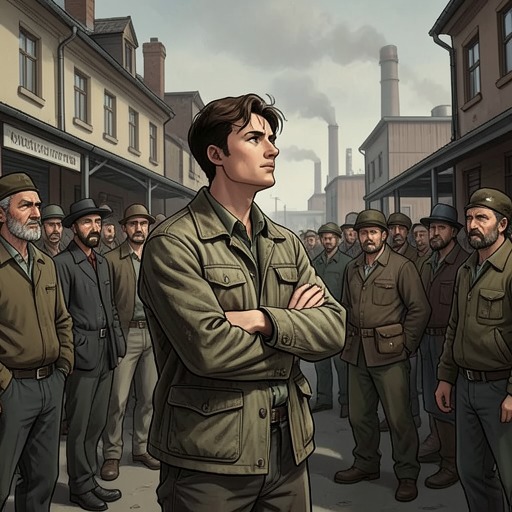
Ben Compton
1919Ben Compton’s political formation begins with a boy’s practical ambition: to study, become a lawyer, and earn enough to give his parents back the home they lost. His journey from that domestic purpose to socialist organizing is marked by encounters with precarious labor, strikes, and state repression. The transformation does not erase his attachment to his family or his desire to learn; it gives those desires a wider object, as he comes to understand individual advancement through the conditions of workers as a class.
Identity and Early Ambition
Ben was born into a Jewish family in Brooklyn, but at school he insisted that he was American, pointing to his birthplace, his home in Flatbush, and the fact that his parents owned it. His father worked repairing watches in a jewelry store. When a teacher noticed Ben squinting, his father took time off to bring him to an optician, who prescribed heavy steel glasses. The glasses hurt behind Ben’s ears, but his father saw them as a sign of intellectual promise: he imagined a future lawyer or scholar rather than another son drawn into sports and casual work. Ben became good at his lessons and joined the high-school debating team.
The family’s finances changed when Ben was thirteen. His father’s long illness forced him to stop working for a year, and the family lost the house that had nearly been paid off. They moved to a flat on Myrtle Avenue. Ben took evening work in a drugstore and became preoccupied with making money so his parents could again have a home of their own. His older brothers left home as well: Sam found work in Newark, while Isidore was cast out after drifting into pool halls. Ben’s early ambition thus grew out of a specific loss, and the promise of professional success initially appeared to him as a way to repair it.
Work, Friendship, and Class Politics
A visit with Isidore took Ben well beyond the familiar bounds of home. He accompanied his brother on a rough journey to Lancaster, Pennsylvania, where Isidore was to box a Filipino featherweight. They crossed New York on foot, rode freight trains, evaded a yard detective, and walked the remaining distance after a brewery wagon carried them toward West Chester. A farmer let them sleep in his barn, but required two hours of wood chopping before breakfast. Ben arrived exhausted and slept through the fight. Isidore won by knockout in the third round, spent his twenty-five-dollar purse, and nevertheless found Ben a job at a construction-camp canteen.
Ben stayed at the road job for two months, earning ten dollars a week and his keep. He learned to drive a team and keep books. The canteen boss, Hiram Volle, cheated the construction workers in their accounts; at first Ben paid little attention because many of the men were Italian immigrants. That indifference began to shift through his friendship with Nick Gigli, a young worker from northern Italy. Nick spoke with Ben after work and on Sunday walks, introducing him to anarchist ideas and arguing that becoming a rich businessman would make Ben resemble the exploiters around him. Ben admired Nick’s experience across jobs and industries, and the men at camp came to associate the two so closely that they would call out to Ben asking where Nick was.
When Nick told Ben that the men would strike over stolen time, Ben said he would join them. Volle mocked him with an ethnic slur and threatened him with violence; Ben answered by rejecting the insult and declaring his solidarity with his class. The camp’s superintendents and gang bosses then confronted the workers, some carrying revolvers, and warned that anyone absent when the whistle blew would be fired and could be subject to Pennsylvania’s vagrancy laws. Most returned to work. Ben and Nick walked away with their bundles. Nick’s disappointment at the workers’ retreat sharpened the lesson of the episode: a shared grievance did not yet mean that the workers knew their collective strength.
Ben later left Nick and returned home, but carried his advice with him. He enrolled at the College of the City of New York, supported by a hundred-dollar loan from his father, money for books from Sam, and his own evening work at a drugstore. He read Marx’s Capital at the library, joined the Socialist Party, and attended lectures at the Rand School. His stated purpose was to make himself a well-prepared instrument for the cause. Scarlet fever interrupted his studies: he spent ten weeks in the hospital, and afterward his eyes were so strained that an hour of reading brought on a headache. The illness arrived as his father’s debt increased, placing his intellectual project under both physical and financial pressure.
Organizing, Love, and the Strike
At a lecture, Ben met Helen Mauer, five years older than he was and already marked by years of work. She had worked in a textile mill, been arrested during the Paterson strike, and been blacklisted; she was then a salesgirl at Wanamaker’s, while her family continued to work in a mill at Passaic. Helen doubted that socialism offered the right strategy and favored syndicalism. She introduced Ben to radical acquaintances at the Cosmopolitan Café, while his father urged him to stop associating with radicals and earn money. Ben and Helen nevertheless began living together. At one point they passed as newlyweds to obtain a room, sharing a cramped, bedbug-infested lodging house and using contraceptives because they believed a child would interfere with their work in the movement. Their private circumstances made their politics immediate: they imagined a society in which workers would not have to live in filthy rooms or choose between organizing and having children.
When Helen lost her department-store job during a seasonal reduction in staff, the couple moved to Passaic. Ben found work in a worsted mill’s shipping department, and when a strike began, he and Helen served on the committee. Ben discovered that he could hold a crowd’s attention. He spoke from a soapbox, and when arrested he continued to address the court about surplus value. The strikers in the courtroom cheered; the judge threatened an additional six months for contempt if Ben did not stop. He received a six-month sentence and was taken to the county jail with special deputies carrying riot guns. Newspapers identified him as a well-known socialist agitator. In prison, his daily meeting in the yard with fellow worker and organizer Bram Hicks became the one thing that sustained him; Hicks urged him to obtain an Industrial Workers of the World membership card and learn the labor movement on the West Coast.
Public Voice and Political Repression
After living at home for a winter, Ben began clerking in the lower Broadway office of Morris Stein, a radical lawyer he had met through efforts to raise money for the Everett defendants. He also spoke at protest meetings about the Everett Massacre. Morris Stein’s sister, Fanya Stein, a wealthy pacifist, gave Ben books by Tolstoy and Kropotkin and sometimes drove him between meetings. Ben felt panic before addressing audiences made up of garment and waterfront workers, factory workers, socialists, and people gathered in Madison Square Garden. At first the faces blurred and the noise overwhelmed him; then he would hear his own voice become clear, see listeners lean forward, and find phrases about protest, mass action, and the united working class registering in the room. Afterward his glasses were misted, his hands and body betrayed his nerves, and Fanya praised his speech. Their connection remained largely within the movement, though Ben understood that she loved him.
The February Revolution in Russia filled Ben and the Steins with a sense that revolutionary change was dawning. At a later meeting in the Empire Casino, federal agents and a stenographer sat in the front row; police closed the doors, dispersed people outside, and soldiers and sailors entered the gallery. The chairman announced a message of solidarity with Russian workers. Ben warned that bankers and munitions makers were the only beneficiaries of the war and that workers would learn how to use the weapons with which profiteers were instructing them. Police broke up the meeting and arrested Ben and others. Men of conscription age had to show their registration cards before leaving, and Ben was taken away in a closed limousine before he could speak to Helen.
Federal agents held him for three days in a disused office, denying him food and water for much of that time and repeatedly questioning him. One group brought rubber hose and threatened to beat him; Ben stood up to them, and they instead gave him water and stale ham sandwiches. Afterward he stayed with Morris and Edna Stein, withdrawn and indifferent to his case. Helen telephoned with what news she could share, but he did not ask her to visit. He went only as far as a bench overlooking the Hudson, where he sat looking across at the New Jersey shore.
Trial and Continuing Conviction
At trial, the press carried reports of German victories, and the courtroom seemed to Ben sleepy and deceptively ordinary. The jury found him guilty, and the judge sentenced him to twenty years in prison. Morris Stein filed an appeal, and the judge allowed Ben to remain free on bail. Ben’s most forceful moment came when he addressed the court before sentencing. A speech he had prepared seemed weak to him at first; as he continued, his voice strengthened. He ended with the Communist Manifesto’s vision of a society founded on the free development of each person. The speech did not change the verdict, but it turned the courtroom into another place where he could make his politics audible.
When a visitor later expressed hope that public sentiment and President Wilson might secure Ben’s release, Ben replied, “I guess it’ll be the workers will get me out, if I’m gotten out.” He did not smile or return the visitor’s hand pressure. The exchange brings his development back to the question raised at the construction camp: who has the power to change a worker’s condition? Ben’s answer had moved beyond his childhood hope of restoring one family’s lost home. He still faced an uncertain legal future, but he placed his faith in collective action rather than presidential favor or the goodwill of liberal allies.