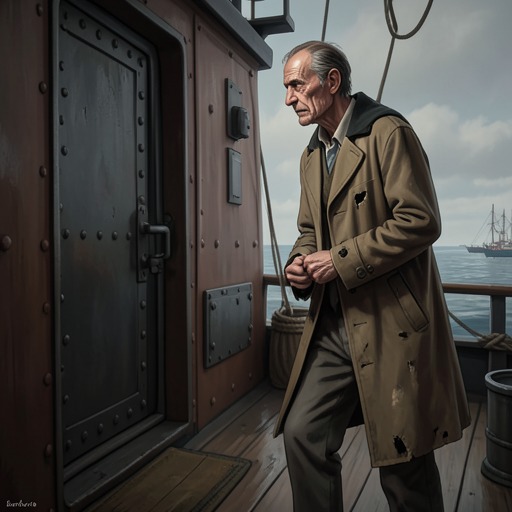
Joe Williams
1919Joe Williams is a seaman whose life moves through ships, ports, precarious jobs, and a marriage that repeatedly promises more than it can sustain. His episodes make the costs of war and working-class mobility tangible: even when he imagines leaving the forecastle for a settled home, the sea, economic insecurity, and the machinery of wartime service keep drawing him back. In a novel without a single heroic plot, his story is a succession of concrete reversals rather than a triumphant passage toward security.
Identity and Narrative Place
Joe Williams belongs to the ordinary people whose lives U.S.A. follows beneath the public headlines. The novel’s interwoven narratives do not resolve into one controlling hero’s quest; instead, Joe’s experiences recur as fragments within a larger account of people caught in historical circumstances. His story is told through work, travel, appetite, and private disappointment, with the movement from one ship or port to another often taking the place of lasting progress.
A cigarbox gathers the intimate materials of Joe’s past. Once a Flor de Mayo cigar box bought while he was drunk in Guantanamo, it holds Janey’s high-school graduation photograph, a snapshot of Alec with his motorcycle, a team picture from Joe’s own high-school baseball days, and a faded image of his father’s tug, the Mary B. Sullivan. It also contains a postcard of a woman he had been with in Villefranche, shaving blades, foreign stamps, and ten small shells collected on the beach at Santiago. The assortment sets family, boyhood, sexual experience, and travel beside one another without arranging them into a polished autobiography.
At one point Joe changes into a secondhand suit and drops his uniform, weighted with a cobblestone, from the dock into the muddy basin. He then realizes he has left the cigarbox behind, retrieves it, and walks to the beacon to watch a fleet steaming down the River Plate. The discarded uniform and rescued box pull in opposite directions: he can shed the visible sign of a role, but he carries his private history with him. The fleet soon blurs into smoke, while his attention shifts to a rusty tramp steamer coming into port.
The Sea, Work, and Mobility
Joe’s work at sea is laborious and often degrading. On the Argyle, a twenty-five-day passage means chipping rust, painting hot steel, enduring bedbugs in the forecastle, and eating poor food in a pitching ship. At Port of Spain, rain and heat leave the crew soaked and sore, with the prospect of loading asphaltum adding to their resentment. When Joe protests the seaman’s lot to Tiny, he voices a desire to escape the life; his childhood image of the tropics, he admits, has not survived contact with the work.
A dangerous passage later gives Joe the chance to be seen as more than a replaceable hand. After the crew has been confined for twelve days in a tarpaper shack inside a barbed-wire enclosure, Captain Perry praises Joe’s presence of mind in cutting the lashings on rafts, saying that the action helped save half the men aboard. He urges Joe to study for an officer’s position and suggests that, with time at shore school, he could obtain a third mate’s ticket. Joe is heartened by the prospect and longs to tell Della Matthews that he may no longer have to live as a forecastle hand. When the Vicksburg reaches Newport News, he refuses a drink with his shipmates and hurries toward Norfolk, eager to begin the more respectable life Captain Perry has made imaginable.
That promise does not end Joe’s dependence on the sea. A later trip on the Higginbotham is slow, mechanically troubled, and dispiriting. Joe worries about Della Matthews and about whether he is succeeding; the engines repeatedly break down, and the ship makes little headway against moderate headwinds. His companionship with Glen Hardwick, an older amateur boxer who gives him lessons, offers a temporary counterweight. By Bordeaux, Joe can give Glen a hard workout, and Glen encourages his natural right hand as a possible asset in boxing.
Bordeaux briefly opens a different world. After the United States declares war on Germany, Joe and Glen find that Americans are welcomed in town. Joe meets Marceline, goes with her to a hotel, and spends the four days in port drinking wine and cognac and enjoying food and company. He is married, and he thinks about that fact, but he also resents what he sees as Della Matthews’s prior withholding. The visit becomes a pocket of pleasure rather than a new life: when the Higginbotham sails home, it springs leaks so badly that reaching Halifax is uncertain.
In fog south of Cape Race, a sudden blow throws Joe onto the deck. The crew never learns whether a mine or torpedo struck the ship. The boats get clear, but are separated; Joe’s boat and Captain Perry’s remain together until a fishing schooner picks them up. Captain Perry is unconscious by the time they reach Boston and dies on the way to hospital of pneumonia. His death removes the mentor who had urged Joe toward advancement, while the wreck leaves the prospect of a secure career suspended in another maritime emergency.
Joe’s later return to sea is not a simple choice for adventure. After illness, unemployment, and the fear of being arrested over the draft, he goes out as an ordinary seaman on the Appalachian. The ship is badly maintained: a storm damages two lifeboats, the convoy scatters, and water leaks through an inadequately caulked deck into the forecastle. Because Joe is the only man aboard whom the mate trusts at the wheel, he is taken off paint-scrubbing and given four-hour watches. The responsibility improves his standing but does not change the poor conditions surrounding him.
Marriage, Desire, and Disappointment
Joe’s marriage to Della Matthews is sustained by reunions, jealousy, and incompatible hopes. On returning to Norfolk, Joe wants a quiet married life and imagines that the couple might have a child. Instead, Della is occupied all day at her office and much of the evening at the Red Cross canteen. Joe lies awake hearing officers bring her home, imagining intimacy between them, and then quarrels with her when she returns. Della argues that he does not understand her and treats his interference with her war work as unpatriotic. At other times they make up, and her affection renews his intense attachment to her.
Domestic tenderness appears in small, recurring scenes. On Sunday mornings, when Della is too tired to rise, Joe cooks breakfast and they eat together in bed. The scene recalls his morning with Marceline in Bordeaux, but its intimacy does not settle their disagreement about the future. Della wants Joe to find a shore job and earn more; she tells him that a wealthy army officer sought to marry her and that a well-paid man offered her a pearl necklace, which she says she refused. Joe feels diminished by these stories. When he tries to talk about having children, Della makes a face and turns away from the idea.
Joe’s own conduct further unsettles the marriage. He nearly gets a foreman’s job at a Newport News repair shop, but someone else takes it at the last moment. At parties with Della and Hilda Thompson, army officers and a naval midshipman treat him as inferior, while Della accepts attention from men in uniform and slips away with them. Joe begins drinking heavily at a poolroom with men he knows. Della is angry when she finds him drunk, but he has become increasingly indifferent to her anger. The strain is not resolved by a single rupture; affection and resentment keep replacing one another without producing a durable agreement.
War, Political Pressure, and Compromise
War enters Joe’s life as employment, danger, and a demand to demonstrate loyalty. On a later voyage, the convoy’s merchant ships travel under naval orders, their hulls patterned with camouflage. One new wooden ship, apparently shoddily built for someone’s profit, leaks so badly that it has to be abandoned and scuttled halfway across the Atlantic. In the danger zone, the ships steer zigzags, false submarine alarms recur, and gun crews fire at objects mistaken for threats. The war’s official language of service is set against improvised vessels, frightened crews, and the possibility that ordinary laborers will pay for poor construction.
Joe sees that political suspicion can reach even men trying to stay out of politics. When a sick acquaintance tells him that a secret-service agent has recruited him to report on radicals, draft evaders, and suspected German spies for twenty-five dollars a week, Joe declines an introduction. He says he is going back to Brooklyn and intends to go to sea rather than become part of the informer’s work. His refusal does not make him a political organizer; it shows his preference for the familiar risks of maritime labor over a job built on watching and reporting other people.
On the Appalachian’s passage through the Mediterranean, Joe encounters wartime danger in a different form. Near Genoa, a red glare initially prompts rumors that the town has been captured. It proves to be a burning Standard Oil tanker outside the breakwater. Joe climbs aboard despite the others’ calls for him to return. With the forward ship and surrounding water lit by fire, he takes a new sweater, lights a Havana cigar in the cabin, and finds seven pairs of women’s silk stockings. He first thinks of bringing the stockings home to Della Matthews, then remembers that he considers himself finished with that domestic hope; he pockets them anyway. The scene joins danger to acquisitiveness and unease: even beside a burning tanker that might explode, Joe’s instincts turn toward small, portable goods and the life he has failed to leave behind.
After reaching home, Joe becomes ill and cannot drink for several months. He steadies himself in Brooklyn, attends the Shipping Board’s shore school at Platt Institute, and earns a second mate’s license. He then works on the Owanda, a new wooden ship built in Seattle, making repeated trips between New York and St. Nazaire. Janey, overseas with the Red Cross and strongly patriotic, writes to him that civilization must be saved. Joe begins to think she may be right; he reads the papers, starts a savings account, and buys a Liberty Bond. His investment in the war’s cause grows alongside his professional advancement, though it rests in part on what he reads and on Janey’s letters rather than on any settled political understanding.
Armistice and Narrative Significance
On Armistice night, Joe is in St. Nazaire amid celebrations shared by American and French troops and sailors. People drink, dance, sing, exchange kisses, and cheer the Allied flags. Joe goes looking for Jeanette, a woman he has been seeing during the Owanda’s stays in port. She is dancing with a Senegalese French officer, and Joe, enraged by the sight, pulls her away and strikes him. The officer does not fall; his response is described as puzzled and smiling, while a waiter and French soldiers try to separate Joe from him. The outburst exposes the racialized possessiveness beneath Joe’s claim on Jeanette, set against a celebration supposedly marking the end of war.
The contrast gives the episode its force. Joe has endured dangerous passages, taken on responsibility, obtained a license, and begun to save and invest; yet the armistice does not deliver the orderly private life he had repeatedly imagined. In U.S.A., his movement from ship to ship is not a clean ascent from the forecastle to security. It is punctuated by brief openings—Captain Perry’s confidence, Bordeaux’s pleasures, a better license—and by losses or reversals that leave him unsettled. The novel’s documentary collage of headlines, popular language, and historical lives places such private episodes within forces larger than Joe, while his particular objects and choices keep those forces grounded in the daily life of a working seaman.