Theodore Roosevelt
1919Theodore Roosevelt’s life is rendered as a sequence of transformations: a sickly heir learns to turn physical limitations into disciplines, then carries the same strenuous self-fashioning into politics, exploration, and war. The resulting figure is both celebrated and unsettled. He embodies a confident, righteous idea of America, yet the arrival of modern war and his own failing health expose the limits of the world in which that ideal once seemed secure.
Identity and formation
The Roosevelts had lived on Manhattan Island for seven generations and possessed a substantial foothold in New York: a brick house on 20th Street, an estate at Dobbs Ferry, city lots, and investments. The family’s sense that Manhattan, and America, belonged to them frames Theodore’s upbringing as one shaped by wealth and inherited authority. The account’s emphasis on righteousness as an inheritance makes that privilege part of his public identity, not merely a background detail.
His body seemed poorly suited to the vigorous life expected of him. He suffered from asthma, was very nearsighted, and had short arms and small hands and feet; even learning to box was difficult. His family nevertheless encouraged outdoor activity and practical training. He rode ponies, walked in the woods, camped, boxed and fenced, taught Bible class, and did mission work. These pursuits joined physical self-defense and outdoor life to the duties of an American gentleman, combining action with a sense of moral responsibility.
Nature study gave that training a lasting direction. Roosevelt read about birds and wild animals, hunted, and became a good shot despite his glasses, a good walker despite his small feet and short legs, and a fair horseman. The description makes improvement through effort a defining pattern: limitations remain visible, but they do not get the last word. It also links the naturalist to the scrapper and politician, presenting these identities as parts of one restless character.
From Harvard to public action
In 1876, Roosevelt went to Harvard University in Cambridge, Massachusetts. He arrived as a wealthy, talkative, erratic young man with strong opinions. There he drove a dogcart, collected stuffed birds, and mounted specimens he had shot on trips to the Adirondacks. His place in elite student clubs reflected the family standing that had opened doors to him. The account holds inherited access and personal eccentricity together: he belonged to the established world, but already pursued interests and reforms that set him apart from its conventions.
Roosevelt’s later public career carried the same mixture of institutional position and appetite for action. He wrote a naval history of the War of 1812 and became Assistant Secretary of the Navy. When the Maine blew up, he resigned and went to war as a lieutenant colonel leading the Rough Riders. The narrative casts this decision as a crossing into a defining test. Its account of San Juan Hill gives him a characteristic contradiction: he charged ahead without his men, then had to go back to fetch them. The episode makes the boldness real without concealing its disorder.
After he became president, Roosevelt brought the habits of strenuous activity into the White House. He took foreign diplomats and senior army officers walking through Rock Creek Park, leading them over stepping-stones, through fords, and up shaly banks. The physical ordeal was more than a private pastime: it turned his style of leadership into a public performance. He also wielded the Big Stick against what the account calls malefactors of great wealth, joining energetic spectacle to an assertion of political authority.
Exploration and the progressive challenge
The pattern of testing himself continued beyond the presidency. On the River of Doubt, Roosevelt ran the rapids toward the Amazon frontier and arrived sick, with an infected abscess in his leg. The expedition image strips away the clean triumph of the heroic pose: he lies beneath an awning in a dugout, with a tame trumpeter bird beside him. Exploration remains an achievement, but its cost and vulnerability are made visible alongside its daring.
In 1912, Roosevelt made his last major political fight when he sought the Republican nomination as a progressive and champion of the Plain People. As supporters rallied around the Square Deal, the Bull Moose movement broke away from the Taft steamroller and formed the Progressive Party at the Chicago Coliseum. The convention’s emotional scene—delegates who hoped to restore democratic government singing a hymn as they rocked with tears—turns a party rupture into a moment of almost devotional conviction. Roosevelt’s politics are presented as a crusade for righteousness, but also as a challenge to the institutions and leaders that had once contained him.
War, illness, and the Happy Warrior
The Democrats’ victory and the coming of World War I changed the scale of the story. The war drowned out what the narrative calls the righteous voice of the Happy Warrior. Woodrow Wilson would not allow Roosevelt to lead a division, rejecting him as an amateur for a war that was no longer to be approached in the old manner. Roosevelt could write magazine articles against the Germans and send his sons to fight; Quentin was killed. The family loss gives the war a consequence that public rhetoric cannot absorb, while Roosevelt’s exclusion marks the failure of the older model of personal heroism to command the modern conflict.
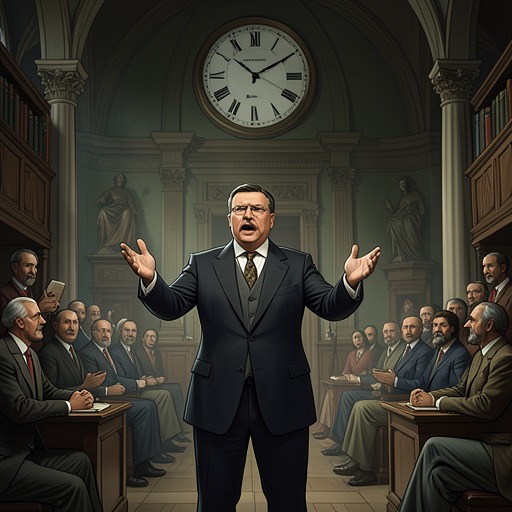
On Armistice Day, the account gathers Roosevelt’s many roles into a single portrait: naturalist, explorer, magazine writer, Sunday-school teacher, cowpuncher, moralist, politician, and righteous orator. It also retains his grin, his shaking forefinger, his denunciations of liars, and his pillow fights with his children. The playful and combative details prevent the portrait from settling into a monument. But the claim that it was no longer the world of the amateur warrior is followed by a concrete blow: Roosevelt was taken gravely ill with inflammatory rheumatism. The refrain that things were no longer bully makes the change plain. His grit remains, but it cannot restore the world in which action, righteousness, and victory had seemed to fit together.