John Doe
1919John Doe is both an anonymous soldier and a figure through whom the novel gives individuality to people whom war and public ceremony reduce to an unknown name. The text places the name beside unidentified remains selected for burial, then follows a soldier shaped by training, military equipment, and the routines of service. It does not establish that the chosen dead man and the living serviceman are literally the same person. Instead, the name holds together the distance between a body whose identity cannot be recovered and a human life whose particular history is repeatedly obscured.
Identity and the Unknown Dead
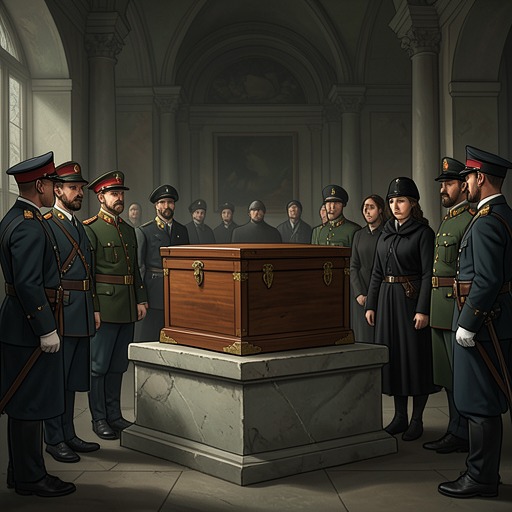
In a temporary morgue at Châlons-sur-Marne, amid rows of pine boxes containing remains that could not be identified, officials must choose one body. The question of how to select John Doe makes the anonymity explicit: he is not introduced through a known family, occupation, or personal history, but through a name used when a person cannot be identified. The selection gives one unknown dead person a place in a national act of remembrance, while leaving the other unidentified remains outside that singular honor.
The text does not make the selected body’s identity recoverable. It emphasizes instead the severe limits of the choice: one box can be taken, although many contain the remains of people whose names are equally unknown. The name John Doe therefore marks a distinction produced by ceremony rather than by knowledge of the individual. The chosen dead man becomes publicly present as a representative, but the person he was remains inaccessible.
That problem of recognition is sharpened by the account of how he was born. John Doe begins not as an abstraction but as a child brought into the world by two people alone together. The passage places birth, with its fear and pain, against the later anonymity of the soldier’s name. The contrast restores a human beginning to a figure whom official language can otherwise treat as a number or a vacant category.
A Life Scattered Across Places
The text gives John Doe a broad, deliberately unifying geography rather than a single settled hometown. It says he was raised in Brooklyn and Memphis, near the lakefront in Cleveland, in Chicago’s stockyards, on Beacon Hill, in Alexandria, on Telegraph Hill, and in a Tudor cottage in Portland. These disparate settings range from working districts and city landmarks to a residential cottage. The catalogue does not explain which one is his exclusive home; its accumulation makes the name stand for lives formed across many American places.
This multiplication of origins resists the idea that an anonymous soldier must have had no particular past. John Doe belongs, in the text’s construction, to neighborhoods and households with different surroundings, yet the list does not settle into a singular biography. The person remains recognizable as someone who was born and raised, while the repeated name gathers many possible lives into one figure. His anonymity is thus not an absence of human origins; it is the result of a narrative and public language that can no longer distinguish one origin from another.
Training, Equipment, and Service
Military identity arrives through equipment and instruction. John Doe is issued an identification tag stamped with a serial number, regulation equipment, a condiment can, and a copy of the articles of war. The tag is meant to attach a number to a body and make that body administratively legible. Yet the later account says he loses it while swimming in the Marne River. The object designed to identify him is therefore lost, leaving the name John Doe to express the very uncertainty the tag was intended to resolve.
His service is rendered as a sequence of repeated tasks and conditions: drilling, hiking, learning the manual of arms and the salute, eating army food, and enduring guard duty overseas. The passage also includes the enforced rhythms of military life, from restrictions on smoking aboard ship to inspection and latrine routines. Forty men and eight horses appear in the same compressed inventory as weapons, gas masks, mud, and machine-gun fire. The effect is not to offer a battle narrative centered on individual heroism, but to show how service absorbs a person into collective movement, equipment, orders, and exposure to danger.
The soldier’s own need is more specific than the impersonal inventory around him. He asks how he can get back to his outfit, a request that locates him within the military organization even as it leaves his exact circumstances unstated. The question recurs in the fragmentary account, giving the anonymous figure a practical objective: to find his unit and return to it. The text does not supply a resolution to that request, so his place in the army remains more definite than his individual fate.
The Person Within the Name
John Doe is not presented as an empty symbol. The text says he has a head and registers an intensely felt world through the nerves of the eyes, ears, palate, tongue, fingers, toes, and skin. This inventory of sensation counters the abstraction of the serial number and of the repeated drills. The soldier possesses a body that perceives, remembers, and reacts, even when the narrative does not give him a stable personal identity or extended speech of his own.
The account also associates him with a set of learned sayings about obedience, discipline, national belonging, and social hierarchy. Among them are assumptions about who belongs in the country and how authority should be accepted. They appear as part of the mental material surrounding the young man, not as evidence that he has independently chosen or endorsed each belief. Their presence complicates the figure of the ordinary soldier: the same institutions that train him to follow orders also furnish the language through which he is taught to interpret society.
The final image returns from those learned formulas to the body’s pulse. John Doe’s heart continues to pump blood, and the prose dwells on the sound of blood in the ears. This bodily persistence does not settle whether the John Doe at the morgue and the serviceman in the later passage are one person. It instead holds the text’s central tension open: an official name can represent the unknown dead, while the living person behind that name remains particular, sensing, and incompletely known.
Narrative Function
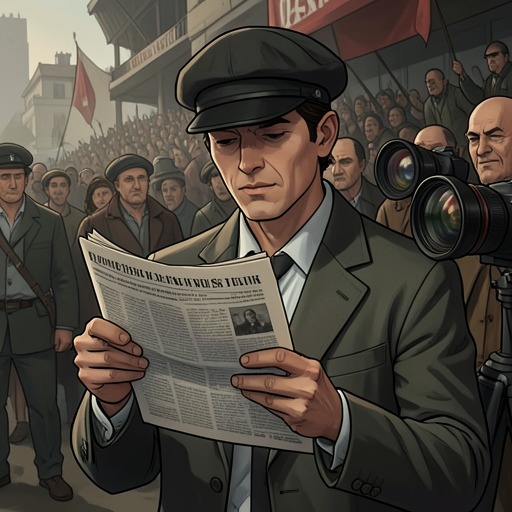
The John Doe passages belong to a larger collage of headlines, patriotic language, public ceremony, and documentary detail. News about timber holdings and political or commercial affairs appears alongside a national song, while the anonymous soldier’s identity emerges in a sequence that also invokes the selection and burial of unknown remains. This juxtaposition connects public declarations of country and collective purpose with the individual lives that such language gathers under a common name.
The figure’s significance lies in the gap between representation and recovery. A single unknown body can be selected to stand for the dead, and a serial tag can be issued to distinguish a soldier. Yet the tag can be lost, other remains stay unidentified, and the text supplies no complete personal history to replace what is missing. John Doe makes that gap visible without closing it: he is at once a ceremonial representative and a person whose origins, sensations, and ordinary needs exceed the anonymity imposed on him.