Richard Ellsworth Savage
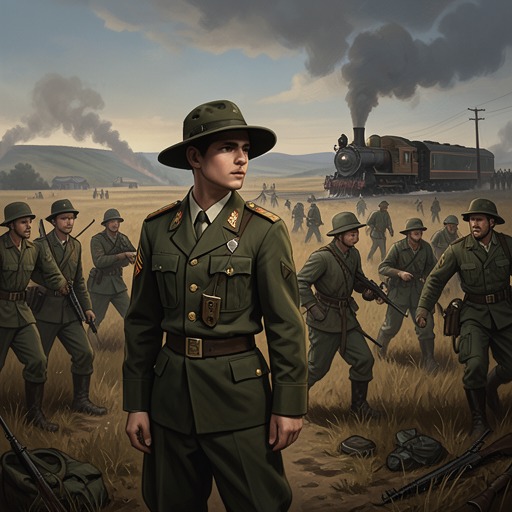
1919Richard Ellsworth Savage is a poet, pacifist, and American ambulance volunteer whose passage through the First World War exposes the distance between private conscience and public demands for obedience. He does not resolve that conflict by remaining outside the war: he enlists in volunteer ambulance work, serves near the front, and later accepts an army commission. Instead, his story follows the uneasy compromises, disillusionments, and attempts at escape that accompany his movement from youthful conviction into official service.
Identity and Early Life
As a boy, Richard Ellsworth Savage grows up without a settled account of his father. While doing homework in the attic, he tries to recover a childhood image of the man: a large, laughing figure in a Panama hat, associated with family life in Oak Park. Other memories are less comforting. He recalls his father drunk, striking him, and arguing with his mother, while she carries him upstairs. The recollections place affection and fear side by side, leaving the remembered father difficult to reconcile with the absent one.
That absence becomes a painful presence when his father returns. His mother summons the boys to the basement, where she introduces the man as their father through tears. Richard sees a visibly changed stranger and struggles to connect him with the familiar figure from childhood. The reunion offers no simple restoration of family life: the returned father speaks dismissively to his mother and seeks recognition from his sons, while Richard is frightened and uncertain. This early experience of attachment interrupted by disappointment anticipates the instability of several later relationships.
Richard is also shaped by his mother’s family history and precarious circumstances. Much later, when he asks about her father, she remembers a military funeral, a white-goateed man in blue, and a small silver bonbonnière that she eventually had to part with after the family’s fortunes failed. The story of inherited status and diminished means complicates the family’s later appeal to ancestry. Richard’s connection to the Ellsworth name becomes especially consequential when Hiram Halsey Cooper invokes it during his return to America.
Youth, Love, and Education
As a young man, Richard spends Sundays with Hilda Thurlow, whose husband, Edwin Thurlow, is usually away until late in the evening. Richard anticipates their walks and also tells himself he should stop seeing her, because the closeness leaves him feeling guilty. The relationship reaches a turning point when Hilda tells him that she wants him but fears having a child and says that she and Edwin are not sharing a married life. Richard pulls away from the encounter and returns alone to his room, distressed by the religious language through which he tries to understand what has happened.
The following summer, he finds that Hilda and Edwin have reconciled and that she is expecting a child. Richard responds with bitterness, declares that he has lost his Christian faith, and turns instead to the classical figures Pan and Bacchus. He writes Hilda a poem titled To a Common Prostitute, dedicates his life to Beauty and Sin, and sends it to her. The gestures show both his capacity to turn emotional injury into literary performance and the limits of that performance: Hilda treats his declarations as growing pains, while he leaves with his grievance unresolved.
At Harvard University, Richard finds that academic distinction does not guarantee social ease. He arrives in Cambridge with a new suit, a new hat, and a certified cheque for the bank, but quickly discovers that his clothing and room in the Yard mark him as a freshman. He fails to make the freshman rowing crews and rows alone in a wherry. Although he attends rallies and social gatherings, he often depends on a small circle of acquaintances and feels excluded from the students who seem to define campus life. His literary work, by contrast, advances: he publishes poems, joins the Monthly and The Advocate, and is invited to dine with Amy Lowell.
Pacifism and Ambulance Service
Richard’s pacifism becomes a direct choice as the United States moves toward war. While his friend Ned drinks heavily and dismisses the political situation, Richard argues that joining the Navy would be meaningless. Hiram Halsey Cooper tries to steer him toward a government position in Washington, warning that military service may endanger his career. Richard says that helping the war would violate his conscience, though he agrees to consult Cooper before taking an impulsive step. He is finishing his degree quickly, but his coursework has lost its significance as military drilling and preparation become part of campus life.
A sonnet sequence, Morituri Te Salutant, wins a prize from The Literary Digest. When the editors ask for a hopeful note in the final sestet, Richard revises the poem and sends the hundred-dollar prize to his mother for a stay in Atlantic City. Then, without telling anyone, he signs up for volunteer ambulance work. The decision does not mean that he has adopted the war’s aims. On the voyage to France aboard the Chicago, he feels that he is leaving a book unfinished: his friends, poetry, and earlier life recede, while the danger ahead remains unknown. The lyrical beauty of the journey through Bordeaux and the poppy-dotted countryside contrasts with his apprehension about what awaits him.
At Fontainebleau, Richard first sees the large gray Fiat ambulances his section will drive. French drivers resent being sent back toward the front and question the Americans’ presence. On the Fourth of July, the section celebrates with champagne and speeches about victory, then faces an air raid. The festive rhetoric and immediate danger arrive together. Richard and his fellow volunteers go out to a nearby bar, where French soldiers greet them warmly but speak bitterly about the war and ask about revolution in Russia. The scene brings him into contact with people whose experience of the conflict has little in common with the patriotic assurances of the ceremony.
At the Front and in Conflict with Authority
Near Verdun, Richard and his companions share a ruined barn in the rain as troops and munitions pass along the road. When Richard and Fred Summers lose their way in shell-damaged woods, nearby explosions send them into a ditch. Richard finds that he is no more frightened than the others, and, when Fred breaks down, puts an arm around him and urges him onward. Their ambulance returns with shell-fragment holes in its side. The work makes danger immediate, not abstract: the men carry casualties while facing the same shellfire that wounds them.
After the attack on Hill 304, the section moves through the Argonne, where the conditions briefly change. In one quiet sector, French and German soldiers play chess across the front line and warn one another before detonating mines near a trench piece. When the ambulance section is disbanded and its members are sent back to Paris, Richard dislikes leaving the autumn woods. The American army is taking over the service attached to the French, and the section’s citation and its leader’s farewell mark an ending imposed by administrative change rather than by any resolution of the war.
In Italy, Richard’s doubts sharpen. He writes to the Thurlows that the war is a dishonest undertaking promoted by governments and politicians, and that Edwin’s encouragement of young men to join it undermines the principles he professes. He adds that censorship prevents him from writing everything he has seen. Yet his conviction does not hold him in a single, steady mood: he sometimes abandons political argument to make rum punch and talk with Steve Warner about books, painting, or architecture. During air raids, he occasionally stays out of the dugout, reasoning that it offers no protection from a direct hit. His conduct suggests not confidence in the war but an unsettled mixture of defiance, fatalism, and exhaustion.
That tension becomes an institutional confrontation in Rome. A Red Cross official calls the matter involving Richard’s letters an indiscretion and insists that it is closed; Richard keeps trying to explain that he can do useful work without believing in the war. In Paris, the officials he approaches tell him that his opinions are cowardly, criminal, or an obstruction to national purpose. The argument is not merely about whether Richard has performed his duties: he wants his dissent recognized as compatible with service. The authorities instead treat private opinion itself as a threat. After giving up his effort to obtain a hearing, he volunteers as a stretcher-bearer at an American hospital, carrying casualties through the German offensive’s approach to Paris.
Escape, Return, and the Peace Conference
Richard briefly forms a plan to leave military life. After buying a pocket compass on the Rue de Rivoli, he decides to purchase civilian clothes, leave his uniform at the wharf in Bordeaux, and try to cross into Spain. He packs his books and belongings and prepares a letter to his mother. The plan gives concrete shape to his wish to get beyond the war’s reach, but it does not become a lasting escape. When he later returns to America, Hiram Halsey Cooper meets the transport and directs him to put on his uniform before landing. Richard is worried about money, the draft board, and his mother; Cooper, in major’s uniform, takes charge of the conversation and brings him to Washington.
Richard’s return leads not to civilian freedom but to an army commission. A War Department letter appoints him a second lieutenant in the Ordnance Department and orders him to Camp Merritt within twenty-four hours. He is placed in charge of a company of casuals and relies on a sergeant to manage the assignment. On the Leviathan, his earlier experience at the front gives him an advantage over the other officers. Later, while serving in the Despatch Service, he receives the news that the real armistice has arrived. Colonel Edgecombe offers him a place as a courier for the American delegation to the Paris Peace Conference. Richard accepts gladly, partly because the prospect of returning home and finding work troubles him and partly because travel through Europe appeals to him. The peace process becomes another form of official service, though he approaches it with a sense of spectacle rather than solemn commitment.
In Paris, Richard’s personal losses and professional obligations continue to overlap. After a painful parting with Anne Elizabeth, he lies awake alone in his hotel, imagining the ordinary lives he might have lived and regretting that he could not have spent one of them with her. He does not turn the feeling into a decision to pursue her; instead, routine reasserts itself in his thoughts: shaving, breakfast, puttees, and the office. Later, he stays with Eleanor Stoddard despite wanting to leave, then attends a press gathering connected to J. Ward Moorehouse. The discussion presents cooperation between American oil producers and Royal Dutch-Shell as evidence of a new international order serving peace and democracy. Richard is present as a working intermediary, while the claims around him join capital, diplomacy, and public messaging in language that recasts economic power as a force for peace.
At Eleanor’s gathering, Richard tries to sustain conversation with Paul Johnson’s wife while Paul drinks and Steve Warner makes hostile remarks about the privileged. Richard nearly fights with Steve after an argument about the Peace Conference, and the Johnsons remove Steve from the room. The gathering ends with a dead parakeet discovered in its cage, a small, stark counterpoint to the dinner’s polished sociability. Richard’s story leaves him neither outside the institutions he distrusts nor fully reconciled to them. He continues to work, travel, and maintain relationships, but the distance between his ideals and the roles available to him remains unresolved.