Mr. Rasmussen
1919Mr. Rasmussen is a Standard Oil engineer who enters Eveline Hutchins’s Paris social circle with two kinds of urgency: he fears that Britain will gain control of vital oil supplies, and he wants a different life from the lonely prospecting and engineering work he has pursued in the field. His conversations turn the peace conference into a contest over Baku and American influence, while his repeated invitations, flowers, and messages make him one of Eveline’s suitors. The overlap is revealing: Mr. Rasmussen speaks of changing the course of international affairs, yet admits that only a handful of powerful men can act, and that he does not know who can reach them.
Introduction and Professional Background
Eveline first notices Mr. Rasmussen at the opera, where he sits at the back of the box talking quietly to J.W. Moorehouse. Eleanor Stoddard identifies the man as General Gouraud; Mr. Rasmussen is a different figure, introduced into the conversation after the music has begun. At an intermission, Eveline speaks with him and J.W. Moorehouse about the performance. Mr. Rasmussen’s professional identity becomes clearer after the opera, when he joins them at the Café de la Paix: he is an engineer with Standard Oil, and the company’s interests shape his account of the political situation.
He is characterized as energetic but uneasy. At the café he gulps champagne between sentences and runs his fingers through his spiky black hair. Later, while the group dances, he tells Eveline that he has spent his life in the bush, prospecting for gold and testing shale specimens, and that he is tired of that existence. His boast that he needs a good woman in his life gives his courtship a note of weariness as well as appetite: he presents himself as someone ready to leave the field behind, though the account does not say that he succeeds in doing so.
Oil, the Peace Conference, and Political Influence
Mr. Rasmussen’s central concern is Baku. At the opera, he tells J.W. Moorehouse that he has positive information that Baku cannot be held without heavy reinforcements, and that the United States is the only country from which those reinforcements can come. At the Café de la Paix, he broadens the argument to include Mohommarah and Mosul. He says that Anglo-Persian and Royal Dutch interests are getting ahead of the United States in the Near East, and fears that Britain will secure the region’s future oil supplies while pushing an Armenian mandate onto the Americans.
The conversation exposes the limits and contradictions of his political reasoning. Mr. Rasmussen invokes self-determination to argue that Russia has no right to Baku because its population is mostly Turkish and Armenian. Yet when J.W. Moorehouse asks about the Russians, Mr. Rasmussen says he would prefer the Bolsheviks to the British, while predicting that they will not last. He claims to have reliable information that Lenin and Trotsky have split and that the monarchy will be restored in Russia within three months. The prediction is presented as his confident report, not as a confirmed outcome.
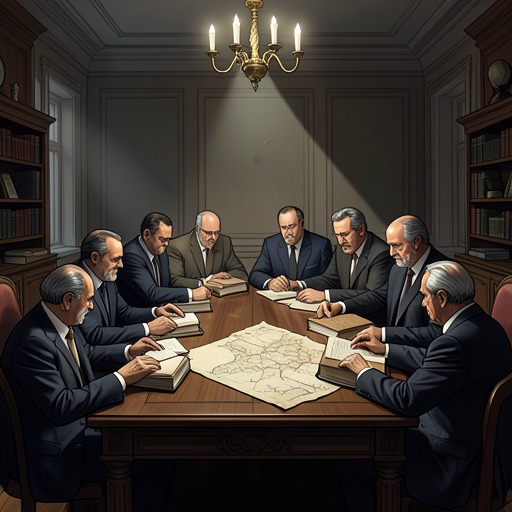
For Mr. Rasmussen, the problem is not simply that American interests may lose ground; it is that President Woodrow Wilson is allowing the British to dictate the settlement. He believes public opinion might be stirred, but immediately dismisses the public as powerless after the war. The practical task, he argues, is to make a few key men understand the situation. J.W. Moorehouse is important because he is, in Mr. Rasmussen’s formulation, the key to those key men. His analysis therefore rests on concentrated influence: oil policy depends less on popular debate than on access to a small network of decision-makers.
Courtship and Social Conduct
Mr. Rasmussen’s first evening with Eveline and her companions moves between political talk and the rituals of Paris nightlife. After the opera, he dominates the conversation over champagne, nervously drinking and repeatedly returning to the struggle over oil and mandates. The party then goes dancing at L’Abbaye in Montmartre. He dances badly with Eleanor while Eveline dances with J.W. Moorehouse; on the next dance, Mr. Rasmussen takes Eveline and compliments her appearance. His personal disclosure—that he is tired of the bush and wants a good woman—comes in the middle of their discussion of American policy, so courtship and politics are not separate subjects for him.
Eveline asks whether he could present his ideas to the public. He replies that this is J.W. Moorehouse’s job, not his, and insists that the public will do what it is told. When Eveline asks who has influence over Moorehouse, Mr. Rasmussen answers soberly that he wishes he knew. Her playful suggestion that she might be that person meets with a tight-lipped smile rather than an invitation to pursue the joke. The exchange makes the distance between his aspirations and his actual reach plain: he can describe the channels of influence, but does not claim to command them.
The night continues after the dancing, with onion soup and cold meat, a proposed visit to hear Freddy Seargeant sing, and a return across Paris in a worn taxi. At Freddy’s, Mr. Rasmussen compares Freddy’s appearance to an old prospector he once knew in the Sangre de Cristo mountains and launches into a story about Death Valley that no one listens to. The episode recalls his own life in the field, but its reception is subdued: the party is cold and sleepy, and his story does not draw attention.
Pursuit and Narrative Role
The following day, Mr. Rasmussen calls Eveline at her office to invite her to lunch. She finds it difficult to invent an excuse not to go. Thereafter he seems to be wherever she goes: he sends flowers and theatre tickets, arrives with automobiles to take her riding, and sends small blue pneumatiques containing tender messages. Eleanor teases Eveline about her new Romeo. These repeated gestures establish Mr. Rasmussen as a persistent suitor, but the supplied episodes do not record a settled relationship or a final outcome for his pursuit.
His presence also sharpens the contrast between private desire and public power in Eveline’s Paris circle. He imagines a new personal life after years of field work, just as he worries that the United States will lose its position in the competition over oil. Yet in both spheres he approaches rather than possesses what he wants: Eveline remains the recipient of his attentions, and the political access he describes leads through J.W. Moorehouse to unnamed influential men. Mr. Rasmussen’s significance lies in this conjunction. His talk gives the peace conference a material stake in oil and strategic influence, while his courtship makes visible the smaller, uncertain ambitions unfolding alongside the remaking of Europe.