Nick Gigli
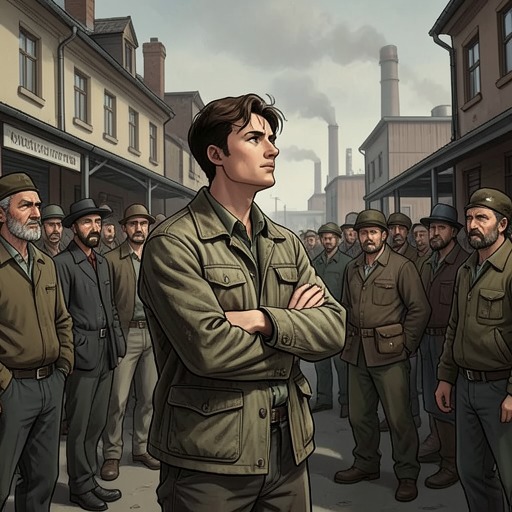
1919Nick Gigli is an eighteen-year-old laborer and anarchist whose brief friendship with Ben Compton gives political conviction a practical test: when construction workers walk out over dishonest pay, Nick and Ben stand with them and accept the cost of leaving their jobs. Nick’s experience of precarious work shapes both his criticism of employers and his insistence that solidarity must be learned through action.
Background and Political Outlook
Nick is from northern Italy and works with a gang of Sicilian laborers at a gravel pit near Mauch Chunk. The camp’s canteen is run by Hiram Volle, who cheats the construction workers in their accounts. Ben initially takes little interest in the injustice, but Nick’s friendship makes the workers’ circumstances harder for him to dismiss.
Nick’s politics are rooted in family as well as experience: his father and elder brothers are anarchists, and he shares their commitments. He tells Ben about Bakunin and Malatesta and argues that Ben should use his education and abilities in the service of workers rather than aspire to become a rich businessman. To Nick, business is not an innocent route to success; Volle’s conduct makes it a system in which employers profit by robbing laborers. He sees little point in changing employers, since he expects other capitalists to behave much the same way, and counsels patience for a future revolution.
His own work history gives this argument weight. Nick has shined shoes, sailed as a sailor, mined, washed dishes, and worked in textile mills, shoe factories, and a cement factory. He has also spent three weeks in jail during the Paterson silk strike. The range of these jobs and his firsthand knowledge of labor conflict distinguish him from someone repeating an abstract political doctrine.
Friendship with Ben Compton
Nick and Ben become close while Ben is working at the camp canteen. Nick often waits there after closing, and the two go out to smoke and talk. On Sundays they walk in the countryside with the newspaper, spending the afternoon discussing its magazine articles. Their friendship is also visible to the other workers: when they see Ben going somewhere alone, they call out to ask where Nick is.
Nick advises Ben about more than work and politics. He teaches him to roll cigarettes and warns him against letting romance divert a worker from political aims. His counsel reflects Nick’s conviction that private choices can compete with collective struggle. Ben, meanwhile, admires Nick for the many kinds of work and experience he has accumulated and listens as Nick challenges his ambition to become a businessman.
The Walkout
The break comes after an argument as the construction workers are being paid. Nick tells Ben that the bosses have been cheating the men on their hours and that the workers plan to strike the next morning. Ben says that he will join them. Nick responds by welcoming him as a comrade and kissing him on both cheeks, making their political agreement an unmistakably personal bond.
When the whistle sounds, only some of the pick-and-shovel workers turn out. Volle asks Ben to hitch up a team for an errand; Ben refuses because he is on strike. Volle dismisses the refusal as a joke and insults him. Ben answers that he is American-born and will stand with his class, then Volle fires him and threatens further violence. Ben packs his belongings and goes to find Nick among the workers.
The superintendent and gang bosses appear with revolvers in holsters. They tell the laborers that the company has treated them fairly, warn that anyone who misses the next shift will be fired, and invoke Pennsylvania’s vagrancy laws. When the whistle sounds again, the other workers return. Nick and Ben alone walk away with their bundles. Nick is tearful, but interprets the workers’ retreat not as proof that solidarity is impossible, rather as evidence that they have not yet learned their collective strength.
After the Camp
That night Nick and Ben find a broken-down schoolhouse on a hill above a river. After buying bread and peanut butter, they sit outside to discuss what to do next. Nick shows Ben how to use his jacket as cover and how to sleep against the wall on the bare boards. The scene carries their departure beyond the immediate labor dispute: the men have lost the camp’s shelter and income, but remain together after refusing to return to work.
As they try to sleep, a noise strikes the roof and rolls down the shingles. Nick calls to Ben, and both get up to look through the broken window frame. The passage ends with them facing an unexplained sound in their exposed shelter, leaving their next move unresolved.