Eveline Hutchins
1919Eveline Hutchins is an artist and American Red Cross worker whose life carries her from a protected Chicago childhood into the unsettled social and political world of wartime Paris. Her story is shaped by the pull between private longing and independent work: she seeks love and companionship, but also pursues painting, earns a place in Eleanor Stoddard’s decorating business, and speaks urgently for a threatened political dissenter. The promises available to her never quite resolve into security, and the novel presents her hopes as repeatedly tested by distance, war, and time.
Childhood and artistic formation
Eveline grows up on the top floor of a yellow-brick house on North Shore Drive, in a family organized by both tenderness and rules. Her sisters and younger brother share the upper floor, while below them her father, Dr. Hutchins, has a study where he must not be disturbed and her mother spends mornings painting in a lavender smock. The public rooms belong to parishioners and guests; at dinner, the children hear the scrape of cutlery and their father’s booming voice, which can silence the company. At night, his presence beside the bed as the children say their prayers frightens Eveline. She feels safe only after she has climbed into bed and pulled the covers over her nose.
Her early memories also include the warmth of illness and family attention. When the children have measles and mumps, they stay in bed among potted hyacinths and guinea pigs. Their mother reads The Jungle Book and draws for them, while their father invents paper bird beaks and stories. The contrast between these affectionate scenes and the intimidating authority of his voice gives Eveline’s childhood a double character: home is a place of care, but it is also a world in which adults define the boundaries of children’s behavior.
Art offers Eveline an early language of her own. A birthday gift of Dante Gabriel Rossetti’s illustrated Blessed Damozel leads her to make paintings and verses about angels and poor children. Her first oil portrait, of Elaine, the Fair, is praised by friends of her father, who identify her as the talented one. Her sisters are less impressed by the family’s respectable domestic life and its lack of style, but Eveline’s response is to keep working. She paints a portrait of her younger brother as he had been in childhood, and her attachment to him and to the poor children she sees in the street often brings her to tears over her paints. The talent others recognize is already bound up with sympathy: looking carefully at people becomes both an artistic practice and a form of feeling for them.
A church charity production of Aglavaine and Selizette brings that ability into public view. Eveline designs the scenery and costumes, which are praised even though the production as a whole disappoints its organizers. The episode also connects her to Sally Emerson, whom her sister first meets and describes as exceptionally stylish. After the performance, Sally invites Eveline alone to lunch. The invitation singles her out within her family and marks a step from being praised as a promising girl toward entering adult artistic and social circles on her own.
Friendship, travel, and romantic possibility
At the Art Institute, Eveline begins what she regards as a beautiful friendship with Eleanor Stoddard. She is drawn to Eleanor because she seems to understand painting, can talk about things with her, and is independent and funny. After a romantic disappointment, Eveline imagines that friendship and art can provide a life of their own. She deliberately wears her hair in a knot at the nape of her neck, even when her sisters call the style unbecoming: she would rather choose an appearance for herself than satisfy their judgment.
A family journey abroad expands the world in which she can imagine that life. The trip carries her through London and Paris, where the cathedrals, their colored glass, incense, and stone figures nearly make her a Catholic. In Florence she draws from life and reads Gordon Craig, despite the rain, the chilly villa, and her distaste for the young men who pursue her sisters. Returning to the United States with her mother aboard the Kroonland, she remembers the ship’s departure as the happiest moment of her life. The movement of travel itself seems to promise release from the constrictions of home.
On the crossing, Eveline meets Dirk McArthur, an American from Chicago who has been studying in Munich. They become close companions during the voyage, playing games on deck and spending time in the bow. One moonlit night they climb to the crow’s nest. When Dirk puts his arm around her, she is frightened but does not want to show it; after he kisses her, she pushes him away. The scene makes her attraction and her boundary visible at once. Romantic possibility draws her toward intimacy, but it does not erase her ability to resist a gesture she has not chosen.
Work and life in wartime Paris
Eveline later leaves for New York City, where she takes up the prospect of work with Eleanor. Her return east is accompanied by a private fear: on the train, after St. Louis, she decides that she may be pregnant. The fear turns an outward journey into a period of bodily anxiety, intensified by the anonymity of Grand Central Station and the nausea of the taxi ride downtown. It is one of several moments when a hoped-for new beginning is shadowed by uncertainty about what her choices may bring.
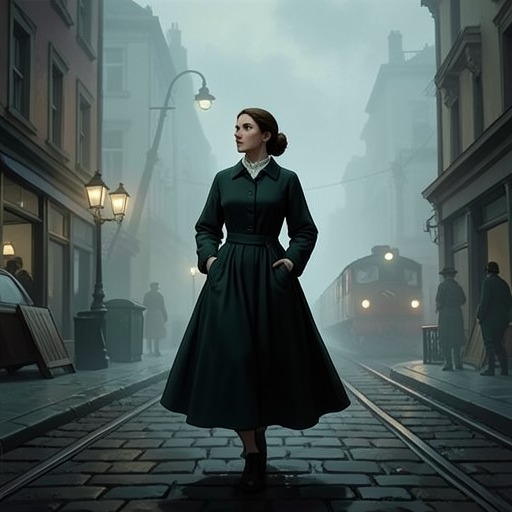
When war is declared, the plans Eveline has made with Eleanor and Freddy Seargeant for shows and decorating houses come to little. Flags and uniforms fill the streets, patriotic feeling surges, and people begin seeing spies and pacifists everywhere. Eveline finds the atmosphere so unnerving that she wonders whether she is losing her mind. Eleanor offers her a position as an assistant in her Paris office; Eveline accepts without caring what the work will be, and follows her across the Atlantic. In Paris, she and Eleanor live in an apartment on the Quai de la Tournelle, overlooking the Seine River and the island opposite. Their work consists of assembling scrapbooks of ruined French farms and orphaned and starving children for American Red Cross campaigns. The apartment’s carefully observed river view and the images of wartime suffering pasted into those scrapbooks place beauty and organized relief side by side.
Her working life also brings her into contact with the compromises of wartime publicity. Jerry Burnham, a correspondent who visits her office while covering American Red Cross activities, takes her to restaurants and walks with her through the Marais. In cafés, he confides that censorship prevents him from reporting what he sees and that he is made to send prepared material he regards as lies. He says the war is too profitable to end and dreams of writing a truthful book afterward. Eveline tries to encourage that ambition. His distress gives her an intimate view of how propaganda and censorship corrode professional self-respect, while his promise of a future book suggests that telling the truth remains imaginable even when the present seems to forbid it.
When Eleanor and J. Ward Moorehouse leave for Rome, Eveline is left alone with Yvonne in a cold, lonely winter. She holds on to her job and sometimes goes out with Raoul, including to places where drinks can be found after the legal hour. From a hill near Montmartre, she and Raoul see Zeppelins over Paris: searchlights move through the darkness, shrapnel glitters above the rooftops, and incendiary flares appear below. The spectacle makes the war at once distant and present, a disturbance in the night sky above the city where Eveline is trying to construct an ordinary life.
Desire, aging, and political commitment
At the Armistice, Eveline’s workroom becomes a scene of collective release. In early November, Major Wood rushes into the shared office and kisses her and Eleanor, announcing that the moment has finally come. Eveline then kisses J. Ward Moorehouse. The office fills with bottles and songs, and the group sets out by taxi for the Café de la Paix. Her action belongs to the rush of celebration, but it also returns her to a relationship whose emotional charge recurs later. On leave at Nice, she hears Moorehouse in the adjoining room and finds her heart pounding; she answers Eleanor with an outwardly composed cheerfulness that contrasts with her private reaction. Eveline’s poise does not mean that attachment has disappeared.
Another intimate scene turns on age rather than romance. Looking in a mirror, Eveline notices shadows beneath her eyes and the first faint lines at their corners. The sight brings her to tears and makes her call her life silly. A conversation with Paul Johnson sharpens the contrast between them: he says he is twenty-one, while Eveline tells him she is five years older and voices her hatred of growing old. His nervousness and her effort to emerge from the moment smiling show her trying to manage vulnerability through composure. Age is not merely an idea here; it becomes an unwelcome fact she encounters in her reflection.
Eveline’s thoughts about Paul combine romantic and domestic possibility with an awareness of political argument. In a crowded restaurant during a general strike, she wonders whether she might marry him and have children who resemble his young, coltish appearance. At the same time, she listens as Don Stevens explains the revolution to Paul, who admits that he knows little beyond what other people tell him and says he wants to travel and learn for himself. When two American military policemen enter, Paul fears being caught without his uniform. Eveline tells him to go back and change, then continues toward the Red Cross with Don. Her attention moves between private hopes, concern for Paul’s immediate safety, and the larger unrest outside the restaurant.
That concern becomes a direct defense of Don when he is arrested by the Army of Occupation on suspicion of Bolshevik propaganda and faces the possibility of execution. At dinner with G. H. Barrow and others, Eveline insists that Don is a newspaper man, not a propagandist, and urges Barrow to appeal to the President and help stop the execution. She is angered by his embarrassment and his suggestion that Don has failed to show the proper spirit. For Eveline, the issue is not whether Don’s politics are respectable: a man should not be shot for wanting a better world. Her plea brings together the sympathy evident in her childhood paintings and the political urgency she has acquired in wartime Paris.
Narrative role and unresolved trajectory
Eveline’s episodes connect the novel’s intimate and public worlds without reducing one to the other. Art, friendship, work, romance, and political conviction are not separate stages of a settled development; they repeatedly overlap. Her career begins in childhood paintings and theatrical design, develops through collaborative decorating and relief work, and remains linked to her way of noticing suffering. Her relationships, meanwhile, promise companionship without guaranteeing permanence or security. By the time she argues for Don’s life, her compassion has become an explicit refusal to let political labels make a person disposable. The episodes presented here leave her future unresolved, but they establish a persistent tension: Eveline continues to seek a life of her own in a world where affection and self-direction are both vulnerable to forces beyond her control.