Woodrow Wilson
1919Woodrow Wilson is presented as a man who built his public identity around truth, reform, and democracy, then became the leader of a state at war. The novel follows the widening gap between his language of democratic renewal and the machinery of conscription, corporate influence, and peace-making that gathers around him. His path from university lecturer to wartime president and peace negotiator ends in political defeat and physical ruin, turning the promise of a world made safe for democracy into one of the book’s most sustained contradictions.
Identity and Formation
Wilson was born in Staunton, Virginia, in the year James Buchanan was elected president, into a Presbyterian household shaped by generations of religious argument. His father was a minister and a teacher of rhetoric; the family’s world, as the narrative presents it, was held together by words and inherited belief. Wilson’s later confidence in public language has roots in this early environment, where speech could appear to give order to moral and political life.
He developed a strong tenor voice, became a debater and editor at Princeton, and published an early appreciation of Bismarck in the Nassau Literary Magazine. After studying law at the University of Virginia, he practiced in Atlanta, but legal work dissatisfied him. He preferred libraries, lecture rooms, and the institutional life of education. A historical fellowship at Johns Hopkins led to his book Congressional Government; after earning his doctorate, he taught at Bryn Mawr and Wesleyan, writing and speaking on history, responsible government, and reform. In 1901, Princeton’s trustees offered him its presidency. The sequence establishes Wilson as an ambitious intellectual and public speaker before it shows him exercising national power.
Reform and the Turn to War
Wilson’s political appeal rests on the language of reform. The novel evokes his New Freedom as a vision of reformed democracy, but places that ideal under pressure as the United States moves toward war. After his reelection on the promise that he had kept the country out of war, Wilson pushed the Armed Ship Bill through Congress five months later and declared that a state of war existed between the United States and the Central Powers. The abrupt turn makes his earlier posture of neutrality part of the story’s political irony: the president who had campaigned on keeping the nation out of war now demanded force without limit.
Wartime mobilization also changes the meaning of his reform program. In the novel’s compressed, polemical account, New Freedom gives way to conscription, democratic renewal to the demand to win the war, and reform to the safeguarding of Morgan loans. The wartime government draws dollar-a-year men from major corporations. Political ideals and financial interests appear not as separate subjects but as competing explanations of what the state is doing. Wilson becomes, in the book’s formulation, inseparable from the expansion of state power.
The costs of that expansion appear in the story of Randolph Bourne, whose initially hopeful reading of Wilson’s politics collapses into opposition. Bourne came to see the rhetoric of democracy and progress as serving conscription, war mobilization, and financial interests. He resigned from The New Republic, while The Seven Arts was the only publication willing to print his antiwar articles. Its backers withdrew their support; friends distanced themselves, and Bourne’s father urged him not to disgrace the family. The novel further associates the wartime climate with surveillance and intimidation: Bourne was shadowed by espionage and counter-espionage agents, arrested while walking with two friends at Woods Hole, and deprived of a trunk of manuscripts and letters in Connecticut. Wilson does not appear in these incidents as their direct agent; rather, the narrative places them within the political order created in the name of wartime necessity. Bourne died six weeks after the armistice while planning an essay on the foundations of future radicalism in America.
The Peace Conference and Its Contradictions
On December 4, 1918, Wilson sailed for France aboard the George Washington, becoming, in the novel’s account, the first U.S. president to leave the country during his presidency. His arrival carries the weight of an international promise: European people read the Fourteen Points as a challenge to oppression, even as the book contrasts that hope with the devastation they had endured. On January 18, 1919, the Allied Powers assembled at the Quai d’Orsay to dictate the peace. The grandeur of uniforms, decorations, and formal procedure does not, in the narrative, guarantee that peace can be made openly or on the terms Wilson’s public language implies.
The negotiations narrow his room to maneuver. On April 7, Wilson ordered the George Washington held at Brest, ready to take the American delegation home, but he did not leave. On April 19, Georges Clemenceau and David Lloyd George drew him into the Council of Four. By June 28, the Treaty of Versailles was ready, and Wilson faced the return journey to explain the settlement to political opponents at home and to a public whose hopes had been raised by his principles. The progression is rendered as a reversal: the president who arrived as the leading advocate of peace remains at the table, but the resulting settlement leaves him having to account for how far his ideals have been compromised.
The book also stages the contrast between presidential language and the people who hear it. During Wilson’s visit to Rome, Dick Savage attends official functions and hears Wilson speak in the Roman Forum about the ruins as more than stones—as enduring symbols—and praise Americans’ love of humanity. Savage, watching Wilson’s grey, rigid face among the ancient columns, carries away a far less reassuring impression. The scene places the president’s words beside the image of imperial ruins and invites the reader to consider what kind of power speaks through the language of civilization.
The Speaking Tour, Collapse, and Narrative Role
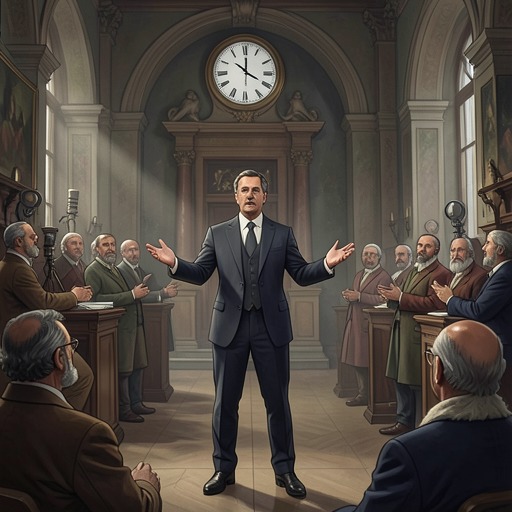
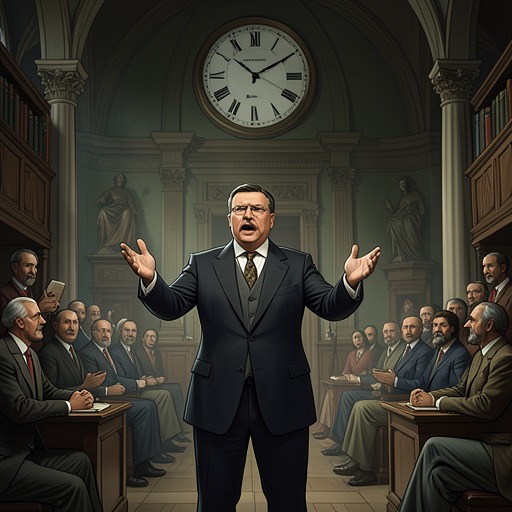
Wilson returned to the United States to seek support for the League of Nations and undertook a speaking tour. In Seattle, workers stood silently as his car passed, a marked contrast to the applause and patriotic cheers elsewhere. In Pueblo, Colorado, Wilson delivered a speech insisting that truth, justice, liberty, and peace would guide the American people and, through them, the world. It was his last speech. On the train to Wichita he suffered a stroke, abandoned the tour, and became a severely disabled man who could barely speak. When he later relinquished the presidency to Harding, he managed to rise painfully from his chair and tell Senator Lodge that he had no further communication to make. He died on February 3, 1924.
Wilson’s appearances across the novel are set against sharply different experiences of government: Bourne’s ostracism and surveillance, soldiers’ changing fortunes, and the bureaucratic power of wartime institutions. The narrative does not reduce him to a single private motive. Instead, it tracks how a reformer’s language travels through institutions and acquires consequences that exceed the promise attached to it. The repeated contrast between democratic ideals and the state’s coercive reach gives his character its central tension. By the time his body fails on the speaking tour, the public voice that once carried his principles has become inseparable from a political record those principles could not secure.