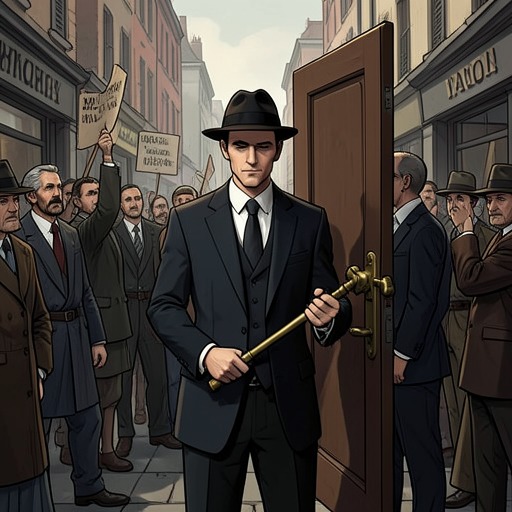
Jack Reed
1919Jack Reed is portrayed as a journalist who crossed the boundary between observing political conflict and taking part in it. He went to Paterson to report on a strike and became a jailed striker himself; later, he wrote from the upheaval in Petrograd and undertook missions amid the revolution. The account closes his trajectory in Moscow, where work, illness, and death converge, giving his career the shape of a sustained commitment to witnessing events at close quarters.
Identity and Background
Reed is identified as the son of a United States Marshal, described as a prominent citizen of Portland Oregon. That brief family and civic background sets him against the worlds in which the narrative later places him: labor protest, wartime reporting, and revolutionary politics. The passage does not develop his upbringing in detail, but the contrast between his father’s public position and Reed’s later choice to enter a strike from the inside gives the biographical sketch its first sharp turn.
The account also gives Reed a particular relation to language. It says that Mexico taught him to write and describes him as a westerner for whom words meant what they said. These claims make writing more than a professional skill in his portrait: it is the means by which experience becomes reportable, and a standard against which public language can be measured. The text offers no account of his time in Mexico here, so its emphasis falls on the result it assigns to that experience: Reed’s development as a writer.
Reporting the Paterson Strike
In 1913, Reed went to Paterson to write about the textile workers’ strike. The details of the assignment are already scenes of confrontation: workers paraded, police beat them, and strikers were jailed. Reed did not remain outside that sequence. Before long, he too was a striker, beaten by the police and imprisoned alongside the workers whose struggle he had come to cover.
When the editor offered to bail him out, Reed refused. The stated reason was practical and immediate: he would learn more by remaining in jail with the strikers. His decision turns the reporting assignment into an act of participation, and makes the jail both a consequence of the strike and a place from which he sought to understand it. The narrative then connects that experience to the Paterson Strike Pageant, which Reed put on in Madison Square garden. His response to the strike thus moved from witnessing and imprisonment to a public pageant: the events he entered became material he could put before an audience.
War Correspondence and Revolution
The passage describes the war as destroying the moral clarity associated with the image of Diogenes’ lantern: good men, it says, began to join calls for machineguns. Against that reversal, Reed is singled out as the last of the great war correspondents who evaded censorship and risked their lives for a story. The description makes the danger of reporting part of his significance, while the reference to censorship places the work in conflict with forces seeking to control what could be known.
The narrative insists that readers who wanted to know about the war could have read Reed’s articles. It thus presents his journalism as a record available against the surrounding violence and restriction, not merely as a personal adventure. The claim that he was the best American writer of his time is emphatic praise within the passage; more concretely, the account grounds his importance in the articles he wrote and the risks he took to report. Its account of the war’s moral disorientation also throws his commitment to reporting into relief: while others turned toward machineguns, he continued to pursue the story.
In October 1917, Reed was with soldiers and peasants in Petrograd, at the Smolny Institute. The compressed placement of him among these groups locates his reporting inside the revolutionary moment, rather than at a distance from its participants. The subsequent statement that the first workers’ republic was established and stood gives this scene a historical consequence in the narrative. Reed wrote and undertook missions while spies were everywhere, continuing his work in an atmosphere of surveillance and danger.
Work, Illness, and Death
Reed’s final sequence is stated without an account of his specific missions or the circumstances of his illness: he worked until he dropped, caught typhus, and died in Moscow. The order of these facts makes the ending stark. The work that had taken him from strike reporting into wartime and revolutionary settings continues almost to the point of collapse; illness then ends the career that the narrative has defined through its persistence. No further details are supplied about his death, and the passage does not explain the missions individually.
That brevity contrasts with the scale of the history around him. The workers’ republic is said to have been established and to stand, while Reed’s own life ends in Moscow after a period of ceaseless labor. The account does not present his death as a resolution of the political conflicts he witnessed. Instead, it leaves the reader with the contrast between a collective political achievement described as enduring and the reporter, whose work carried him into its midst, dying from typhus.
Narrative Role
Reed’s appearances connect several otherwise distinct kinds of political experience: the local violence of a textile strike, the censorship and danger of war correspondence, and the revolutionary upheaval in Petrograd. The pattern is not simply that he visits important events. At Paterson he refuses rescue because remaining with the strikers will teach him more; in the war he is remembered for evading censorship and risking himself for a story; in Petrograd he is among soldiers and peasants and undertakes missions amid spies. Each episode joins proximity to the act of recording or investigating.
The narration also makes Reed’s biography a measure of the distance between public language and lived events. His reported conviction that words meant what they said sits beside a war in which good men turn toward machineguns and authorities impose censorship. His articles are offered as a way readers could learn what was happening, while his refusal to leave the Paterson jail shows how he sought knowledge through direct exposure. By ending with his work, typhus, and death, the account preserves both the force and the cost of that method without claiming that one reporter could settle the conflicts he witnessed.