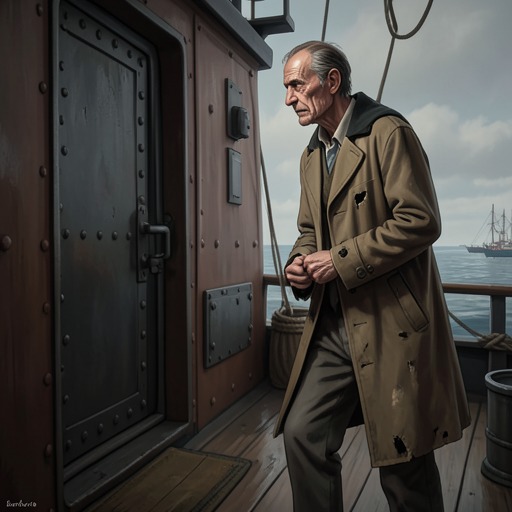
Captain Perry
1919Captain Perry is an experienced merchant captain whose command of the North Star is tested when a German submarine forces the crew to abandon ship. He survives the sinking and, recognizing Joe Williams’s quick thinking, helps him pursue a ship’s officer’s ticket. Perry’s blend of hard-won seamanship, wry composure, and personal loyalty links the immediate danger at sea to Joe’s hopes for a different life.
A veteran returned to sea
Perry had spent a couple of years ashore at Atlantic Highlands before signing back on for the wartime money. He hoped to make a pile for his daughter, though Joe heard him tell the mate, with a wheezy laugh, that she would get the insurance anyway. The remark gives his return to sea a grimly matter-of-fact edge: he takes the danger seriously enough to know what the insurance means, but does not let it govern his manner.
He commands the North Star, a former Great Lakes oreboat described as a crazy whaleback. The ship leaks badly enough that the pumps run about half the time, yet Perry’s crew likes him, and Joe remembers the food aboard as good. On the outward voyage, the vessel carries cargo listed as canned goods that everyone knows is shell caps; the crew receives danger bonuses for sailing through the war zone. Perry brings an old mariner’s experience to a voyage where commercial cargo, military risk, and ordinary shipboard life are inseparable.
The North Star and the submarine
On the return passage, the North Star carries steel ingots and explosives and heads for Cardiff. Perry takes a northerly course through fog. After a week of icy weather and a heavy following sea, the crew sights Rockall. When the green hand in the crow’s nest mistakes the rock for a battleship, Perry stands on the bridge laughing as he looks through his binoculars. The joke is a brief release of tension, and it also sets up the difference between a false alarm and the danger that follows.
The next morning, a lookout spots a submarine off the Hebrides. Its periscope and conning tower appear before it fires across the North Star’s bows. Perry throws the ship into full speed astern. When the submarine crew boards and orders the men to abandon ship within five minutes, he hands over the ship’s papers while the boats are lowered. The evacuation is hurried but orderly; the blocks are well oiled, and the boats go down quickly.
Joe runs back to cut the lashings on the liferafts with his jackknife. He and Perry, with the ship’s cat, are the last to leave. The submarine crew has planted bombs in the engine room, and the explosion hits Perry’s boat just after it pushes away. The boat swamps, throwing its occupants into icy water amid wreckage. The North Star sinks with its flag still flying and its signal flags blowing in the breeze. Perry’s later appearance aboard the Vicksburg confirms that he survives the sinking; the account does not describe the full rescue itself.
Recognition and mentorship
After the surviving crew spends twelve days confined in a tarpaper shack, they are transferred to the Vicksburg for the trip home. On the first sunny day, Perry seeks out Joe and tells him he has not yet had a chance to express what he thinks of Joe’s decision to cut the raft lashings. Perry says that half the men aboard owe their lives to that presence of mind. His praise turns Joe’s unplanned action into a consequential act of seamanship, while making clear that its value is measured in the lives it helped save.
Perry urges Joe to study his way out of the forecastle. He explains that the American merchant marine is growing during the war and that young men like Joe are needed as officers. Joe welcomes the prospect, eager to leave behind the feeling that he has been treated like a jailbird. Perry’s encouragement gives that desire a concrete route: shore school, preparation for the licensing board, and the chance to earn a third mate’s ticket.
A personal connection and a practical opportunity
Perry’s assistance becomes more specific when Joe visits him at Newport News. Learning that Joe is the son of Captain Joe Williams, Perry recalls sailing with Joe’s father aboard the clipper ship Albert and Mary Smith. Their old shipboard connection changes the encounter into something more personal, and Perry promises Joe a junior-officer berth on the Higginbotham once repairs are complete. He also tells Joe to attend shore school in Norfolk and offers to coach him on the details needed for the licensing examination.
Perry’s forecast is ambitious: if Joe works as he should and the war continues, he could be master of his own vessel in five years. The offer is not merely praise but a job, training, and a professional future, all grounded in Perry’s own authority as a captain. Joe immediately wants to tell Del that he will no longer be in the forecastle. In Perry’s arc, the rescue and the mentorship are closely joined: he recognizes practical courage at sea and answers it by opening a path toward command.