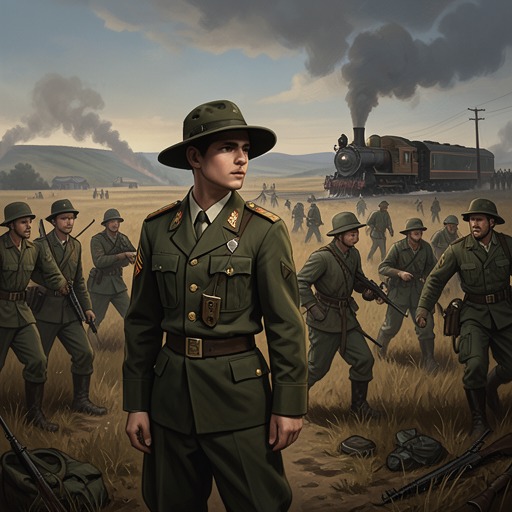
Steve Warner
1919Steve Warner is a Harvard special student who joins an American ambulance section and experiences the war first in the French lines and later in Italy. His story links the intimate routines of the ambulance crew—shared rooms, meals, books, and plans—with the violence and political controls surrounding them. As the war’s promises of purpose give way to gas, bombardment, and punishment for dissent, Steve’s opposition becomes more consequential: he eventually refuses to register and is reported to have received a year’s sentence.
Identity and Introduction
Steve enters the narrative as one of the ambulance section’s companions: a special student at Harvard who, with Richard Ellsworth Savage, Fred Summers, Ripley, and others, forms part of a close-knit group. They find omelettes and pommes frites in villages, visit local bars, and acquire the nickname the grenadine guards. The friendship is made of ordinary habits as much as shared danger; they live, eat, and travel together, and Steve remains part of the circle through successive postings.
The group’s camaraderie does not make Steve indifferent to what surrounds them. When the section is stationed for three rainy weeks in Erize la Petite, near Verdun, he looks at the French soldiers being sent toward the attack and compares their passage to the condemned being carried to execution. His response turns the spectacle of military movement into an indictment of the war: the men are being driven forward amid mud, rain, and repeated cries against the conflict.
At the Front: Friendship and Disillusion
The attack brings the crew into continuous barrages and heavy gas bombardments. The section works around the clock for three days; several men suffer dysentery, one is sent back to Paris with shell shock, and Steve and Ripley vomit after exposure to mustard gas. These consequences situate Steve’s dissent in the bodily reality of the campaign without making him the sole or most severely affected member of the group. The violence is collective, and the crew’s shared routines have to continue within it.
In their time off, the men gather at a garden in Récicourt, where a pink villa has been reduced to dust but the garden itself remains. They sit in the dry fountain, eat melons, drink champagne, and talk about returning to the United States to start an underground newspaper that could tell people what the war was actually like. The plan gives their friendship a public purpose: the men do not merely want to escape the front but to break through the distance between what they have witnessed and what people at home are told.
A conversation in the garden makes Steve’s moral revulsion explicit. He says he is ashamed to belong to his race and to be a man, condemning humanity as cruel and foolish; he imagines that only a great wave of hope, such as a revolution, might restore his self-respect. The exchange is not an abstract debate detached from the setting. It follows the attack and unfolds among men who have watched young soldiers go forward and endured bombardment themselves. The others answer in their own register, turning the conversation back toward a practical errand for champagne. Their different responses preserve the crew’s familiar banter even as Steve’s words expose the depth of his disillusionment.
Italy, Dissent, and Separation
After the French section is disbanded, Steve and Richard Ellsworth Savage are assigned to the American Red Cross ambulance work in Italy. In a late-Renaissance villa near Bassano, the crew evacuates cases of frozen feet, drinks hot rum punch, and spends its off-duty hours drawing, reading, and talking. Steve and Ripley decide to learn to draw, sketching architectural details and a covered bridge. These pursuits continue the group’s shared life, but they also provide a contrast to the machinery of war and the exhausted work of evacuation.
The political disagreement is present even in Steve’s correspondence and conversations. Richard Ellsworth Savage writes to the Thurlows that their advocacy of a war to end war contradicts the Christian principles they profess, and later returns to books, painting, and architecture in conversation with Steve. In Italy, the crew’s circumstances change abruptly when Steve, Richard Ellsworth Savage, Ripley, and Ed Schuyler are ordered to report to Rome for return to the United States. They are not given a clear explanation. A fellow officer says he has heard references to seditious utterances and that Italian intelligence has been asking about them; the other members of the section become nervous and distant. The four leave without saying goodbye, and their departure breaks up the companionship built through the front-line postings.
The men initially treat the transfer with bitter humor, imagining that their orders might become an unexpected tour of Italy. In Paris, however, Steve’s own decision is direct: he goes to the Red Cross office to arrange passage home and says he intends to become a conscientious objector. His refusal is not simply a wish to avoid another assignment; the narrative connects it to his established opposition to the war and to his sense that participation has become morally intolerable.
Refusal and Reported Fate
Richard Ellsworth Savage later remembers the cheap room he shared with Steve behind the Panthéon in Paris. The memory makes Steve’s absence personal: returning to the neighborhood, Richard wonders what became of his former roommate. At a later meeting with Ripley, he asks again. Ripley has received a letter from Boston reporting that Steve was sentenced to a year for refusing to register, while many others received twenty-year sentences. The account supplies a definite outcome but reaches Richard indirectly, through a letter reported by another member of the old group.
Steve’s fate clarifies the cost of the position he had voiced among his companions. His opposition began in the presence of the front’s suffering and was sustained through the group’s conversations, his intention to become a conscientious objector, and finally his refusal to register. The narrative does not show the sentence being imposed or describe Steve’s life in prison; it leaves him at a distance, remembered by friends and identified through the punishment reported to them. That limited knowledge is part of his narrative role: the comrade who once shared rooms, meals, and plans becomes an absence whose whereabouts are uncertain until the brief report from Boston gives that absence a legal consequence.