Andromache
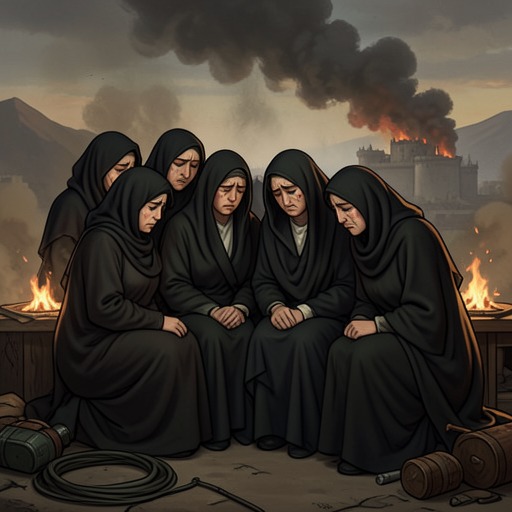
AeneidAndromache is presented as a Trojan woman whose identity has been shaped by the destruction of her first world and by the forced rearrangement of the lives that followed it. Her significance lies not in a single battlefield action but in the way her survival preserves Troy within later political and family structures. When Aeneas reaches Buthrotus, he finds that Andromache has been restored by fate to happiness with a Trojan husband, even after she had been carried away as Priam’s captive son’s prize. Her story therefore turns displacement into a complicated form of continuity: Troy has fallen, yet its people, marriages, memories, and bloodlines persist elsewhere.
Identity and Background
Andromache is associated with the defeated Trojan royal world and with the losses that followed the fall of Troy. The account of her at Buthrotus places her among survivors whose former status has been transformed by conquest. She is no longer simply the wife situated within Troy’s old dynastic order; she is a woman whose life has passed through captivity, separation, and remarriage. The narrative’s emphasis on her being “restor’d by fate” gives her survival a providential dimension, while also acknowledging that her happiness has been reached only after violent historical rupture.
Her position is especially marked by her connection to Priam’s captive son, who succeeded Pyrrhus in both his bed and his throne. That succession joins private intimacy to public rule. Andromache’s new marriage is not merely a domestic consolation: it places a Trojan woman within another political household and allows the displaced Trojan past to acquire a new institutional setting. The language of restoration consequently carries both emotional and dynastic force. She has not recovered the world she lost, but she has found a form of life in which Trojan identity remains legible.
Encounter with Aeneas at Buthrotus
Aeneas and his companions reach Chaonia’s port after skimming along the rocky coast of Epirus, then ascend to the heights of Buthrotus. The place is introduced through reports of marvelous events, and Andromache’s presence becomes part of this strange geography of recollection and survival. Buthrotus is not Troy recreated in full, but it functions as a settlement where the past has been gathered, narrated, and given a provisional home.
Andromache’s reunion with Aeneas is therefore a meeting between two forms of Trojan exile. Aeneas is still moving toward Italy, while Andromache has established herself in a different western landscape. Her experience offers him an image of what survival after Troy may look like: not a return, but adaptation; not the recovery of the old kingdom, but the preservation of its relationships and memory under altered conditions. The encounter also broadens the poem’s account of exile beyond Aeneas’s own mission. The Trojan future is shown to have several branches, each marked by loss and reinvention.
Marriage, Restoration, and Political Continuity
The narrative describes Andromache as once again happy with a Trojan mate. This happiness is significant because it follows captivity and because the new husband occupies a position of authority. Her restoration thus repairs, at least partially, the double wound of personal bereavement and political dispossession. The marriage gives her a place in a living household, while the husband’s succession gives Trojan lineage a continuing public presence.
Yet the restoration is not represented as a simple erasure of suffering. The very need to say that fate has restored her recalls what had been taken from her. Her present happiness is meaningful because the poem keeps the earlier violence in view. Andromache stands at the intersection of marriage as consolation and marriage as political rearrangement: her personal future is inseparable from the succession of kingdoms and from the survival of a people after conquest.
Hospitality and Parting
When Aeneas prepares to leave Buthrotus, Andromache and her queen grieve the departure of the Trojan visitors. The queen is described as no less generous than her Trojan lord, and she gives a noble present to Aeneas’s son. Although the gift is attributed specifically to the queen in the surviving passage, the scene belongs to the emotional and ceremonial world that Andromache shares with the household receiving Aeneas. Hospitality becomes a means of recognizing common origin across separate settlements, while generosity gives material form to a farewell that words alone cannot sustain.
The parting reveals the limits of restoration. Andromache has found a home, but the arrival of Aeneas reopens the memory of the larger Trojan community from which she was separated. Their departure confirms that no single refuge can gather all the exiles together again. The survivors must continue along different routes, carrying tokens, obligations, and memories from one settlement to another.
Narrative Role and Significance
Andromache serves as a counterpoint to Aeneas’s forward-moving mission. He is defined by the necessity of continuing toward Italy; she embodies the lives that remain suspended between a destroyed past and an adapted present. Her appearance makes Trojan exile plural rather than singular. The poem’s future is not produced only by conquest or by the hero’s journey, but also by survivors who preserve identity through remembrance, marriage, hospitality, and settlement.
Her story further complicates the heroic language of fate. Fate has restored her to happiness, but only after captivity and political displacement. The result is neither a return to Troy nor an uncomplicated triumph over suffering. Andromache’s endurance instead shows how historical continuity can survive in altered forms. Through her, the fallen city remains present in later households and dynastic arrangements, and the Trojan past becomes part of the network of relationships from which new political futures emerge.