Ascanius
AeneidAscanius, also known as Iulus or Julus, is the son of Aeneas and a central bearer of the Trojan line into its promised future. He is not presented merely as a dependent child rescued from danger. His survival helps determine Aeneas’s conduct at the moment of Troy’s destruction, while later visions and prophecies place him within the succession by which Trojan blood becomes the foundation of Latium and Rome. The character’s significance lies in that double status: he must be protected as a child, yet he is also treated as the future embodied in human form.
Identity and Family Background
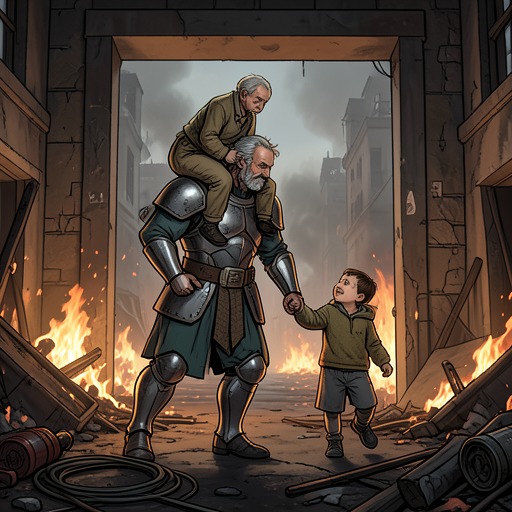
Ascanius belongs to the family whose continuity gives the epic its historical direction. During the night of Troy’s ruin, the appeal made to Aeneas is explicitly domestic and immediate: he must remember the father, son, and wife left behind. Ascanius is named alongside Anchises and Creusa as one of the helpless members of Aeneas’s household, and his presence turns flight from a personal act of fear into a duty toward dependents and descendants. Aeneas’s obligations are therefore arranged across generations: Anchises represents the past, Ascanius the future, and Aeneas the figure forced to carry both through catastrophe.
The evidence also identifies Ascanius through the alternate name Iulus. When Aeneas holds his son during the family’s last embrace, the narrative calls him “young Iulus,” making the Roman dynastic name part of the child’s earliest appearance. The variation is more than ornamental. It allows the boy to stand simultaneously within the immediate Trojan household and within the later lineage that the epic is preparing to reveal.
The Escape from Troy and the Sign of Fire
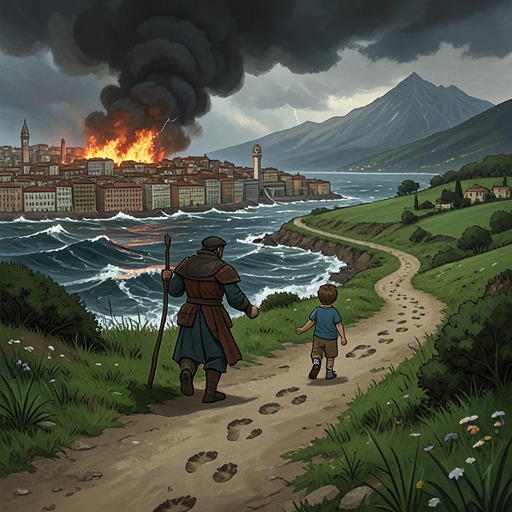
Ascanius’s vulnerability is central to the escape from Troy. Aeneas is urged to look back toward the surviving members of his house and to determine whether Ascanius and Creusa still live while Greek forces move through the home. The child is thus positioned amid the confusion of a city under assault, where family survival depends upon Aeneas’s ability to resist panic and gather those entrusted to him. Ascanius does not yet command events, but his endangered presence gives Aeneas’s action its ethical pressure and practical purpose.
During the escape, an extraordinary sign marks the child. While Aeneas holds him, in the brief interval between their kisses and final embrace, a lambent flame rises from young Iulus’s head and spreads gently around his brows and temples. The flame does not consume him, and its gentleness distinguishes it from the destructive fire that surrounds Troy. Against the city’s burning ruin, the child bears a different kind of fire: a sign of protection, election, or future destiny. The image makes his body a meeting point between domestic tenderness and divine history. The father’s embrace preserves the child, while the flame declares that the child’s preservation matters beyond the household.
From Trojan Exile to Future Settlement
Ascanius’s future is included in the prayers that seek a permanent home for the remnants of Troy. Before the shrine of Thymbraeus, the appeal asks for a resting place for the sad relics of the Trojan race, a secure seat, a region of their own, a lasting empire, and a happier town. Although the prayer is voiced in the context of the displaced community rather than as a private address to Ascanius, its promised continuity depends upon children such as him. The boy’s survival gives the request a human scale: empire begins not as an abstraction but as the preservation of a family that has escaped destruction.
A later vision places Ascanius within a long genealogical sequence. Silvius is shown as the last-born descendant and as the first in the order destined to fill the place of the generation before him, bearing an Alban name mixed with Dardan blood. This future descendant makes Ascanius’s role legible as an origin within a chain rather than as an isolated hero. The Trojan inheritance does not end with the refugees’ arrival; it is transformed through successive generations, and Ascanius stands among the necessary links joining Dardan ancestry to Alban and Roman development.
The same future-oriented pattern appears in the account of the old heroic race descended from Teucer. Assaracus and Ilus are named within a lineage associated with better times and happier years. The reference binds Ascanius’s dynastic identity to a remembered Trojan genealogy and to a future imagined as an improvement upon exile and war. His name thus carries both backward reference and forward promise: it recalls the ancestral race while helping authorize the history that will emerge from it.
First Movement toward Martial Adulthood
Ascanius’s transition from protected child to participant in war is sharply marked in the later narrative. He had previously been accustomed to shooting savage prey in the woods, an activity belonging to youthful exercise and the natural world. On a decisive occasion, however, he bends the sounding bow for the first time in martial conflict. The action is important because it converts an existing skill into a new social and historical function. Hunting practice becomes warfare; the child’s body, once carried through the ruins of Troy, begins to enter the violent world that will determine the settlement’s future.
This first martial act does not erase his earlier identity. Rather, it shows how the epic turns inherited capacities toward the demands of destiny. Ascanius’s development is measured through a change of context: the bow remains an instrument of aim and force, but the woods and their prey give way to organized conflict. The moment therefore anticipates the burdens of succession. To inherit the Trojan future is not simply to receive a name; it is to acquire the ability to defend the community that the name represents.
Narrative Role and Dynastic Significance
Ascanius functions as the living answer to the destruction of Troy. The epic repeatedly places him beside images of threatened continuity, sacred promise, and ancestral succession. He is named when Aeneas is tempted to rush into hopeless combat, protected during the family’s flight, marked by flame, associated with prayers for a permanent Trojan home, and carried forward into visions of the descendants who will follow. These episodes distribute his significance across the poem rather than confining it to one deed.
His role also reshapes the heroic ideal. The immediate demand made upon Aeneas is not merely to fight bravely but to remember whom he would abandon. Ascanius’s presence exposes the limits of undirected martial rage: courage that ignores the child, the father, and the household would destroy the very future that heroic action is supposed to secure. The child therefore stands at the center of a conflict between battle and responsibility. He is the reason to leave a doomed city, the sign that the escape serves a larger purpose, and the descendant whose eventual maturation will allow protection to become participation.
Ascanius’s importance finally depends on the contrast between his small, vulnerable figure and the immense historical promises attached to him. The flame around his temples is intimate enough to be witnessed during a father’s last embrace, yet portentous enough to anticipate a lineage of towns, peoples, and imperial destiny. In this contrast, the epic locates the origin of Rome’s future not only in conquest or prophecy but in the preservation of a child through the ruins of Troy and in his gradual conversion from refugee heir to martial successor.