Creusa
AeneidCreusa is the wife of Aeneas and the figure whose loss marks the emotional fracture between his life in Troy and his compelled future as an exile. During the city’s destruction, she is not merely left behind: she actively confronts Aeneas’s attempt to return to the fighting, and her later ghostly appearance confirms that the separation has become an irreversible death. Her brief presence therefore carries unusual narrative weight, binding domestic love, familial duty, military catastrophe, and the claims of destiny into a single remembered scene.
Identity and Place in the Fall of Troy
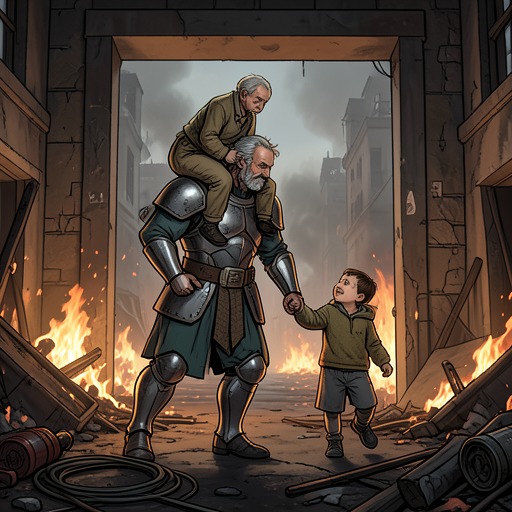
Creusa appears within the household that Aeneas is urged to protect while the Greeks overrun Troy. The appeal to him is explicitly familial: he must remember whom he is abandoning and what pledges he is leaving behind, and he must determine whether his helpless father Anchises, Ascanius, or Creusa still survives. In this setting, Creusa is presented as one of the vulnerable members of Aeneas’s household, but the language also makes her a pledge of the life he is trying to preserve rather than an incidental casualty of the city’s fall.
Her position is defined by the collision between household survival and heroic impulse. Aeneas is preparing to take up his shield and rush into the abandoned field, apparently driven by rage and the desire to meet the enemy. Creusa’s existence stands at the center of the counterargument: the warrior’s movement toward battle would mean forsaking the living dependents whose survival gives his escape its purpose. The poem thus places her beside Anchises and Ascanius in the moral field of Aeneas’s responsibility, even though her own subsequent action makes her more than a passive object of rescue.
Separation During the Escape
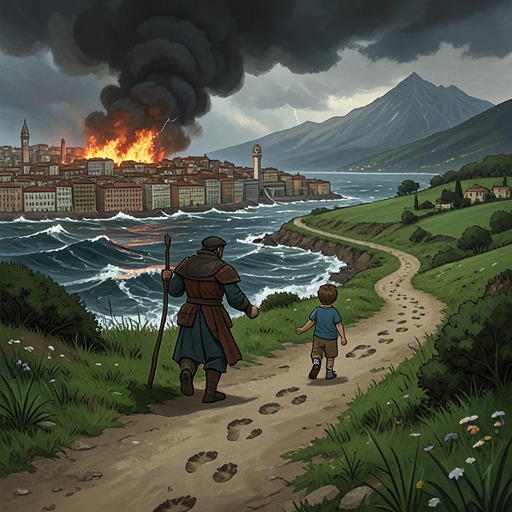
When Aeneas goes out through the devastated city and later attempts to flee by winding ways toward the shelter of night, Creusa stops him. She crosses the threshold in his passage and embraces his knees while he is about to depart. The gesture is physically direct and emotionally urgent: rather than remaining an unseen presence in the household, she obstructs the movement of the armed man who would abandon the home to seek the battlefield. Her intervention gives the escape a domestic resistance, making clear that departure is experienced not as a clean act of leadership but as a painful division forced upon a family.
Aeneas nevertheless continues through the darkness, and Creusa is lost. The account leaves the immediate mechanism of her disappearance uncertain. Aeneas cannot tell whether she fell through fatal destiny, sat down exhausted, or wandered away in terror. This uncertainty is important because it turns the escape into a scene of confused perception rather than a neatly witnessed death. The ruined streets, winding route, and night conceal the exact moment at which Creusa passes from companion to missing person, while Aeneas’s inability to establish what happened keeps the wound open.
The Search and the Ghostly Recognition
After discovering that Creusa is gone, Aeneas searches for her in mounting distress. He calls her name throughout the silent street, repeating it until the call seems to reach her. The repetition is both an attempt at recovery and an early form of mourning: his voice tries to restore the domestic world by making the absent woman answer. At length she does appear suddenly through the shadows of night, but the apparent recovery is immediately overturned.
The woman who appears is no longer Creusa as Aeneas’s wife. The recognition scene depends on a terrible substitution: she has the form and identity of Creusa, yet she is a ghost, not the living companion whom he hoped to find. Aeneas stands aghast, astonished, and struck dumb with fear, with his hair rising in terror. The encounter therefore converts uncertainty into knowledge while making that knowledge more devastating. He learns that the lost wife cannot be regained through pursuit, and the supernatural revelation arrives only after the living search has failed.
Creusa’s ghost begins by soothing his grief and declaring that neither tears nor cries can give the dead relief. Her words reject the possibility that continued lament can reverse the catastrophe. The tenderness of her address does not erase the finality of death; instead, it gives that finality a form Aeneas can hear. She remains emotionally connected to him, but the connection now operates across the boundary separating the dead from the living.
Change in Aeneas’s Mission
Creusa’s death changes the meaning of Aeneas’s escape. Before she vanishes, he is torn between returning to combat and carrying his household away from the burning city. After the ghost appears, grief must yield to the continued obligations that the surviving family and the larger Trojan future impose upon him. Her apparition does not send him back into the ruins or authorize a renewed attempt to retrieve her. By forbidding the dead to be relieved by his cries, it turns his attention away from an impossible recovery and toward the journey that remains.
This makes Creusa a threshold figure in Aeneas’s transition from Trojan husband to exile and founder. Her disappearance belongs to the night of Troy’s destruction, but her last appearance helps establish the emotional discipline required for what follows. Aeneas’s duty is not presented as freedom from attachment; it is formed through attachment and then tested by its removal. He must carry the memory of Creusa without allowing the memory to halt the survival of Anchises, Ascanius, and the displaced Trojan community.
Narrative and Thematic Significance
Creusa’s scene concentrates the poem’s tragic contrast between the claims of intimate love and the demands of a larger destiny. She is part of the household Aeneas is bound to defend, yet she becomes the member of that household whom he cannot save. Her loss exposes the cost concealed within heroic continuity: the future associated with Aeneas’s family and people can proceed only after a marriage and a home have been broken by war.
The episode also gives the fall of Troy a structure of delayed recognition. Aeneas first knows only that Creusa is absent; then he calls for her; finally, her ghost reveals what the darkness withheld. The repeated call and the sudden answer create a pattern in which narration itself becomes an act of witnessing. The event cannot be made whole by recovering the missing facts, because the recovered truth is death. Creusa’s brief ghostly speech consequently functions as both farewell and correction, restraining Aeneas’s grief while preserving her role as the beloved wife whose loss remains foundational to his story.