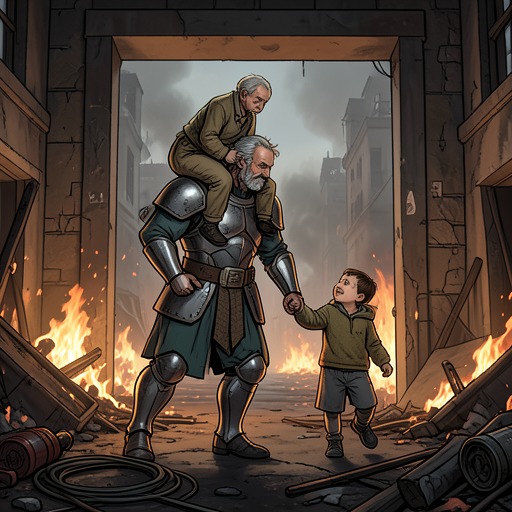
Evander
AeneidEvander is the Arcadian king of Pallanteum, a figure whose apparently humble authority carries consequences far beyond his small kingdom. His settlement, founded by a band driven from Arcadia, becomes the place where Aeneas finds a willing ally and where the Trojan quest is joined to the political future of Italy. Through Evander, the poem turns poverty, exile, and hospitality into foundations for a greater historical order.
Identity and Settlement
Evander rules a community whose origins lie in displacement. A banished band was driven from the Arcadian land with Evander and established itself in the new country, building walls on elevated ground. His authority therefore emerges not from an ancient, secure empire but from the labor of refugees who have converted exile into settlement. The community’s vulnerable beginning gives Evander’s kingship a distinctive character: he is both ruler and exile, guardian of a people who have had to make a homeland after losing their first one.
The physical appearance of his kingdom reflects that history. The dwellings are described as poor cottages of common clay, even though the same sites will later rise in marble under Roman rule. Evander’s kingdom is thus shown in a deliberately double perspective: in the present it is mean and materially slight, while in the future its ground will belong to Rome’s monumental power. The contrast makes the settlement an origin-point whose historical significance exceeds its visible scale.
Meeting with Aeneas
Aeneas sees Evander’s humble dwellings and turns his ships toward the shore. The encounter occurs on a solemn day, giving the meeting a ceremonial quality rather than presenting it as an accidental political transaction. Evander comes down to the strand, embraces the stranger prince, and joins hands with him. His first response to Aeneas is therefore physical and public: recognition is expressed through welcome, contact, and the immediate suspension of suspicion.
The two leaders are then conducted to a grove, where Aeneas breaks the silence and addresses the king. The grove and the solemn occasion frame their conversation as a moment of unusual weight. Aeneas arrives as a foreign prince seeking cooperation, while Evander receives him as a ruler capable of answering a stranger’s appeal. Their meeting establishes a bond between Trojan exile and Arcadian exile, linking two displaced peoples through mutual recognition.
Alliance and Political Consequence
Evander is mindful of promised aid, and that prior commitment governs his movement toward Aeneas. His assistance is not represented as a sudden impulse but as the fulfillment of an obligation already given. Even so, the evidence emphasizes the urgency of the meeting: Evander mends his pace and encounters Aeneas in the middle space between them. The image presents alliance as something actively met and completed by both sides rather than passively bestowed by one ruler upon another.
The alliance carries a significance disproportionate to Evander’s limited resources. His settlement is poor, but its location and history place it within the line of development that will lead to Roman greatness. The later marble city is foreshadowed in the clay cottages, so Evander’s welcome becomes part of the deep political ancestry of Rome. He contributes not merely shelter or courtesy but a bridge between the Trojan mission and the future civilization that will arise on the same ground.
Relationship with Pallas
Pallas attends his father’s steps when Evander goes to meet Aeneas. The detail identifies the young man as part of the king’s immediate political and familial world: Evander does not appear alone, but with his son beside him. Pallas’s presence also gives the encounter an intergenerational dimension, placing the future of the Arcadian house within the scene where Evander extends aid to Aeneas.
Evander’s role is consequently bound to the transmission of authority and obligation. The king represents the community founded by exiles, while Pallas follows him into the encounter with the Trojan prince. Their shared appearance connects Evander’s past—his expulsion from Arcadia and establishment of Pallanteum—to the next generation’s participation in the alliance that will reshape the Italian world.
Narrative Role and Significance
Evander functions as a threshold figure between a small, precarious present and the immense Roman future. His clay cottages are not dismissed as irrelevant poverty; they are made legible as the earliest form of a place that will later rise in marble. The poem therefore asks the reader to see historical greatness before it becomes visible, locating Rome’s future magnificence within an origin marked by exile, simplicity, and endurance.
His conduct also embodies the political value of hospitality. He recognizes Aeneas as a stranger prince, receives him with an embrace, and honors promised aid. In a narrative driven by wandering, warfare, and the search for a homeland, Evander offers a model of alliance founded on welcome rather than conquest. His importance lies precisely in the fact that his modest kingdom can nevertheless become the decisive human link through which Trojan purpose enters the future of Italy.