Anchises
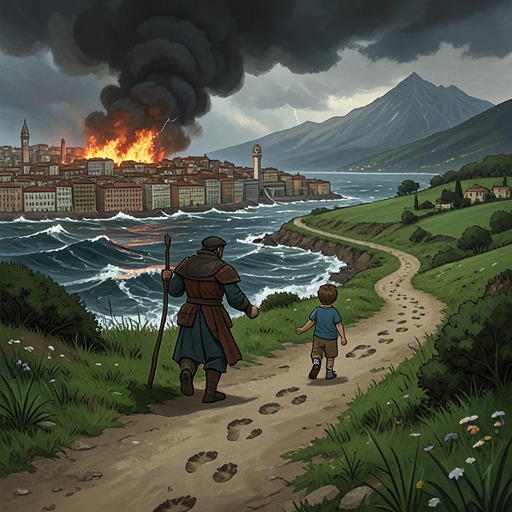
AeneidAnchises is the aged father of Aeneas and the central human reason for his son’s endurance through exile. In the aftermath of Troy’s destruction, Aeneas presents his escape not as a solitary feat but as an act undertaken chiefly for Anchises: after passing through enemies and flames, he reaches home and turns toward the father whose safety has given the dangerous journey its purpose. Anchises therefore stands at the emotional center of Aeneas’s pietas, linking physical rescue with filial duty and the preservation of Trojan continuity.
Identity and Place in Aeneas’s Mission
Anchises appears as an old man whose age makes him dependent on the younger hero, yet his dependence does not reduce his importance. Aeneas’s labor is measured by what it costs to save him. The father is the person for whose sake, or chiefly for whose sake, Aeneas undertakes such toil, so that the hero’s courage is defined through care rather than individual glory. The escape from Troy becomes an intergenerational act: Aeneas carries forward not merely a survivor, but the living representative of the household and its inherited past.
This filial purpose also gives Anchises a symbolic position between ruin and futurity. He belongs to the world that has been destroyed, but his survival allows that world to enter the uncertain future. Aeneas’s movement away from Troy is consequently not a clean break with the past. Anchises makes the past bodily present, vulnerable, and costly to transport, while also making its preservation the condition of everything that follows.
The Burden of Exile
During the wanderings, Anchises is associated with the practical and moral burdens of displacement. When Aeneas prepares for a difficult passage, he orders what prudence can provide, clothes his shoulders with a lion’s hide and yellow spoils, and bends his back beneath the weight he must carry. The scene makes endurance concrete: protection, improvisation, and bodily strength are all marshalled around the task of conveying the elder safely onward. The burden is heroic precisely because it is accepted as necessary rather than treated as an obstacle to be discarded.
Anchises’s presence also enlarges the meaning of every danger. Storms, hostile shores, and the uncertainty of travel threaten more than the young expeditionary force; they threaten a father already worn by age. Aeneas’s efforts are thus repeatedly tested against the frailty of the person he has vowed to preserve. The journey’s victories remain incomplete whenever the rescued elder is exposed to further peril, and safety itself becomes temporary, something won through repeated labor rather than secured once and for all.
Death After the Long Voyage
After endless labors, repeated tossing by raging storms, and driving from coast to coast, Aeneas loses his dear father. Anchises has been saved through a thousand toils, but that salvation proves temporary: the man rescued from Troy dies after the voyage has already extracted its full price. His death is therefore a reversal within the rescue narrative. What Aeneas could accomplish through courage and prudence cannot finally overcome age, exhaustion, and the mortal limits that govern even those whom fate appears to protect.
The loss is described as both the end of Aeneas’s cares and the solace of his pain. Anchises has been the cause of anxious effort, but also the companion whose existence makes that effort meaningful. His death removes the immediate burden while intensifying the wound beneath it. The son is freed from carrying the father, yet deprived of the person for whom he had carried so much. The emotional contradiction prevents the episode from becoming a simple triumph of duty: pietas succeeds in preserving Anchises for a time, but cannot preserve him forever.
Return in the Underworld
Anchises’s role does not end with his earthly death. In the Underworld, he appears in a place of blessed spirits, where Aeneas encounters him again. The reunion transforms bereavement into a new kind of instruction. The father is no longer the aged body requiring rescue; he becomes a seer of lineage and destiny, able to look beyond the immediate generation toward the race that will descend from the Trojan survivors.
In a flowering valley, Anchises reviews his assembled descendants and takes their number. The setting and action present him as an overseer of continuity: he surveys the future family not as an abstract promise but as a gathered succession. His knowledge gives shape to what the voyage has been carrying toward. The father who once had to be borne on Aeneas’s back now occupies the position of one who comprehends the generations ahead, turning personal memory into a vision of historical destiny.
Narrative and Thematic Significance
Anchises embodies the interdependence of private affection and public destiny. Aeneas’s mission begins in the immediate obligation to save his father, but the same act preserves a lineage that will eventually be displayed before him. The narrative thus binds the household to the future community: the son’s bodily labor becomes the means by which ancestry survives, and ancestry later becomes the interpretive framework for the son’s continuing mission.
His arc also gives the epic its clearest pattern of gain and loss. Anchises is rescued from the flames, carried through exile, and then lost despite those efforts; later, he returns in the Underworld not as a restored mortal but as a prophetic ancestor. The change preserves the emotional truth of death while granting it a larger narrative consequence. Anchises cannot accompany Aeneas in the ordinary world, but his memory and vision continue to guide the meaning of the journey. Through him, the epic presents filial devotion not as a private detour from destiny, but as the first and most intimate form in which destiny is enacted.