Aeneas
AeneidAeneas is the central Trojan hero of the epic and the agent through whom the destruction of Troy is transformed into the beginnings of a new political future. He appears not as a conqueror returning to an intact kingdom, but as the survivor of a catastrophe who must lead a displaced people through uncertainty, error, love, diplomacy, and war. His decisive significance lies in the way private suffering is repeatedly subordinated to a larger obligation: the ruined Trojan state becomes the starting point of a journey toward Italy, while Aeneas’s conduct gives that journey its moral and political shape.
Identity and Introduction
Aeneas is presented as the light and support of the Trojans, the champion of his father, and the joy of his country. This praise defines him through several overlapping loyalties rather than through solitary prowess. He belongs to a defeated nation, stands within a family line, and bears an expectation that has long been directed toward his arrival. His identity is therefore collective from the beginning: to name Aeneas is to invoke Troy, his father Anchises, his companions, and the future that depends on Trojan survival.
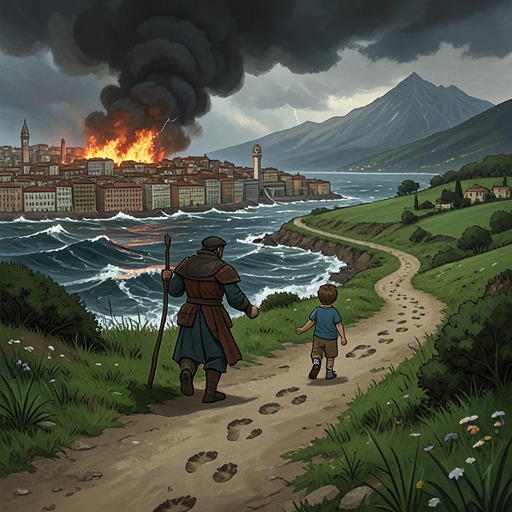
The narrative introduces him against the memory of Troy’s fall. Heaven has overturned the Trojan state, Priam’s throne has been destroyed, and ruined Troy has become the prey of the Greeks. Aeneas’s task begins in the aftermath of this political extinction. He is not merely escaping danger; he is carrying the remnants of a people away from a city that can no longer protect them. The epic’s later foundation narrative depends on this reversal, in which defeat becomes the first condition of historical continuation.
The Exile’s Journey and Its Reversals
Aeneas’s movement after Troy is marked by exploration, mistaken interpretation, and repeated displacement. He sails first toward Thrace, then to Delos, where he seeks divine guidance concerning the land appointed for his habitation. The oracle’s answer is misunderstood, and he settles in Crete before a dream from his household gods reveals the error and directs him toward Italy. The journey thus makes Aeneas a hero of discovery as well as endurance: his progress depends on learning to distinguish an apparent destination from the place required by fate.
The voyage continues through surprising encounters and uncertain shores before reaching Sicily, where Anchises dies. That loss gives the journey a more intimate cost. Aeneas is not only the leader of a migration but also a son forced to continue after the death of the father whose protection and authority helped define his mission. The later storm that throws him upon the Carthaginian coast is presented as occurring after this Sicilian departure, linking the sea’s violence to the continuing instability of Trojan exile.
Aeneas’s path also places him within a larger heroic and mythic inheritance. In the grove of Trivia, he encounters a temple whose golden roof preserves the story of Daedalus’s flight from Crete. The image of the man who escaped one shore by taking to the air reflects, by contrast, Aeneas’s slower and more arduous escape by sea. The same setting contains the heroic race of Teucer, associated with better times and happier years. Such memories place Aeneas inside a chain of displaced founders and old heroic houses, while also making his own expedition part of a historical movement from remembered origins toward a future yet to be established.
Love, Leadership, and Political Duty
In Carthage, Aeneas becomes the object of Dido’s growing passion. The queen is seized by anxious care and nourishes an unseen flame; his valour, deeds, and birth inspire her attachment. The relationship gives Aeneas a powerful alternative to his assigned mission. Carthage offers the possibility of emotional and political settlement, but his identity as the bearer of Trojan destiny prevents that settlement from becoming permanent. His departure therefore turns personal attachment into a test of public obligation, and the consequences fall most violently upon Dido.
Aeneas’s political character is equally visible in his dealings with foreign peoples. When confronted by strangers, he takes his stand high upon the stern with an olive branch in his hand and speaks openly of the Phrygian arms and the purpose of his arrival. The gesture presents him as a supplicant and negotiator rather than an automatic aggressor. He makes his identity visible while using a traditional sign of peace, showing that Trojan power can be expressed through restraint as well as force.
That willingness to seek accommodation reappears during the war in Italy. Suppliants sent from Laurentum approach with olive branches and ask for a truce. Aeneas grants the request because their suit is just, then condemns the severe fate that has involved the Latian princes in causeless quarrels and armed them against an unoffending man. His words establish a principle of proportionality: conflict is not automatically honorable merely because princes or armies undertake it. The appeal is especially significant because it comes from a leader already capable of war; mercy is shown as a deliberate political choice, not as helplessness.
War, Treaty, and the Burden of Victory
Aeneas’s peaceful conduct does not remove him from violence. The Trojan hero is repeatedly required to defend a people whose survival depends on his ability to fight, and the narrative contrasts his preference for justified settlement with the destructive passions that prolong the Latin conflict. His public role is therefore divided between the olive branch and the weapon, between the speaker who asks that needless war cease and the champion who must meet the enemy in combat.
The epic also places Aeneas within the legal and ritual structures of collective life. He sends word to Latinus that the rage of arms should end and that peace should be ratified. When peace is tied in public view with solemn vows sworn on both sides, the agreement is completed through the dues required by holy rites. Aeneas’s political project is consequently not simple conquest. It seeks a recognized order in which promises, ritual obligations, and reciprocal submission can bind communities that have been drawn into war.
At the climax of the fighting, Aeneas hears the name of the champion and soon leaves the captured works and mounted walls to confront him. The movement from fortification to single combat concentrates the wider conflict into a personal encounter. Yet victory does not immediately produce easy triumph. In the final decision, the Trojan hero stands in deep suspense, prepared to strike but restraining his hand. The hesitation shows that even the destined victor must confront the moral weight of killing a yielded opponent; conquest remains inseparable from judgment.
Change, Ending, and Narrative Role
Aeneas changes from the leader of a shattered remnant into the founder-like guarantor of a future political community. At the beginning, his authority is grounded in what has been lost: Troy, Priam’s throne, and the world that made the Trojans a people. By the end, his authority is directed toward what must be secured: a peace with the Latins, the continuation of Trojan identity, and the settlement that will make later Roman history imaginable. The change is not a rejection of his past but its conversion into a public destiny.
His defining discipline is the management of competing claims. Family loyalty, grief for Anchises, attachment to Dido, compassion toward suppliants, and the demands of warfare all press upon him, but none can wholly replace the obligation to continue. The epic gives this discipline its most severe form at the moment when his hand is raised and then checked. Aeneas is not portrayed as untouched by pity or uncertainty; he is portrayed as a man who must act while fully exposed to both.
The narrative finally makes Aeneas the mediator between ruin and foundation, exile and settlement, war and treaty. His olive branch, his voyage through mistaken destinations, his memory of fallen Troy, and his hesitation before the final blow all belong to the same larger design. He carries the past forward without allowing it to remain only a lament, yet the future he secures is born through losses that the epic never permits the reader to forget.