Priam
AeneidPriam is the aged king of Troy and the final human image of a royal world collapsing with its city. His death is presented not as an isolated killing but as the consummation of Troy’s ruin: the ruler who once wielded the scepter of all Asia falls together with Troy in ashes and with his destroyed state.
Identity and Royal Position
Priam’s significance rests on the authority attached to his name. The poem treats the claims of his royal dignity as already sufficiently answered by the suffering endured in Troy’s destruction: more than enough has been paid both to Priam’s name and to the demands of duty and fame. His identity therefore carries a double weight. He is an individual king, but he also embodies the throne, the dynasty, and the political order that the Greek assault is overturning.
The language surrounding him joins personal honor to public catastrophe. Troy is seen nodding from above and tottering toward its fall, while Priam’s royal name stands within the accounting of what the defeated have already paid. The king’s fate cannot be separated from the city’s fate; the destruction of the palace is simultaneously the destruction of the authority that palace represents.
Priam During the Fall of Troy
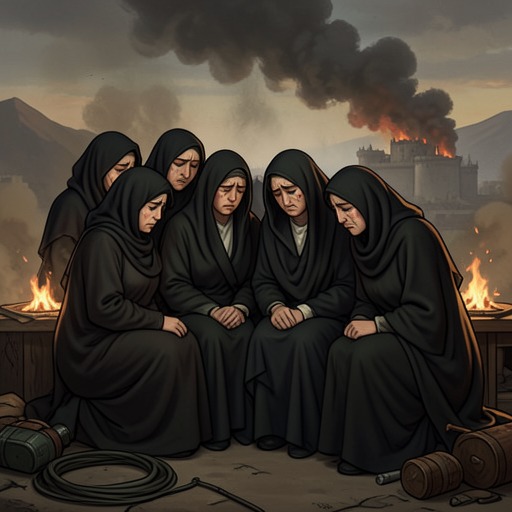
At the height of the catastrophe, Priam is recalled amid the spectacle of the royal household and the invading armies. The witness who describes the scene has seen the conqueror pass between the brother kings and has seen the unhappy queen, the hundred wives, and the place where old Priam stood. This positioning makes Priam the fixed center of a moving disaster: around him are gathered the royal family, the women of the household, and the armed forces that have breached the city.
The Greeks enter wherever the raging fire has left an opening and take possession of the city. When Priam sees his regal town burning, his ruined palace, and the enemy entering, the scale of the loss becomes fully visible to him. His recognition of the scene gives the fall a distinctly political and familial dimension: he does not merely witness fire and invasion, but the destruction of the seat of kingship and the extinction of the world over which he ruled.
Death and the Ruin of Troy
Priam’s death is narrated as the decisive convergence of royal helplessness and military violence. He falls after the invaders have entered the burning city, and the poem marks the physical reality of the killing through the wound, the rushing lukewarm blood, and the streams that stain the sacred ground. The imagery strips royal power of its protection without stripping the victim of his dignity: the former ruler is exposed to the same bodily vulnerability as any other mortal, even as the setting preserves the enormity of his rank.
The conclusion is deliberately total. Priam falls and shares one common fate with Troy in ashes and with his ruined state. The king who had swayed the scepter of all Asia is therefore reduced by the city’s fall, but the city is also made legible through him. His death functions as the personal form of a national disaster, turning the collapse of a kingdom into a scene of human suffering.
Memory, Mourning, and Historical Meaning
Although Priam belongs to the past of the narrative, his presence persists through recollection. Later scenes give sustained attention to tombs, funeral observances, ancestral spirits, and the public display of the dead or their spoils. Aeneas orders a stately tomb on the shore for a fallen companion, marked with a trumpet, a soldier’s falchion, and a seaman’s oar; Anchises reviews the race of future generations in the Elysian Fields; the shield of Aeneas turns Roman triumphs into visible history; and the armor of Mezentius is hung high on a naked trunk as a trophy. Against this culture of commemoration, Priam’s remembered death becomes one of the foundational losses from which later Trojan identity is formed.
His memory also stands behind the poem’s repeated concern with the limits of vengeance and the obligations owed to the defeated. Suppliants from Laurentum later approach Aeneas with olive branches and ask for a truce; Aeneas grants the request and recognizes the justice of their suit. The Latins and Trojans eventually bind peace with solemn vows and the rites required by religion. These later practices do not undo Priam’s death, but they create a contrast with the unrestrained violence that ended his reign. Priam’s fate helps define the moral distance between a city consumed by war and a political order seeking to establish peace through ritual agreement.
Narrative Role and Significance
Priam is a tragic emblem of the transition from heroic and dynastic Troy to the future world promised to Aeneas. His death closes one historical order, while the visions of Anchises and the images on Aeneas’s shield direct attention toward the Roman future. The contrast is stark: Priam’s scepter, palace, and city are destroyed in fire, whereas Aeneas’s shield presents triumphs rising in gold and Anchises surveys descendants ordained by fate.
The poem thus makes Priam’s fall carry more than pathos. It is a warning about the fragility of power, a record of the cost paid by the defeated, and a necessary ancestral wound within the story of Trojan survival. His royal name receives its due not through victory, but through the magnitude of what is lost when Troy and its king share a single ruin.