Mnestheus
AeneidMnestheus is one of the most dependable Trojan leaders in the poem, distinguished less by solitary spectacle than by the repeated conversion of courage into useful command. He fights beside Aeneas in the ruined city, competes successfully in the funeral games for Anchises, shares responsibility for the threatened camp, rallies broken troops, and finally helps remove the wounded Aeneas from battle. His significance lies in continuity: wherever the Trojan cause requires endurance, coordination, or recovery after catastrophe, Mnestheus becomes one of the figures who makes survival possible.
Identity and Early Service
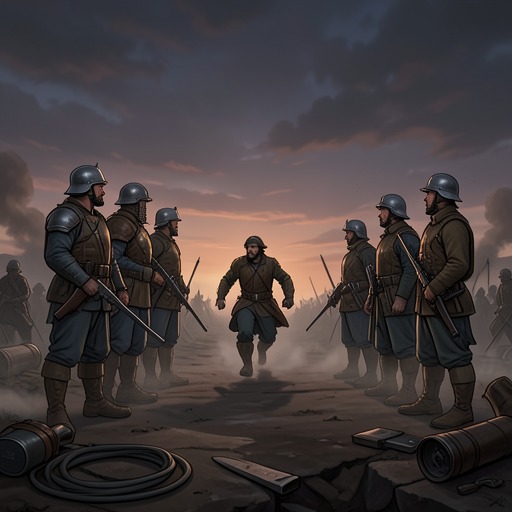
Mnestheus first appears among the companions who remain with Aeneas amid the night battle at Troy. Ripheus and Iph’itas fight at Aeneas’s side, while Mnestheus is named within the same circle of Trojan defenders who run toward clashing arms and the call to defend the walls. The setting gives his character an immediate military definition. He is not introduced as a detached observer or as a hero seeking private distinction; he belongs to the emergency of a city under assault, where loyalty is measured by the willingness to return to danger.
His association with Aeneas also places him inside the surviving Trojan leadership. The poem repeatedly presents Trojan resistance as a collective undertaking, and Mnestheus’s recurrence among commanders shows that he is trusted beyond a single exploit. His role develops from armed companion in the catastrophe at Troy into an officer capable of directing others when the Trojan community has become an exiled people seeking a new homeland.
Skill, Competition, and Recognition
Mnestheus’s athletic appearance during the funeral games for Anchises reveals a second aspect of his public identity. He commands the speedy Dolphin in the galley race, a vessel described as outstripping the wind. The contest transforms the fleet from an instrument of exile into a ceremonial arena, and Mnestheus’s participation demonstrates that his authority is not confined to land warfare. He is equally at home in the discipline of navigation, rowing, and coordinated action.
The result gives this competence visible social value: Mnestheus is declared the second victor and is summoned to receive the second prize, a coat of mail. The award is especially fitting because it joins ceremonial honor to martial usefulness. His victory does not make him a rival to Aeneas or replace the expedition’s central leader; instead, it confirms Mnestheus as a subordinate commander whose excellence strengthens the larger Trojan order. The games therefore recognize the qualities that later matter in war: speed, control, cooperation, and steadiness under pressure.
Command During the Italian War
When the Trojan camp is endangered, Mnestheus and Serestus patrol the defenses by commission of their absent prince. Their task is practical and administrative as well as heroic: they share the common danger and divide the care of the walls. The language of divided responsibility is important to Mnestheus’s characterization. He does not merely defend a position through personal valor; he helps distribute vigilance across a threatened community, turning military leadership into collective protection.
That capacity becomes decisive after the Trojans suffer losses. When the chiefs see their slaughtered friends, Mnestheus is the first to rally the broken line, supported by Serestus and his troop. His action responds simultaneously to two needs: saving those still alive and avenging the dead. The reversal is from shock and disarray toward renewed cohesion. Mnestheus supplies the first movement back from grief into action, making him a figure of recovery rather than merely of aggression.
His leadership is therefore defined by sequence and consequence. He guards before the crisis, organizes during the crisis, and restores formation after the crisis has fractured it. The poem’s military world depends on such repeated acts of maintenance. Grand champions may decide individual combats, but Mnestheus preserves the army’s ability to continue fighting.
Service to Aeneas and Final Function
Mnestheus’s loyalty reaches its clearest expression in the final fighting, when Aeneas is wounded and forced to leave the field while the Trojans are yielding. Mnestheus, together with Achates, helps remove the wounded prince. The scene gives his earlier qualities a culminating purpose. The commander who once ran toward the walls and later rallied a shattered line now protects the expedition’s central leader at the moment when the army’s fortunes are most precarious.
This rescue also clarifies the hierarchy of his allegiance. Mnestheus’s service is directed toward the survival of Aeneas and, through Aeneas, the future of the Trojan mission. He does not claim the poem’s central destiny for himself. His importance comes from sustaining the person and cause on which that destiny depends. Even when the battle’s immediate value has shifted toward Trojan defeat and danger, his action preserves the possibility of renewed resistance.
Narrative Role and Significance
Mnestheus functions as a model of durable civic heroism. His career moves through four linked forms of service: defense at Troy, honorable competition in the games, delegated guardianship of the camp, and rescue in the Italian war. Each episode adds a different proof of reliability, while the repetition of his presence binds the poem’s separated stages together. He is a surviving Trojan who carries the habits of a fallen city into the uncertain labor of founding another order.
Unlike a hero whose identity depends on one dazzling exploit, Mnestheus gains force through recurrence. The poem places him beside famous warriors, among ceremonial victors, at the walls, in the rally after slaughter, and near the wounded Aeneas. That pattern makes him an emblem of continuity under pressure. His courage is active but not self-advertising, and his authority is exercised through organization, assistance, and recovery. In the epic’s larger movement from the destruction of Troy toward the establishment of Trojan power in Italy, Mnestheus represents the human infrastructure of destiny: the steadfast commander whose repeated acts allow the larger future to survive its immediate disasters.