Drances
AeneidDrances is a prominent Latin statesman and the declared enemy of Turnus. His importance lies less in military action than in political speech: he repeatedly turns the disastrous war into an indictment of Turnus’s leadership, while also exposing the tension between public counsel and private faction. Through Drances, the poem gives the Latin camp a voice that questions whether honor can justify sacrificing the state.
Identity and Political Position
Drances is introduced as the chief of the Laurentian envoys who approach Aeneas seeking a truce. He has long harbored hatred for Turnus and openly professes himself Turnus’s foe, so his diplomacy is never politically neutral. The embassy joins a legitimate public purpose with a personal rivalry: Laurentum needs mercy and time, while Drances also stands against the prince whose rising glory he resents.
His influence is grounded in the council rather than the battlefield. He is described as factional and rich, and his authority comes from his prominence in public deliberation. When the Latin state is endangered, he uses the crisis to attack Turnus, presenting the prince’s ambition as a danger to the whole community. Drances therefore embodies a form of aristocratic power exercised through accusation, counsel, and control of political judgment.
The Embassy to Aeneas
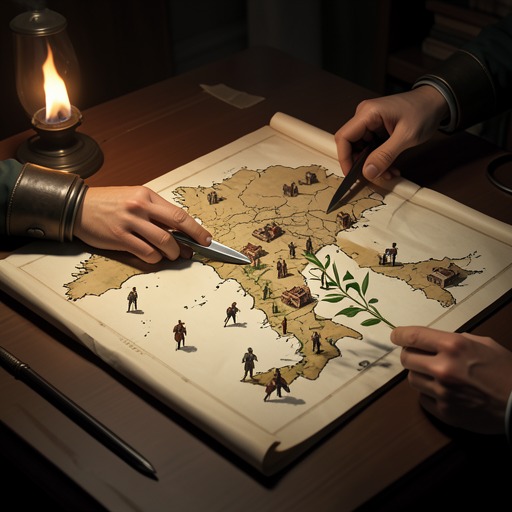
The delegation from Laurentum comes with olive branches and asks Aeneas for a truce. Drances stands among those who implore his clemency, participating in an appeal that recognizes the immediate human and political cost of the war. Aeneas grants their request because their suit is just, and he rebukes the Latin rulers for having been drawn into causeless quarrels against an unoffending man.
The embassy reveals Drances operating within a formal language of supplication rather than command. The envoys’ silence and amazement after Aeneas’s reply show the force of his response: the supposed enemy answers them with moral clarity, while the Latin side must confront the possibility that its war has been unjustly begun. Drances’s presence in this scene links him to the poem’s larger concern with the obligations of mercy, truce, and public responsibility.
Conflict with Turnus
After the Latin king acknowledges the state’s danger and urges collective action, Drances takes the word to criticize Turnus’s increasing glory. He seizes the political moment and loads the young prince with reproachful charges. His argument is not merely that Turnus has made mistakes; it is that Turnus’s prominence itself has become politically destructive, because personal ambition has displaced the safety of the Latin state.
Drances’s rhetoric relies on the contrast between speech and action. Turnus accuses him of never lacking a stream of words when the public need requires swords, making eloquence appear as evasion and cowardice. The charge is especially pointed because Drances is first in the council hall to direct affairs, whereas Turnus claims the authority of the warrior. Their quarrel thus opposes two competing definitions of leadership: deliberative influence against martial courage, and political blame against personal risk.
The exchange also exposes mutual factionalism. Drances attacks Turnus under cover of concern for the state, but the narrative makes his longstanding hatred unmistakable. Turnus’s anger, in turn, does not erase the substance of Drances’s criticism. Their conflict remains suspended between public principle and private resentment, so that neither political speech nor military valor can claim uncontested authority.
War, Truce, and Political Responsibility
Drances’s arguments gain force because the war has become a collective catastrophe rather than a contained contest between champions. The Latin community must consider whether it can continue to spend its wealth, lives, and political future on Turnus’s cause. His intervention gives language to the consequentialist question at the center of the crisis: even if Turnus possesses courage, what is the state preserving by following him?
The poem nevertheless refuses to make Drances a simple moral victor. His wealth and factional position suggest that he is also pursuing influence, and his hostility toward Turnus complicates every appeal he makes on behalf of peace. He recognizes the need to save the sinking state, yet he does so by intensifying an internal political struggle. Drances therefore belongs to the unstable space between civic prudence and opportunism, where a true warning can still be advanced for partisan ends.
The later movement toward peace confirms the importance of the issues Drances raises. Aeneas sends to the Latin king to end the rage of arms and ratify peace, and the agreement is publicly sealed through solemn vows and the completion of the rites required by religious law. Against this formal movement toward reconciliation, Drances’s earlier speeches appear as part of the pressure forcing the Latin leadership to recognize that war cannot be sustained merely by Turnus’s prestige.
Narrative Role and Significance
Drances functions as the Latin camp’s internal critic and as a counterweight to the heroic ideal represented by Turnus. He does not defeat an enemy with weapons; he contests the political meaning of the war by asking who benefits from its continuation and who must bear its consequences. His words make visible a society divided between admiration for a champion and fear for its own survival.
His role also sharpens the poem’s contrast between public language and decisive action. Drances can diagnose danger, organize opinion, and exploit a council, but Turnus can answer that the hour of speeches is the hour of swords. The antagonism is not incidental character color: it dramatizes the failure of a political order to unite counsel, courage, and responsibility before violence overwhelms it.
Drances’s significance finally extends to the poem’s treatment of justice and restraint. The truce requested by the Laurentians, Aeneas’s clemency, the later peace oath, and the final hesitation before striking a yielded man all place violence under ethical and ritual limits. Drances is one of the figures through whom those limits become politically articulate. Yet because his advocacy is inseparable from hatred of Turnus, the poem preserves an unsettling ambiguity: opposition to destructive power may be necessary, but the speaker who voices it may still be driven by faction rather than pure justice.