Hecuba
AeneidHecuba is the queen of Troy and the wife of Priam, presented at the moment when the city’s royal household is overwhelmed by catastrophe. Her decisive significance lies not in a recorded act of battlefield heroism, but in the way her terrified presence makes the fall of Troy visible as a domestic and dynastic ruin: the queen, the king, their household, and the women seeking refuge are all swept into the same destruction that has overtaken the city.
Identity and Royal Household
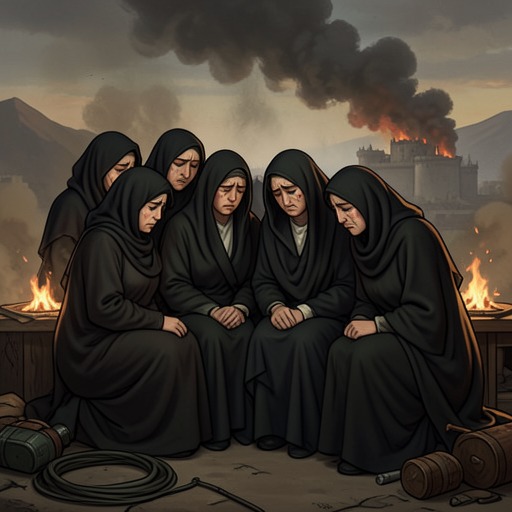
Hecuba appears within the Trojan royal family, alongside Priam and the royal women. The narrator recalls seeing Priam standing amid the disaster and seeing Hecuba with her “helpless train / Of dames,” establishing her as both a particular individual and the representative of a whole endangered household. Her identity is therefore inseparable from the fate of Troy’s ruling house: the queen’s vulnerability mirrors the collapse of the authority that once protected the city.
The scene places Hecuba among the familiar objects of sacred domestic life. She and the women clutch their images and flee toward their altars, while the household gods remain associated with the old sacred ground and the sheltering tree. Their movement from refuge to refuge is crucial: the symbols that should preserve household continuity cannot protect them from the invading violence. Hecuba’s royal status offers no security once the city’s walls and institutions have ceased to function.
Witness to the Fall of Troy
The narrator’s recollection is explicitly visual. He says that he saw Priam between the two brother kings, saw the unhappy queen, saw the hundred wives, and saw where the aged king stood. Hecuba is thus part of a tableau of dynastic grief, viewed by a survivor who converts the scattered horrors of the night into remembered testimony. Her suffering is not reported as distant rumor; it belongs to what the witness personally beheld.
The surrounding destruction is figured as an irresistible flood that breaks dams, carries away cattle and cottages, and overwhelms all before it. Against that image, Hecuba’s flight with the women becomes a human equivalent of being swept away. They are driven “like a flock of doves along the sky,” a simile that combines fragility, panic, and displacement. Their helplessness is emphasized precisely because they are not combatants: the war’s force reaches its most pitiless form when it drives unarmed women from the places meant to shelter them.
Flight, Refuge, and Sacred Powerlessness
Hecuba and her companions seek shelter, but the attempt is futile. They flee toward their altars while embracing the images of their gods, and the narrative places this ritual gesture beside the failure of protection. The women do not abandon their sacred obligations; rather, they perform them under conditions in which sacred space has become exposed to military force. Hecuba consequently embodies the tension between ritual continuity and historical catastrophe.
Her movement also contrasts with the actions of the Trojan warriors. Ripheus and Iph’itas are remembered as men engaged in combat, one renowned for valor and the other for age, while Hecuba is shown among those forced to run from the destruction. The juxtaposition does not erase the military dimension of the fall, but it broadens its moral scale. Troy is not only defended by individual fighters; it is also a city of families, shrines, wives, and ancestral images, all of which become victims when defense fails.
Confrontation with Priam
When Hecuba sees her trembling husband with a heavy sword hanging at his side, she addresses the change that has seized him. Her question, “What rage,” has possessed his mind identifies Priam’s armed response as a crisis of judgment as well as an expression of grief. The aged king’s sword is a striking object: it signals a last attempt to recover the role of warrior and defender, but its presence beside his trembling body exposes the mismatch between heroic intention and physical helplessness.
Hecuba’s speech gives her a distinct voice within the destruction. She does not merely follow Priam or disappear into the anonymous group of women; she recognizes the danger in his impulse and speaks to him as a wife who sees both his fear and his desire to act. Her address turns the royal couple into the emotional center of the scene. Priam’s sword represents desperate action, while Hecuba’s appeal represents the household’s awareness that the old forms of kingship and martial honor can no longer restore safety.
Narrative and Thematic Role
Hecuba’s brief appearance concentrates the poem’s larger contrast between individual valor and collective loss. The remembered warriors can be named for courage or age, but the queen’s scene measures what their resistance cannot prevent. Around her, the royal family, the women, the sacred images, and the altars form a network of relations threatened by the same collapse. Her suffering makes the cost of war legible beyond the battlefield.
She also belongs to the poem’s larger movement from Trojan history toward later foundations. The narrative preserves the old heroic race of Troy and recalls ancestral figures such as Teucer, Assaracus, and Ilus, while elsewhere describing the traditions and sacred places through which later peoples understand their origins. Against that genealogical continuity, Hecuba’s flight marks the human fracture from which such future histories emerge. Her image remains one of dispossession: the dynasty survives in memory and lineage, but the queen herself is shown at the moment when royal protection, sacred refuge, and the city’s physical world have all failed.