Neptune
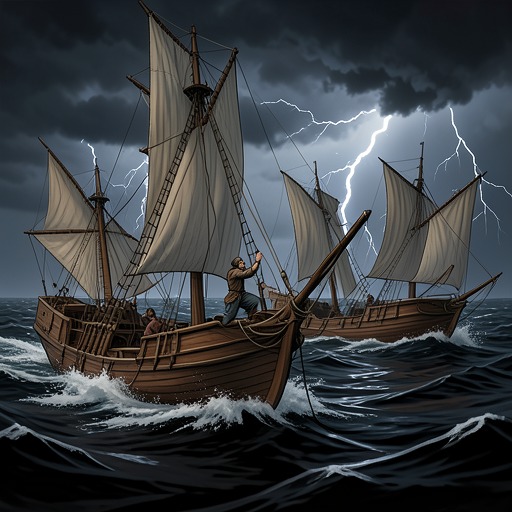
AeneidNeptune is the Ruler of the Main and the divine power who secures the sea-road of Aeneas’s mission. His decisive significance lies in the protection he extends to the Trojan fleet: when Venus fears that hostile divine forces may obstruct her son’s progress, Neptune answers that his kingdom claims Aeneas’s birth and promises that the fleet will safely reach the Latian shore. His intervention makes the voyage not merely an act of human endurance but a passage sanctioned and defended by a higher maritime authority.
Identity and Divine Authority
Neptune’s identity is defined through sovereignty over the sea. He speaks from the position of a mighty ruler whose realm is directly involved in Aeneas’s destiny, presenting the ocean as a domain under his command rather than as an uncontrolled obstacle. His claim that his kingdom is bound to Aeneas’s birth establishes a divine kinship between the sea-god and the Trojan hero’s journey, while also giving Neptune a personal and political reason to protect the expedition.
His authority is expressed through certainty rather than spectacle. Neptune does not need to demonstrate his power through extended action; his word itself regulates the waters and determines the fleet’s prospects. The sea becomes legible as a realm governed by hierarchy, decree, and obligation. Neptune’s speech therefore reinforces the poem’s broader conception of fate: divine forces may contend, but their interventions remain subject to an ordered structure in which the promised destination must ultimately be reached.
Protection of Aeneas’s Voyage
Neptune’s central action is his pledge that Aeneas’s fleet will safely gain the Latian shore. The promise directly answers Venus’s anxiety about whether the decrees of Jove and Fate can withstand opposition. Neptune assures her that the fleet’s passage will be secure and that the Trojans’ lives are granted, although the surrounding evidence also indicates that one destined head alone is excepted from complete safety. Protection is therefore generous but not unlimited: Neptune can preserve the expedition as a collective enterprise without abolishing every individual cost demanded by destiny.
This distinction gives his guardianship its tragic precision. The fleet is not promised an effortless voyage, nor is every member placed beyond danger. Instead, Neptune protects the larger movement of the Trojan people toward Latium while allowing the terms of fate to remain intact. His power operates as a means of preserving the mission, not as a cancellation of mortality or suffering.
Relations with the Divine Order
Neptune’s exchange with Venus places him within a network of divine conflict and cooperation. Venus approaches him because the future of Aeneas and the Trojans is threatened by forces associated with Jove and Fate, yet Neptune does not challenge the existence of that higher order. He answers by affirming what his own realm can guarantee: safe passage across the sea. The scene thus contrasts maritime jurisdiction with the broader decrees of heaven, showing how one god’s authority can mediate danger without overturning the destiny established for the Trojan enterprise.
His response also confirms that divine protection may arise from remembered obligations. Neptune recalls that his power had already secured Aeneas when he once sought, with joy, the destruction of ungrateful Troy. The reference connects the present voyage with the earlier fall of the city. Neptune’s relation to Aeneas is consequently marked by continuity: the god who participated in Troy’s destruction becomes the protector of the survivors who must leave it and found a future elsewhere.
Further Appearances and Narrative Function
Neptune’s influence extends beyond the explicit promise of safe passage. When the Trojan fleet reaches the waterways leading toward Latium, the river-god Tiber addresses Aeneas and submits his streams to the hero’s free passage. This later submission echoes Neptune’s earlier guarantee. The sea and the river, two successive elements in the journey, are represented as yielding to the destined traveler, so that Aeneas’s route is framed by aquatic powers that recognize and facilitate his progress.
Neptune’s role also illuminates the poem’s treatment of divine workmanship and inherited arms. The falchion borne by Aeneas is fashioned in Vulcan’s Aetnaean forge for the hero’s father, Anchises, and endowed with immortal keenness. Although Neptune is not the smith of this weapon, his maritime protection belongs to the same system of divine assistance through which Aeneas’s lineage, voyage, and warfare are supported by the gods. The hero advances through a world in which natural forces, sacred craftsmanship, and political destiny converge around his mission.
Characterization and Thematic Significance
Neptune is characterized less as a volatile rival than as a stabilizing sovereign. His intervention answers fear with assurance, danger with jurisdiction, and uncertainty with a bounded promise. The contrast is especially important in a poem repeatedly shaped by storms, hostile gods, warfare, and competing claims to the future. Neptune represents the possibility that divine power can preserve order rather than intensify conflict.
His protection also establishes a pattern of conditional mercy visible in later political and military scenes. Trojan and Latin leaders seek truce, clemency, and peace through formal appeals; Aeneas grants a request from Laurentum when its justice cannot be denied, and peace is later bound by solemn vows and the rites required by sacred custom. Neptune’s earlier guarantee belongs to this same moral architecture. Passage, survival, and peace are not casual favors but acts of authority that create obligations and define the limits within which violence may continue.
At the poem’s end, when Aeneas hesitates before striking the defeated Turnus, the hero’s pause reveals the enduring tension between compassion and the demands of destiny. Neptune is not present in that final hesitation, but his earlier promise helps explain the poem’s larger structure: the gods may secure the future of the Trojan mission while leaving particular lives exposed to judgment, grief, and death. Neptune’s greatness therefore lies not in abolishing tragedy, but in ensuring that the fleet reaches the shore toward which fate has directed it.