Vulcan
AeneidVulcan is the divine smith whose forge converts celestial purpose into material power. In the poem’s most important scene involving him, he rises before dawn, summons his workers, and makes the arms destined for Aeneas. His significance lies less in personal adventure than in the way his craft mediates between the gods’ designs and the mortal struggle through which Trojan destiny will be fulfilled.
Identity and Divine Craft
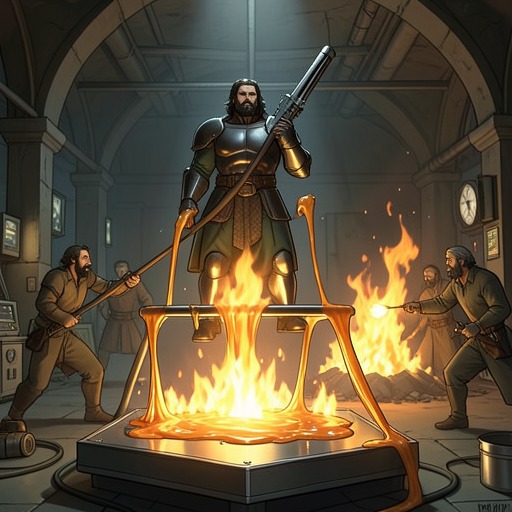
Vulcan appears as the power of fire, metalwork, and disciplined manufacture. He is not presented as a warrior entering the battlefield himself; instead, his authority is expressed through the forge, where molten silver, brass, gold, and deadly steel become instruments of history. The setting associated with his work is a sacred island between the coasts of Sicily and Lipare, a place where divine labor is separated from ordinary human production.
His craft also belongs to a larger mythic tradition of extraordinary human and divine ingenuity. In the temple reached through Trivia’s grove, the story of Daedalus recalls the first flight from the Cretan shore, while another sacred site preserves the ancient heroic race of Teucer. These references place Vulcan’s workmanship within a continuum of inherited skill, invention, and heroic memory: flight, ancestry, music, ritual, and arms all become forms through which civilization gives shape to dangerous forces.
Awakening and Commission
Vulcan rises from his couch at the appointed hour, while the surrounding narrative has just emphasized marital fidelity and divine concern. His prompt awakening gives his labor a ceremonial force. The work is not casual manufacture but a response to a demand that reaches him through divine power. Venus brings the fated arms through the clouds and finds her son Aeneas in a winding vale, establishing the maternal and supernatural chain by which the weapons reach their intended bearer.
When Vulcan addresses his sons, he orders them to set aside their current tasks because their strength and mastery must now be tested. The commission is specifically for a hero and calls for arms capable of sustaining the war. The scene therefore presents the forge as an organized workshop: command, labor, expertise, and raw material converge under Vulcan’s direction. Divine technology becomes the answer to the uncertainty of battle.
The Shield and Its Imagined History
The most distinctive product of Vulcan’s forge is a shield whose construction alone is sufficient to sustain the war. Its structure contains seven nested orbs within a spacious round, suggesting an object built on a cosmic scale rather than merely a defensive piece of equipment. The shield’s value is physical, but its design also prepares it to carry a much larger burden of meaning.
By making the shield, Vulcan gives Aeneas more than protection. The forged object becomes a surface on which the future can be organized and made visible. The weapon belongs to the present emergency of war, yet its artistic and symbolic construction directs attention toward the historical destiny that the Trojan hero is carrying. Vulcan’s forge thus turns metal into memory before the events represented on it have fully arrived.
Relations, Purpose, and Narrative Role
Vulcan’s action is inseparable from Venus’s concern for Aeneas. She brings the arms, while Vulcan and his workers provide their material realization; together, the two divine interventions protect and equip the son whose mission leads toward the Roman future. The relationship is therefore functional as well as familial: Venus supplies divine advocacy, and Vulcan supplies the means by which that advocacy can operate in the mortal world.
The contrast between Vulcan’s hidden labor and Aeneas’s public warfare is central to his role. On the battlefield, human fighters such as Ripheus and Iphitas display valor, age, and immediate physical courage; in the forge, Vulcan works through heat, metal, coordinated hands, and perfected design. The poem places these forms of power beside one another without treating them as identical. Mortal bravery confronts danger directly, whereas Vulcan’s workmanship prepares the conditions under which heroic action can succeed.
His work also participates in the poem’s movement from Trojan ruin toward political foundation. References to Teucer’s heroic descendants, sacred groves, ancient peoples, and the future-bearing shield connect individual combat with the longer history of peoples and institutions. Vulcan therefore functions as a maker of continuity: he transforms divine intention into an object that accompanies Aeneas from the immediate crisis of Latium toward the historical order promised by fate.
Thematic Significance
Vulcan embodies the poem’s belief that destiny requires construction. Fate may determine the direction of events, but that direction must be given form through labor, technical knowledge, and objects capable of entering the human world. The forge mediates between the immaterial promise of heaven and the material demands of war; the shield is the clearest result of that mediation.
The scene also joins sacred time to political time. Vulcan rises at the proper moment, performs work demanded by the divine order, and produces arms that belong to a struggle whose consequences extend beyond the immediate generation. His activity makes the future tangible before it is politically realized. In that sense, Vulcan is both craftsman and historical mediator: through his disciplined fire, the gods’ promise acquires weight, shape, and the power to endure in the hands of Aeneas.