Palinurus
AeneidPalinurus is the pilot of the Trojan fleet and a figure of disciplined vigilance amid the uncertainty of exile. He is associated with the fleet’s passage through darkness, with the practical burden of steering, and with the fatal irony that even a man who can read the heavens cannot escape the gods’ designs. His story joins technical competence, sleepless duty, violent separation from the living, and an afterlife encounter that questions the justice of his death.
Identity and Introduction
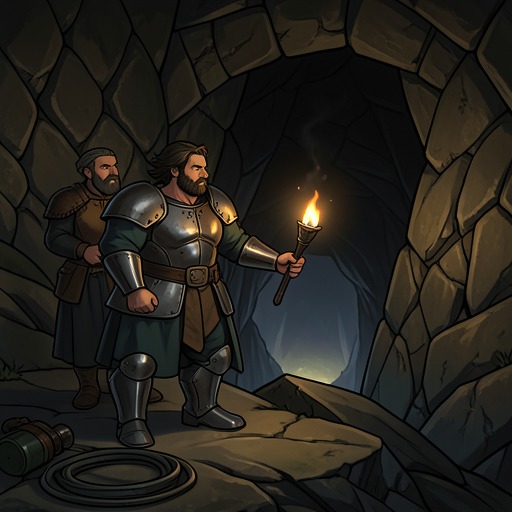
Palinurus first appears as the indispensable navigator of the wandering fleet. During a period when the ships are cast from their course, the darkness is so complete that there are no stars to guide them and no land by which to determine their position. Even Palinurus can find no distinction between night and day. The fleet consequently spends three starless nights in doubtful wandering, and the pilot’s inability to orient himself measures the extremity of the danger rather than any personal deficiency. His expertise is placed against a world in which the usual signs of safe navigation have disappeared.
This presentation makes Palinurus a representative of practical order within the larger condition of Trojan exile. The fleet depends on a human office—keeping the course, reading the sky, and holding the ship steady—but the surrounding darkness reduces that office to a fragile defense. The contrast establishes his defining quality: he is alert and capable, yet his capability operates inside circumstances that exceed human control.
Vigilance and Divine Assault
Palinurus’s decisive scene begins when the god of Sleep descends toward him as his destined prey. Sleep does not come as a natural rest after labor; it is carried to him by a divine power with a fatal purpose. The god bears dire dreams and iron sleep, making bodily exhaustion part of an assault directed specifically at the pilot. Palinurus therefore becomes vulnerable not because the narrative has shown him abandoning his post, but because his very vigilance must be overcome from outside.
He resists the invasion. His hands remain fastened to the rudder, while his eyes are fixed upon heaven in an effort to repel the approaching sleep. The image concentrates his character into a single gesture: the pilot continues to perform his duty even as consciousness is being taken from him. Steering is not merely his occupation but the visible form of his responsibility to everyone aboard. His resistance also sharpens the injustice of what follows, since the scene gives him no ordinary lapse that would explain the disaster as negligence.
The god then uses a branch dipped in Lethe and soaked with Stygian dew. This detail binds the attack to the powers of death and forgetfulness. Palinurus is not persuaded, relieved, or defeated by an equal contest of nautical skill; he is subdued by an instrument charged with infernal potency. Once the divine power prevails, the pilot’s resistance collapses, and the fate of the ship is separated from the vigilance on which it had depended.
Death at Sea and Entry Among the Dead
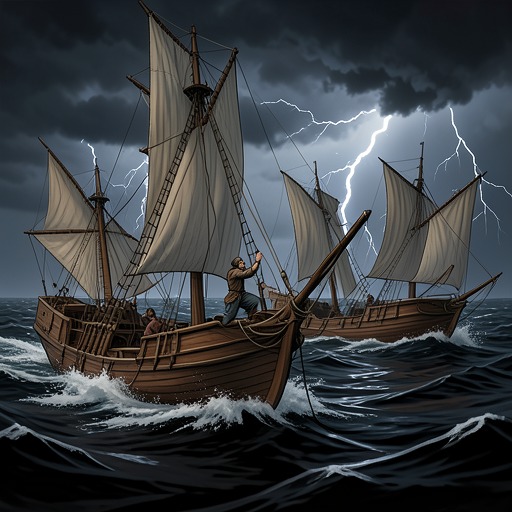
Palinurus’s death occurs in the Tyrrhenian seas. The circumstances are maritime and violent: tempests meet the fleet, the sailors master the immediate danger only for the ship to be overturned, and Palinurus is carried into the sea. His death is thus connected to both natural force and supernatural design. The storm supplies the physical catastrophe, but the prior attack by the god of Sleep explains why the fleet’s chief defense has been removed at the crucial moment.
When he is later encountered among the spirits, Palinurus is described as pressing among them as a newly admitted guest, still fresh from life. The phrase preserves the immediacy of the transition. He has not been transformed into a remote mythic abstraction; the dead retain the mark of a recent and unfinished passage from the world of the living. His presence also recalls the activity that defined him: he had been seen steering while watching the stars and carrying out his duty before the sea claimed him.
This placement among the dead creates a stark reversal. The pilot who could not distinguish night from day, and who nevertheless kept the rudder in his hands, now belongs to a realm where earthly navigation has ended. His expertise once promised direction through darkness; after death, he becomes part of the darkness that the living must enter and interpret.
The Question of Prophecy and Justice
Palinurus’s encounter with the living raises the problem of a prophecy that has apparently failed. A god had foretold that he would not die before reaching the Italian shore, safely delivered from the seas. Palinurus asks whether this was the unerring power of prophecy. His question is not a casual complaint. It measures the distance between divine assurance and mortal experience: he has died at sea, before reaching the promised safety, despite having been told that such a death would not occur.
The ghost receives an answer that preserves the truth of the prophecy while refusing to make the death seem simple. The prophecy did not flatter him, and its answers did not lie; nor had envious gods sent him to the deep. The explanation therefore shifts the issue from false prediction to a more intricate divine order. Palinurus’s death is presented as neither a straightforward error nor the confirmed work of jealous gods. The unresolved tension leaves him caught between what was promised and what happened.
That tension deepens his tragic significance. His suffering does not visibly arise from cowardice, betrayal, or deliberate abandonment of duty. He holds the rudder and resists sleep until a god defeats him. The resulting catastrophe resembles a tragic reversal imposed upon a conscientious servant: the qualities that make him reliable cannot protect him when divine power intervenes. His later question gives the reversal a voice, allowing the poem to register the cost of a destiny that may be coherent from the gods’ perspective but remains devastating from the human one.
Narrative Role and Significance
Palinurus embodies the limits of human control within the Trojans’ larger voyage. The fleet’s wandering through three starless nights shows the collapse of ordinary orientation; the branch from Lethe shows divine power entering the body of the watchman; the overturned ship shows how quickly communal safety can depend upon one person’s continued alertness. Across these episodes, navigation becomes a moral and existential image. Palinurus tries to hold a course through darkness, but the course is ultimately governed by forces he cannot see or resist.
His death also complicates the heroic ideal of successful departure and arrival. The voyage is directed toward Italy, yet not every faithful participant reaches that destination. Palinurus pays for the passage with his life, and his newly admitted spirit stands as evidence that the founding journey contains sacrifice as well as promise. His later challenge to the terms of prophecy prevents the journey’s destiny from appearing painless or mechanically just.
As a character, Palinurus is therefore defined less by speech or personal history than by function under pressure: he is the pilot, the watcher of stars, the keeper of the rudder, and the man whose vigilance is broken by Sleep. The poem grants that function a memorable tragic shape. He is defeated not by ignorance of the sea but by the convergence of darkness, storm, divine compulsion, and a fate whose meaning becomes visible only after the loss has occurred.