Hector
AeneidHector is presented not as a living participant in the later action but as the dead defender whose ghost transforms Aeneas’s sleep into a scene of revelation. His apparition joins the memory of Troy’s greatest champion to the immediate catastrophe of the city, making him the figure through whom the fallen past speaks to the surviving Trojans.
Identity and First Appearance
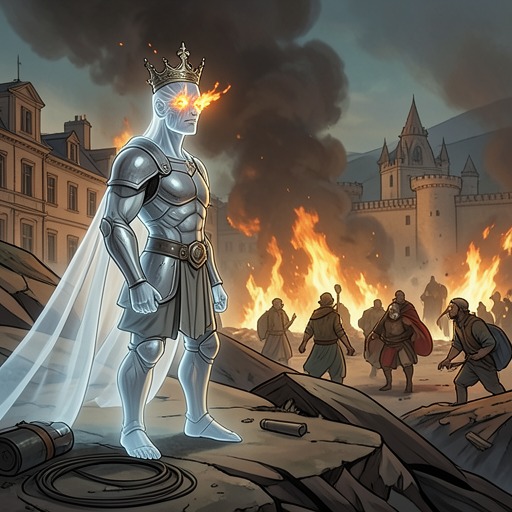
Hector appears during the dead of night, when sleep restores bodies worn by toil and minds burdened by care. Aeneas sees him before him as a bloody, tearful apparition, resembling Hector after he was slain by Achilles. The ghost’s condition is therefore inseparable from the violence that ended Troy’s resistance: he is not recalled as an untouched heroic statue, but as a visible remnant of war, marked by blood, grief, and death.
The apparition carries both personal and national authority. Aeneas addresses Hector as the light of the Trojans, the support of Troy, the champion of his father, and the joy of his country. These titles place Hector at the intersection of military leadership, dynastic loyalty, and collective identity. He is valued not merely for strength in battle, but as the sustaining presence around which the Trojan community imagined its courage and continuity.
Hector as the Voice of the Ruined City
Hector’s appearance gives shape to the truth that the city’s defenders and inhabitants can no longer safely possess. The night vision occurs before the devastation is fully understood, while Aeneas remains within a sleep-like state; yet Hector’s presence makes the coming revelation authoritative. The ghost does not offer an abstract omen. His wounded body makes the cost of Troy’s destruction immediately legible, while his status makes the disaster more than a private nightmare.
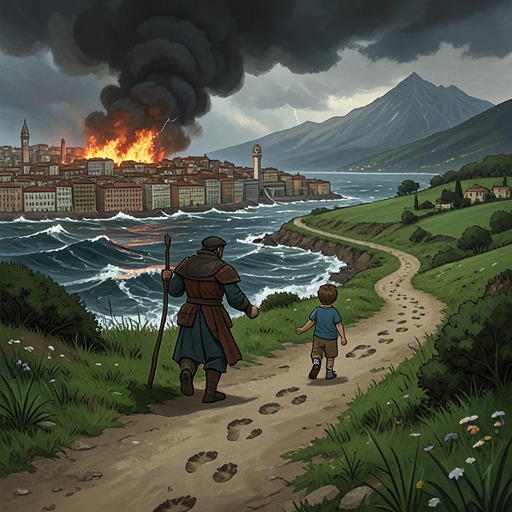
The vision also turns memory into recognition. From the surrounding scene, the ravage of the war is seen from afar, and the treachery of the Greeks is brought into open light. Hector’s appearance is thus connected with the exposure of the Greek fraud that has enabled the city’s fall. His ghost stands at the threshold between uncertainty and knowledge: what had been hidden or misunderstood becomes clear through the ruin surrounding him.
Military Service and Heroic Contrast
Hector’s heroic identity is reinforced by the recollection of a warrior who served him faithfully and remained close to him. This companion served Hector not only with a trumpet, to kindle alarms and rouse men to honorable combat, but also with a spear. The pairing of trumpet and spear defines Hector’s sphere as one of both command and direct warfare. He is the leader whose presence organizes resistance and the warrior beside whom loyal fighters enter danger.
That martial world is already irretrievably past when Hector appears to Aeneas. The warrior who once sounded alarms and fought near Hector survives only in memory, while Hector himself is encountered as a ghost bearing the marks of Achilles’ attack. The contrast between the former vigor of Troy’s defense and the spectral aftermath of Hector’s death gives the scene its tragic force: the instruments of battle remain meaningful, but the order they once served has collapsed.
Narrative Role and Significance
Hector functions as a herald of transition. His presence belongs to the night, the hour of inward vulnerability, but his message opens onto the historical movement from Troy’s destruction to the Trojan survivors’ future. In this role he is both a mournful witness and a guide: he confirms that the old city cannot be restored and makes the necessity of departure part of the survivors’ understanding.
His importance lies in the tension between glory and helplessness. Hector is praised as Troy’s light and support, yet he appears bloodied, grieving, and dead. The strongest emblem of Trojan defense cannot save Troy after the decisive defeat; instead, he can only transmit the truth of the catastrophe to Aeneas. His heroic power has changed from battlefield protection into remembered authority.
The character therefore concentrates the poem’s treatment of heroic loss. Hector’s death is not only the end of an individual warrior but a sign that an entire civic world has passed away. By appearing to Aeneas in a vision, he preserves that world as moral memory while directing attention beyond it. Troy’s defenders are gone, but Hector’s identity as champion, national joy, and faithful commander survives in the consciousness of those who must carry the Trojan future elsewhere.