Colonel Menzies
MunichColonel Menzies is a British intelligence officer who evaluates a leaked German war directive and helps arrange Hugh Legat’s covert meeting with Paul von Hartmann during Neville Chamberlain’s visit to Munich. His role links documentary evidence of German plans to a risky intelligence operation aimed at discovering what further evidence Hartmann possesses.
Identity and Introduction
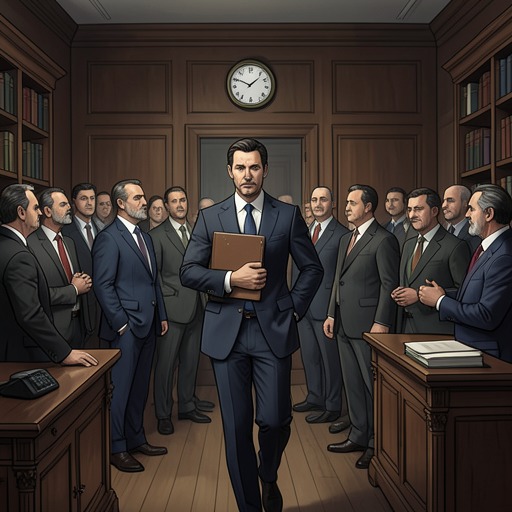
Menzies first appears in Sir Alexander Cadogan’s office, where Cadogan introduces him to Legat as the colonel asked to examine the document delivered to Legat’s home. He is about fifty, elegant and saturnine, with a thick moustache and deep-set, staring dark eyes. Legat notices the incongruity of a colonel in a Savile Row suit in Whitehall and infers that Menzies belongs to the Secret Intelligence Service.
Menzies speaks in a friendly Etonian drawl, but the manner does not reassure Legat; it puts him on his guard. His polished presentation accompanies a professional assessment rather than a personal confidence: he explains what the intelligence service can establish, what remains uncertain, and why the document matters.
Assessment of the Leaked Directive
The document Menzies examines is Adolf Hitler’s directive for a two-front war, with the main effort in the southeast and a strategic concentration designated “Green.” Menzies tells Legat that it is genuine as far as the service can tell. Its contents accord with information received from several German opposition figures since the beginning of the summer, but this is the first time those sources have supplied written evidence.
His account distinguishes the existence of opposition contacts from their reliability and cohesion. The group is disparate: diplomats, landowners and an industrialist, some apparently unaware of one another. Menzies says they expect Britain to fight to restore the Kaiser or his family, an expectation he regards as politically naïve. They claim support within the German Army, but he says the service is not convinced beyond a few disaffected Prussians at the top. Against that doubtful background, he singles out Hartmann as potentially more interesting, without yet treating the claim as proven.
The Munich Operation
Menzies reports that one opposition member he takes seriously has contacted the British through a secret channel. The contact asks that Legat travel to Munich as part of the Prime Minister’s party and offers, in return, to try to secure Hartmann’s inclusion in the German delegation. Hartmann is said to possess a second document, more important than the directive delivered to Legat, and to want to hand it personally to Chamberlain. Menzies says that cannot be allowed; Hartmann will instead give the document to Legat, whose meeting with him should let the service discover what it contains.
Menzies presents the proposal as a calculated risk, warning that Legat’s meeting would technically constitute espionage on foreign soil. Cadogan likewise warns Legat about the danger. Menzies’s plan therefore depends on both a secret opposition channel and Legat’s access to the Prime Minister’s party, while its central evidence—the promised second document—has not yet been inspected.
Role in the Mission
The operation proceeds when Osmund Somers Cleverly tells Legat that he has acceded, with considerable reservations, to Menzies’s request for Legat to accompany Chamberlain. Legat is put in charge of the Prime Minister’s dispatch boxes and instructed to contact the office on reaching Munich. Cleverly also stresses that Legat must do nothing to imperil the conference, setting the diplomatic stakes against Menzies’s intelligence objective.
Menzies is thus the figure who converts a document’s authentication into a further attempt to acquire evidence. The scene in which Legat later locks his Munich room, takes out the envelope and opens its pages establishes that the promised document has reached him; the supplied account does not show Menzies examining it or establish its contents. His significance lies in directing the inquiry toward that still-unread evidence, while the risks of espionage and disruption remain unresolved.