Hugh Legat
MunichHugh Legat is a British diplomatic civil servant who becomes the link between a secret German warning and Neville Chamberlain’s negotiations during the 1938 Sudeten crisis. At first he is a reader and recorder of events: a man studying Adolf Hitler’s latest speech over lunch in London. Once a confidential military document falls into his hands, however, routine office work gives way to an attempt to change the course of the Munich conference. Legat’s significance lies in the distance between what he learns and what political leaders are prepared to do with it.
Identity and Introduction
Shortly before one o’clock on Tuesday, 27 September 1938, Legat is shown to a window-side table at the Ritz Restaurant in London. He orders a half-bottle of 1921 Dom Perignon that he cannot afford, opens The Times at page seventeen, and reads for the third time the speech Hitler delivered the previous night at the Berlin Sportpalast. The scene establishes both his position and his habits: he belongs to the diplomatic service, follows the crisis closely, and is already trying to understand a speech whose implications have not yet settled into policy.
His reading is interrupted by a summons from Cecil Syers, a colleague in the Private Office. Legat leaves the restaurant for the privacy of a small office and takes the call, identifying himself simply by surname. Syers says that events are about to become hectic and that Osmund Somers Cleverly is asking for him. Legat’s quick passage from the newspaper to the telephone makes his function in the story concrete: he is not a distant observer of diplomacy, but a working official summoned into its machinery.
The Crisis Enters His Work
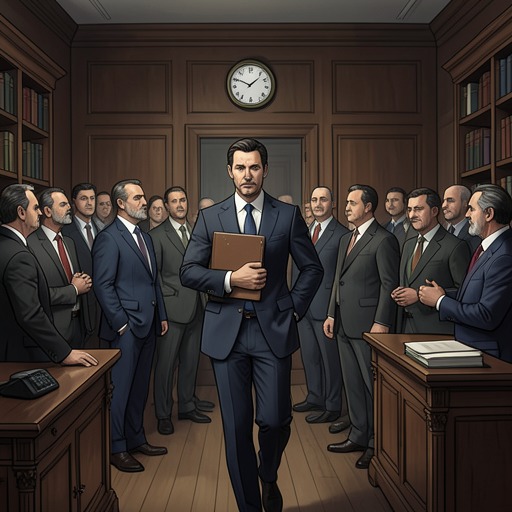
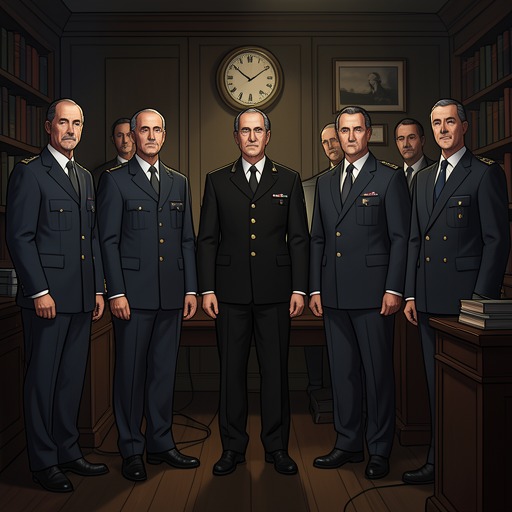
At a meeting with the Prime Minister and the Chiefs of Staff, Legat takes notes as Chamberlain describes the collapse of the earlier plan for an orderly transfer of the Sudeten territory to Germany, subject to a plebiscite. Hitler will not wait even a week and has announced that he will invade on Saturday. Chamberlain also reports Hitler’s response to a warning delivered by Sir Horace Wilson: Hitler has declared himself prepared for every eventuality and predicted that Britain and France will be at war by the following Monday. Legat’s pen runs rapidly over the paper, reducing the threat to a record that can be handled by the government even as the deadline bears down on it.
The discussion of military readiness makes Legat’s position more than clerical. Asked about preparations that would be operational by 1 October, the answer is that they would have to begin that day. Chamberlain notes that this would mean Britain mobilising before Germany; the proposal is for partial mobilisation, intended to show Hitler that Britain is not bluffing and might make him reconsider. Chamberlain counters that such a signal could instead push Hitler into war, particularly if he feels he is losing face. Legat records the competing logic of deterrence and escalation without being the person who can decide between them.
A further change in the crisis comes by telephone from Berlin. At seven minutes past two, Legat hears Sir Nevile Henderson report that Benito Mussolini has sent Hitler a message: Italy will stand by Germany if conflict comes, but asks for mobilisation to be postponed for twenty-four hours while the situation is reviewed. Hitler has agreed. The pause does not resolve the danger; it gives the diplomats more time while leaving the threat of invasion in view. Legat is present at the point where that narrow reprieve enters the British government’s calculations.
The Document and the Munich Mission
Away from the conference table, a confidential German document comes into Legat’s possession. After a car stops outside his home, a figure leaves an envelope on the doormat and drives away. Its official-looking stationery bears his name misspelt as Leggatt. He opens it cautiously, peering first at the typed heading: Berlin, 30 May 1938, followed by a secret German military reference. Rather than treating the envelope as ordinary correspondence, he takes the five typewritten pages to Sir Alexander Cadogan and says that they should be seen at once. Cadogan has the document examined by Colonel Menzies, and Legat is drawn further into the effort to determine what it means.
When Cadogan asks whether he would be willing to go to Munich and meet his old friend there, Legat is taken aback. He is nevertheless permitted to accompany Chamberlain, with considerable reservations from Cleverly. As the Prime Minister’s party leaves, Legat is entrusted with the red dispatch boxes and their official papers, given the keys, and told to contact the office on arrival. Cleverly makes the limits of the assignment explicit: Legat must do nothing that might imperil the conference. His official duty is therefore both practical and restrictive. He is to safeguard the papers and support the mission, not disrupt it.
In Munich, that restriction is tested by his private meeting with his old friend Paul von Hartmann. Legat follows Hartmann through the government district and into the Park-Café, where Hartmann sits facing a mirror so that he can watch the room behind him. The crowded bar, cigarette smoke, and brown Party uniforms make the meeting visibly unsafe. Hartmann asks whether Legat was followed; Legat admits that he does not know and is unused to this kind of encounter. Their familiar friendship persists inside a new political danger, while Legat’s inexperience with clandestine procedure is sharply exposed.
Warning Chamberlain
Legat comes to understand the document as evidence that Hitler’s plans extend beyond the immediate crisis. The record describes earlier objections by senior military commanders and the Foreign Minister to the practicability of Hitler’s strategy: France was too strong, Czechoslovakia’s border defences too formidable, and Germany’s motorised divisions too weak. Legat realises that the officers who voiced those reservations have since been removed and replaced. The change in personnel gives the document a further significance: resistance within the German leadership has been displaced, while Hitler’s capacity to pursue his policy has increased.
Legat concludes that Chamberlain must see the evidence before signing an agreement. Hartmann makes the warning directly to the Prime Minister, arguing that Hitler’s claim to have no further territorial demands is false and that the incorporation of Austria and Czechoslovakia is only the first step towards a war of conquest for living space. He also says that the dissenting Army commanders and Foreign Minister have been replaced, and urges Britain and France not to sign: if they stand firm, he believes the Army will act against Hitler to avert a disastrous war. The risk of this appeal is made explicit in its form and timing. Hartmann brings the document in good faith and at grave personal risk, asking Chamberlain to act at the eleventh hour.
Chamberlain acknowledges Hartmann’s courage and sincerity but rejects the argument as politically impossible. He says that the British and French peoples cannot reasonably be expected to fight to deny ethnic Germans the right of self-determination, and that his immediate objective is to avert war and seek lasting peace. He folds the memorandum and advises Hartmann to return it to wherever it came from. Legat’s effort has brought the warning before the Prime Minister, but exposure does not produce the decision he and Hartmann seek. The conference’s political logic prevails over the document’s forecast.
After Munich and Narrative Significance
The document is not left with Chamberlain. At the airport, Joan reveals that Colonel Menzies is her uncle and that she had been sent to Munich, partly for her typing skills, to watch over Legat. She says she took the memorandum from his room for safekeeping after he went off with Hartmann, and produces it from beneath the neatly folded underwear in her suitcase. The recovery explains why the evidence remains out of the Prime Minister’s hands after the confrontation, while also showing that Legat’s mission has been watched and protected by others around him.
Hartmann, meanwhile, returns to Berlin without being arrested, despite expecting detention at each stage of the journey home. Legat’s story closes on a different but related uncertainty. After hearing Chamberlain’s broadcast to the crowd in Downing Street, Legat tells Pamela that during the flight back he thought he might join the Royal Air Force. The possibility is left as a thought rather than a completed decision. It marks how far his position has shifted: the civil servant who began by reading and recording the crisis has handled a secret warning, risked the limits of his official assignment, and glimpsed a future in which service may mean something other than diplomacy. His role makes the failure of information to compel action personal without turning him into the author of decisions he cannot control.