Sir Alexander Cadogan
MunichSir Alexander Cadogan is the Permanent Under-Secretary at the Foreign Office, a senior official whose authority in the novel rests on scrutinising information and deciding how it should move through government. When Hugh Legat brings him a covertly delivered German directive, Cadogan tests its authenticity, weighs what it can establish, and connects it to reports of opposition to Adolf Hitler. His scenes make bureaucratic judgment part of the crisis itself: documents matter, but so do their uncertain origins and the people entrusted to interpret them.
Position and presence
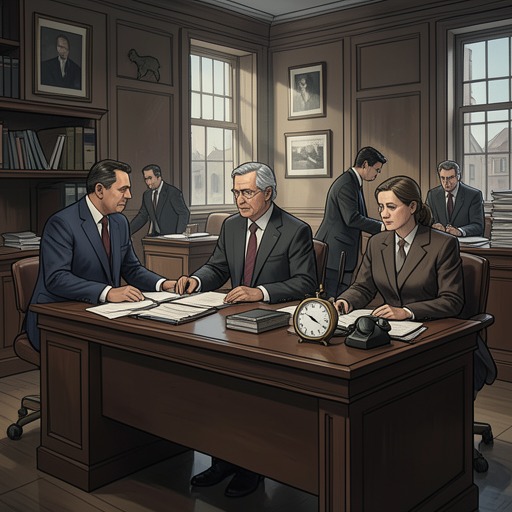
Cadogan works in a high-ceilinged room whose scale makes him seem small. Rather than sitting at his desk, he is at a conference table almost hidden beneath papers: white minutes and telegrams, pale-blue drafts, mauve dispatches, aquamarine Cabinet papers, and brown foolscap files tied with pink ribbon. He peers over round-lensed tortoiseshell glasses with evident irritation when Legat interrupts him. The crowded table gives physical form to the administrative burden of the crisis, while Cadogan’s brisk reception of urgent business shows how little room there is for ceremony.
His manner is controlled but not detached from pressure. When a telegram arrives from Berlin, he snatches it from Miss Marchant and reads so intently that he seems nearly to fall into the page. He mutters an expletive repeatedly, then tells Legat that the Prime Minister must see Hitler’s latest message at once and asks whether Legat is returning to 10 Downing Street. The telegram’s exact contents are not given in this scene; what is clear is Cadogan’s impatience for it and his immediate attention to its passage onward.
The leaked directive
Legat brings Cadogan five typewritten pages delivered to his home in an official-looking envelope. The document is Hitler’s directive for the invasion of Czechoslovakia, describing a war on two fronts with the main effort in the south-east. As Legat explains where it came from, Cadogan’s first response is practical: he reads through the pages, turns each one over, and squares the stack before asking whether it is genuine. His orderly handling of the paper contrasts with the danger its contents describe.
Cadogan judges the directive credible, while making clear that authenticity remains an assessment rather than something its unexplained delivery can prove by itself. The date, 30 May, and its language strengthen his conclusion: Hitler’s stated decision to destroy Czechoslovakia by military action in the near future resembles what Hitler told Horace Wilson that morning. Cadogan sees the correspondence as significant corroboration, not as a revelation of an entirely unknown intention. He notes that Hitler’s determination to act quickly is already understood; the document’s importance lies in its specificity and its apparent connection to military planning.
Source, opposition, and political judgment
Cadogan turns from the document’s contents to the unanswered questions surrounding it: who supplied it, why they did so, and why it was addressed to Legat. Legat cannot answer, and Cadogan does not pretend that the pages disclose their own chain of custody. He explains that opponents of Hitler have been in contact with the British over the summer, offering to overthrow the Nazi regime if Britain guarantees that it will stand firm over Czechoslovakia. As Cadogan describes them, they are not a coherent body: they include disaffected diplomats and aristocrats who want the monarchy restored. This is the first specific material they have provided, but it still does not identify the source or explain why Legat was selected to receive it.
The exchange reveals Cadogan’s guarded method. He separates what the document appears to establish from what remains conjecture, and he presses Legat about when he was last in Germany and why his name might have been chosen. Legat can offer only the possibility that his wife’s occasional appearance in gossip columns has drawn attention to him. Cadogan repeats the term with distaste, leaving Legat unsure whether he is joking. The moment briefly exposes the mismatch between official investigation and the social publicity that may have shaped the leak’s route.
A gatekeeper under pressure
Cadogan’s role is not to resolve every uncertainty but to ensure that consequential information reaches the people who must act on it. He has Legat take the latest telegram to the Prime Minister, while the leaked directive receives close scrutiny as evidence about Hitler’s intentions. At the same time, the novel shows the limits of what senior officials can know: the opposition group’s motives are only partly described, the document’s source remains hidden, and Cadogan’s confidence in its authenticity rests on its date and wording rather than a disclosed verification process.
Through Cadogan, the Foreign Office appears as a place where urgent decisions depend on disciplined reading, guarded inference, and the movement of papers between offices. He is neither a passive custodian nor an all-knowing expositor: he interrogates the evidence, distinguishes confirmation from novelty, and acts on the information’s urgency without claiming to have solved its provenance. That combination makes him a practical intermediary between secret evidence and government response.