Paul von Hartmann
MunichPaul von Hartmann is a German Foreign Service official whose access to secret documents makes him a crucial link between the anti-Hitler resistance and the British government. In September 1938, he tries to turn evidence of Adolf Hitler’s plans into political action: first by carrying a military directive to Britain, then by urging Neville Chamberlain to reject an agreement that would strengthen Hitler. His intelligence is consequential, but it cannot by itself overcome the divisions among Hitler’s opponents or the fear that keeps them from acting.
Identity and Access to Evidence
In Berlin, Paul works in the German Foreign Ministry, housed in a sprawling nineteenth-century building on Wilhelmstrasse. During the crisis, Erich Kordt gives him a six-page account of the meeting between Sir Horace Wilson and Hitler. The report, prepared by the Foreign Ministry’s chief interpreter, records Wilson’s attempt to warn Hitler that Britain would support France in the event of hostilities. It also describes Hitler’s angry response: he said that he had spent billions preparing for war and would give Britain and France the war they wanted. The official language of the report cannot soften what it reveals, and Paul can vividly imagine the confrontation it describes.
Paul’s access is not merely bureaucratic. He handles documents whose format and provenance become matters of life-and-death political judgment. At home, after a visitor leaves an envelope on his doormat, he examines its official-looking stationery and carefully opens it. Inside is a directive dated 30 May 1938, identified as a top-secret military order. Its title specifies a war on two fronts, with the main effort in the south-east: the strategic concentration called Green. When Colonel Mason-MacFarlane reads it in London, Permanent Under-Secretary Sir Alexander Cadogan turns the pages over one by one, checks the date and language, and asks whether it is genuine. The document’s stated decision to destroy Czechoslovakia by military action soon matches the threat Hitler has made to Wilson, giving the British a basis to treat the warning as more than rumor.
Paul also brings a copy of Hitler’s letter to Chamberlain to a meeting of the German opposition. He says that he took the letter from the Reich Chancellery while carrying it to the British Embassy. The act makes the chain of custody personal and dangerous: Paul is not simply reporting what he has heard, but reproducing and circulating material he has been entrusted to deliver.
The Resistance and Its Limits
Paul’s evidence strengthens the case made by General Ludwig Beck and the other conspirators. Beck distinguishes Hitler’s earlier bloodless foreign-policy successes from his current desire for war, arguing that a conflict with France and Britain in 1938 would be disastrous for Germany. Paul supports that warning with the letter he has copied. Yet the resistance’s confidence is fragile. Its core group consists of just six men: Hans Bernd Gisevius, Count von Schulenburg, Hans von Dohnányi, Colonel Hans Oster, Kordt, and Paul. They meet in Kordt’s office in the Prussian State building and devise a harmless cover story about interdepartmental planning for the Sudeten territories. Paul is privately contemptuous of the disparity between their small numbers and the dictatorship’s reach; he feels naive and humiliated by the thought that six men might bring down a regime governing a country of eighty million.
The approaching Munich conference sharpens his purpose. When the group asks what can still be done, Paul argues that the agreement must be prevented from being signed. Kordt regards this as nearly impossible: Hitler is prepared to accept terms already offered by Britain and France, making the conference seem like a public ritual rather than a genuine negotiation. Paul counters that Hitler has postponed mobilisation, not cancelled it. His proposal is therefore aimed at the remaining political opportunity: if the agreement fails, Hitler’s course may yet be interrupted. The resistance’s hope depends, however, on decisions made outside its control and on a military response that its members cannot guarantee.
A Mission Through Hugh Legat
Paul’s route to Chamberlain runs through Hugh Legat, his old friend and a secretary to the Prime Minister. At their meeting in Munich, Paul asks Legat to arrange an audience. He does not disguise the urgency: he wants direct access to Chamberlain, while Legat has already been told in London that this is the request he will make. Their former friendship gives the appeal a personal charge, but it does not erase the practical obstacle of Legat’s position or the danger of being observed.
Paul’s official duties bring him onto Hitler’s special train. He has been assigned to help Dr Schmidt with translation, but when the train reaches Berlin, Sturmbannführer Sauer questions why he is aboard, since translation will only be needed in Munich. Hitler passes within a few metres of Paul, accompanied by men in SS black, while Paul waits in a compartment that feels like a cell. The assignment offers access to the centre of power, but it also places him under the scrutiny of an adversary who can challenge his presence.
At the Führerbau, amid preparations for a banquet that suggest an agreement is close, Kordt asks Paul whether he has made contact with his friend. Paul confirms that he has. The exchange shows how little time remains: the conspirators are watching the negotiations unfold, while Paul’s attempt to reach Chamberlain is now one of their few remaining channels to influence them.
The Warning and Chamberlain’s Refusal
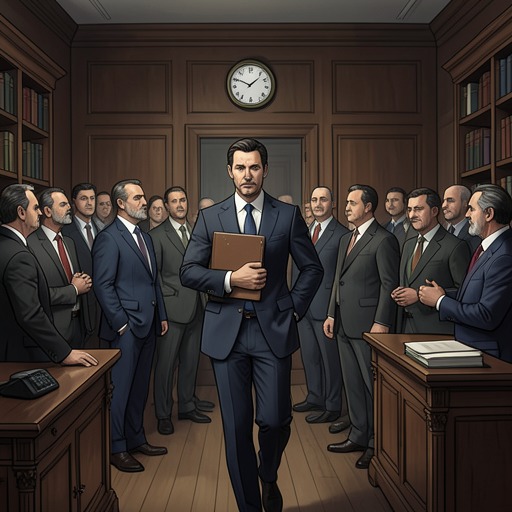
Paul meets Chamberlain and presents his warning as a conclusion drawn from the document in the Prime Minister’s hands. Hitler’s claim that he has no further territorial demands in Europe is false, Paul argues; Hitler intends a war of conquest for German living space, and the annexation of Austria and Czechoslovakia is only the beginning. He further argues that commanders in the Army and the Foreign Minister who had expressed reservations have been replaced. If Britain and France stand firm, Paul believes, the Army will move against Hitler to prevent a disastrous war. He urges Chamberlain not to sign the agreement that night.
Chamberlain recognizes Paul’s courage and sincerity but rejects the political premise of his appeal. He argues that the British and French public cannot be expected to fight to deny ethnic Germans the right of self-determination, and that an agreement offers the chance to avert war in the short term. He also refuses to treat Hitler’s longer-term threats as decisive when they have been made before. The exchange exposes the gap between Paul’s warning about what Hitler intends and Chamberlain’s immediate calculation about what Britain can justify and sustain. Paul can supply evidence and make the case for resistance; he cannot make the warning politically persuasive enough to stop the agreement.
Exposure, Hesitation, and Narrative Role
After the audience, Paul’s danger becomes more immediate. He considers how much circumstantial evidence he has left behind: conversations and meetings that might have been observed, as well as his relationship with Frau Winter, which people in Wilhelmstrasse may have guessed at. Sauer has proved a dogged adversary. Paul wonders how well he would withstand interrogation, a fear sharpened by the knowledge that his movements and associations may already be legible to those watching him.
The final confrontation brings Paul close to acting against Hitler himself. Left alone with Hitler for a second time, he slips a hand inside his jacket and touches metal. He then withdraws it. He knows he is about to be arrested, yet cannot act; in a moment of clarity, he sees that no one—neither himself, the Army, nor a lone assassin—will disrupt the shared destiny of Germany before it has run its course. The moment does not erase his earlier courage or the work he has done. Instead, it gives that work a bleak measure: documents can expose intentions, and warnings can reach the highest levels of government, but neither guarantees action. Paul’s arc turns on that difference between knowing what is coming and being able to stop it.