Sir William Malkin
MunichSir William Malkin, the Foreign Office’s senior legal adviser, brings a lawyer’s attention to wording into the Munich negotiations. Though presented as a reassuring, family-solicitor-like figure, he makes a consequential intervention in the draft agreement: changing a single term and supplying a preamble that reshape how the proposed transfer of the Sudeten territory is described and who appears responsible for it.
Identity and role
Malkin is one of three senior Foreign Office officials sent with the British delegation to Munich. He has already met Adolf Hitler, and his professional role is explicitly identified as the Foreign Office’s senior Legal Adviser. Hugh Legat’s first impression combines appearance and assignment: Malkin looks like a reassuring family solicitor, yet he is being sent into the diplomatic confrontation with the Nazis.
The contrast suits his function in the negotiations. Malkin does not dominate the conference through speeches; his influence emerges in the close reading of a document whose apparently minor choices carry political weight.
Work on the draft agreement
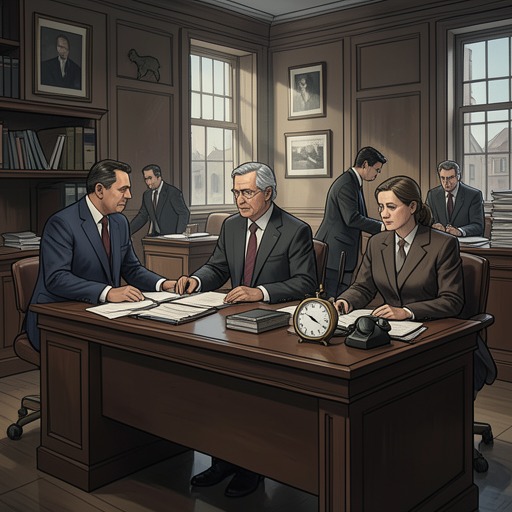
After the British delegation receives an Italian draft agreement, Legat spends an hour translating its German text into English, while Joan types the pages. Malkin sits in an armchair in the corner, reading the draft and puffing on his pipe. His intervention comes at the level of a single verb: he proposes replacing “guarantee” with “agree.” The change appears small, but it alters the tenor of the text by softening the commitment the three powers would make concerning the evacuation.
Malkin also judges the draft’s overall implication, not only its individual clauses. Its structure makes Britain, France, and Italy appear to be conceding something to Germany, as though three powers were making concessions to a fourth. He regards that framing as politically unfortunate and writes a new preamble in his precise copperplate handwriting.
Legal framing and narrative significance
The preamble names Germany, the United Kingdom, France, and Italy together, presenting them as having agreed on the terms governing the cession of the Sudeten German territory and as each responsible for the steps needed to fulfil the agreement. This does not undo the underlying cession; instead, it changes the document’s presentation of the parties and their responsibilities. Malkin’s contribution therefore operates through framing: the agreement is made to read less like a set of concessions offered by three powers to Germany and more like a jointly assumed arrangement.
The Prime Minister accepts both Malkin’s change to the wording and his preamble. The revised text is retyped and completed shortly after four o’clock, before the delegation begins moving downstairs to its cars. Malkin’s role is consequently practical as well as advisory: his legal reading becomes part of the document the British delegation is preparing to take forward.