Leyna
MunichLeyna is the politically committed woman at the centre of a remembered episode that reshapes Hugh Legat and Paul von Hartmann’s friendship. During a 1932 visit to Munich, she urges them to see Adolf Hitler, challenges him publicly outside his apartment, and helps turn a holiday into a dangerous escape from Nazi supporters. Her relationships with both men are altered by what follows: Paul and Leyna part in anger, while Hugh and Leyna become intimate. Much later, Hugh finds her again, but the woman he remembers seems almost unrecognizable.
Identity and Background
Leyna is Paul von Hartmann’s girlfriend during the Oxford friends’ 1932 trip to Bavaria. The holiday had been planned as a visit to proper countryside and an opportunity for Paul to meet her. Hugh’s recollection places her within a private, social world that initially seemed far removed from the political upheaval already taking hold in Germany. Their journey instead coincides with a campaign marked by demonstrations, arguments in cafés, and clashes between opposing political groups.
Leyna identifies herself as a communist. Her interest in Adolf Hitler is not a wish to hear him speak: she considers that incompatible with her politics. She wants to see him in person, and knows that after his rallies he often returns to his Munich apartment, whose address is widely known. The distinction matters to her: she approaches the building to look at a political figure at close range, not to join his audience. Yet her presence there becomes an act of direct confrontation when Hitler appears.
The Munich Confrontation
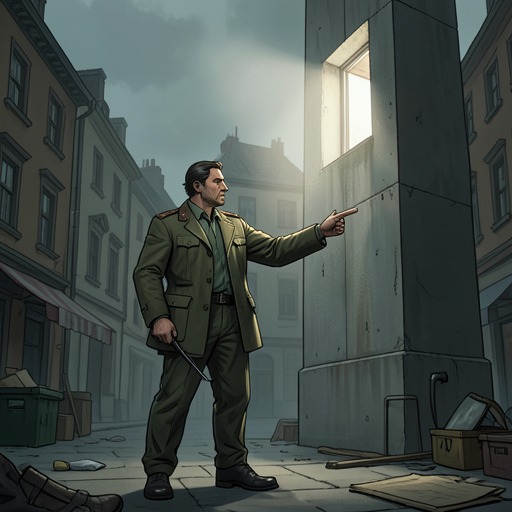
Outside Hitler’s apartment, Leyna points out the second-floor location and balcony. She also refers aloud to Geli Raubal, Hitler’s niece, whose death had become the subject of public speculation. Leyna voices an accusation about the relationship and the circumstances of Geli’s death; a woman nearby rebukes her for speaking that way. The exchange makes plain that the danger is not only in the political symbols on the street but in the willingness of bystanders to police what can be said about Hitler.
When Hitler comes out, Brownshirts form an honour guard between the building and his car. Leyna calls out an insult, then repeats and sharpens her accusation when it appears the people around Hitler have heard her. Hitler gives no visible response, but several SA men break ranks and move towards her. Paul pulls Leyna away; Hugh helps them get past the woman who had confronted her, and a man in the crowd strikes Hugh as they flee. The political challenge thus has immediate personal consequences: the friends are forced to run, and Hugh becomes separated from Paul and Leyna on a side street.
The episode does not leave Leyna merely as the boldest member of the group. Back at the hostel, she is waiting in the courtyard, and she gets up to embrace Hugh when she sees him. She checks his eye and takes him upstairs, where she tends to him. Their closeness leads to a kiss and an intimate encounter. The moment follows her public defiance and the shared danger, but it also exposes a private tension among the three friends: Leyna is Paul’s girlfriend, while Hugh’s response to her changes the meaning of their earlier friendship.
Relationships and Separation
Paul does not return to the hostel that night. Leyna tells Hugh that after the pursuit ended, she and Paul argued and he walked away. Hugh leaves money for his share of the bill and takes the earliest train out of Munich the next morning. The trip becomes, in his later account, the one great adventure that interrupts the carefully arranged course of his life. Its aftermath is not a settled partnership with Leyna or a reconciliation with Paul; it is a hurried departure from a situation in which political danger and personal attachment have become inseparable.
Years later, Hugh asks Paul what happened to Leyna. Paul’s gaze shifts away before he says that they no longer speak. His answer confirms the lasting break without explaining its full history. The briefness of the exchange leaves the separation unresolved, just as Paul’s recollection of their earlier English haunts turns the conversation momentarily towards the life the friends once shared. Leyna remains central to that break even when the men do not discuss its causes further.
Memory, Evidence, and Return
Paul’s attachment to the past is also visible in a small suitcase containing old letters and photographs. Among them is the last photograph of Paul, Hugh, and Leyna together, taken in Munich on 2 July 1932. In walking clothes, they stand smiling, with Leyna between the two men and holding their arms. The image preserves a moment before the confrontation and its consequences, when their friendship and companionship could still be recorded as an uncomplicated holiday scene. Paul also keeps Oxford letters in which Hugh’s neat handwriting and English stamps had once been a source of pleasure.
The photograph and letters are not safe to keep in the present. Paul fears that a Gestapo search of his apartment would make these reminders incriminating, so he burns the Oxford letters, a newspaper cutting about Hugh, and finally the photograph. The destruction removes the surviving visual record of Leyna alongside the two men. It also gives their past a double meaning: what once testified to friendship and travel could now expose a connection that Paul believes must be concealed.
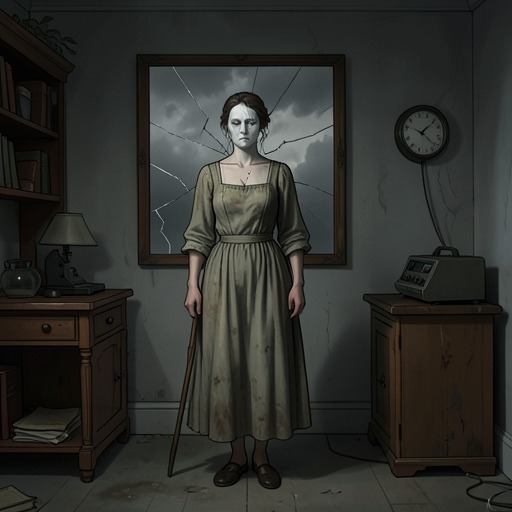
When Hugh and Paul eventually approach a house with barred upper windows, a nurse admits them and leads them to Leyna. Hugh scarcely recognizes her. Her hair is short, her face fuller, and her expression, especially her eyes, appears without animation. Paul takes her hand and kisses her forehead; she gives no sign that she has heard him. Hugh greets her and takes her other hand. She turns her head and looks up at him, and for an instant he thinks he sees a slight change in her eyes, though he later doubts his impression. The reunion offers neither explanation nor restoration. Leyna is present, but the forceful young woman Hugh remembers cannot simply be recovered from the person before him; the small, uncertain movement in her gaze is all the recognition he can tentatively claim.