Osmund Somers Cleverly
MunichOsmund Somers Cleverly is Neville Chamberlain’s Principal Private Secretary and a key operational figure in the government’s response to the Sudeten crisis. A former soldier who distrusts young civil servants without military service, he supervises Hugh Legat closely while assigning him work that connects the Prime Minister’s office to the British Cabinet, the British Broadcasting Corporation, and the British Embassy in Berlin.
Identity and Outlook
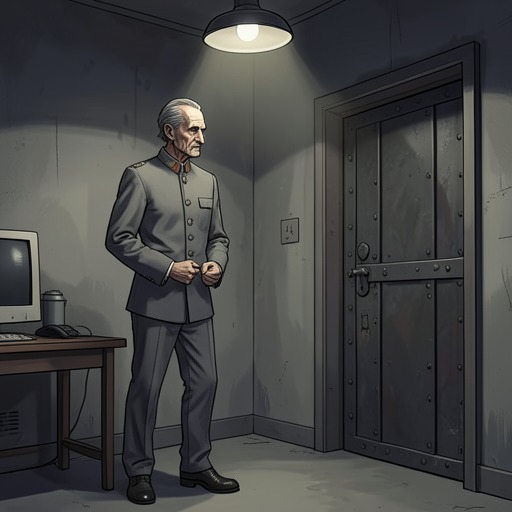
Cleverly is older than his colleagues and had been a soldier by profession before the war. The book describes his long, moustached face and identifies him as the Prime Minister’s Principal Private Secretary. His military background informs his view of civil servants: he is suspicious of brilliant young men from the Treasury and the Foreign Office who have never served in uniform.
That suspicion shapes his treatment of Legat. When Legat arrives after lunch at The Ritz, London, during an international crisis, Cleverly reprimands him for putting a personal engagement ahead of official duties. Legat explains that it is his wedding anniversary and that he could not reach his wife to cancel the table; Cleverly insists that family must sometimes take second place. Their exchange establishes a relationship based on hierarchy and scrutiny rather than easy collegiality.
Directing the Government’s Response
Cleverly gives Legat a dense set of assignments as the crisis accelerates. With Hitler announcing a mobilisation deadline and Neville Chamberlain due to broadcast to the nation at eight, Cleverly orders Legat to arrange for the British Broadcasting Corporation to set up its equipment in the Cabinet Room. The engineers will need to leave quickly afterward so that a full Cabinet meeting can be held. Legat is also to bring in the British Chiefs of Staff when they arrive and take a note of their meeting for the Prime Minister’s later briefing to the Cabinet.
These instructions show Cleverly working through the practical machinery of government: arranging access, timing competing demands on a room, and ensuring that information can be carried from one meeting to the next. The Cabinet Room becomes a temporary centre for broadcasting, military consultation, and political decision-making, while Cleverly’s office coordinates the movement between them.
Oversight and Information Control
Cleverly’s attention extends from the official schedule to the records it produces. After Legat returns from the meeting with the British Chiefs of Staff, Cleverly asks for the meeting’s minute. Legat says the Prime Minister decided not to have it recorded. Cleverly then asks what Legat is carrying, pressing him on the discrepancy between the expected record and his return from the meeting. The exchange presents Cleverly as alert to gaps in the documentary trail, though the evidence does not establish what Legat is carrying or what follows from the question.
Later, Cleverly directs Legat to listen on a telephone line kept open to the British Embassy in Berlin. He stresses that the connection must not be lost and explains that Sir Nevile Henderson is expected back from the Reich Chancellery with Hitler’s response to the Prime Minister’s letter. Legat is at the line when Henderson calls and reports that Benito Mussolini has asked Hitler to postpone mobilisation for twenty-four hours, and that Hitler has agreed. Cleverly has assigned the listening post; Legat receives and records the news.
The Munich Assignment
When Legat is permitted to accompany Neville Chamberlain to Munich at Colonel Menzies’s request, Cleverly makes the appointment with considerable reservations. He puts Legat in charge of the Prime Minister’s dispatch boxes, gives him the keys, and instructs him to contact the office on arrival. The assignment places Legat close to the travelling government’s official papers while leaving Cleverly responsible for defining the limits of his role.
Cleverly’s final warning is that Legat must do nothing to imperil the conference. It brings together the pattern evident in his earlier instructions: Legat is trusted with consequential work, but that trust is conditional, closely supervised, and measured against the government’s immediate objectives. Cleverly’s significance lies less in public argument than in this disciplined control of personnel, communications, and procedure at moments when delay or mismanagement could carry political consequences.