Sir Nevile Henderson
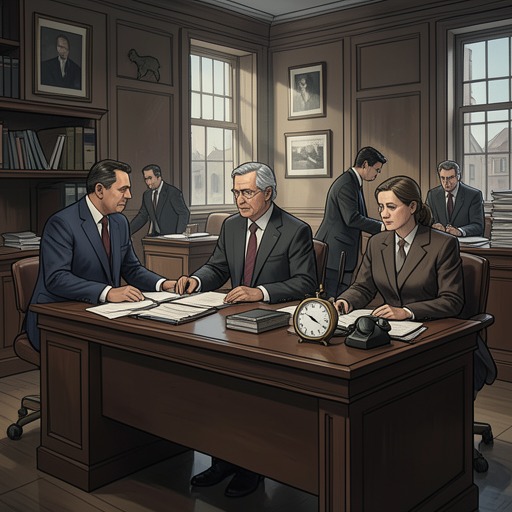
MunichSir Nevile Henderson, the British Ambassador, is shown at a hinge point in the crisis as both a formal representative and a rapid conduit for messages between Berlin and the British government. His immaculate manners and cultivated appearance contrast with the uncertain diplomatic substance he must handle: a reply from Adolf Hitler that offers little hope, followed by news of a temporary postponement of mobilisation.
The Ambassador in Berlin
Henderson receives Paul von Hartmann in an imposing reception hall beneath an oval glass roof. The opulent room, built in the previous century by a railway tycoon who soon went bankrupt, is dominated by two curving staircases with porcelain balustrades. Henderson descends one in a dinner jacket, a red carnation in his buttonhole, smoking through a jade holder. The scene presents him as a conspicuous dandy within the formal world of diplomacy, his appearance as carefully composed as his manners.
Hartmann hands Henderson the Führer’s reply to the Prime Minister. Henderson pulls out its three typewritten pages and reads them standing in the hall; his eyes move rapidly across the text, and his already melancholy face seems to lengthen. After a quiet grunt, he finishes, sighs, looks up at the skylight, and returns his cigarette holder to his mouth. The restrained gestures convey the weight of a message whose contents he must assess before acting.
Reading and Transmitting the Reply
Hartmann makes clear that the State Secretary wants Henderson to pay particular attention to the letter’s final sentence, adding that it had not been easy to secure. Henderson rereads the last page and judges the concession a slender basis for hope, though he accepts that it is something. He gives the letter to his young aide and instructs him to translate it and telegraph it to London immediately, without cipher. His response turns the private delivery into an urgent official communication, moving the text from Hitler’s reply into the British government’s hands.
Henderson’s diplomatic bearing is matched by a reputation for polished, sometimes theatrical self-presentation. He insists on seeing Hartmann to the door, and his manners are described as exquisite, in keeping with his clothes. The account also reports rumours that he was the lover of Prince Paul of Yugoslavia. On an earlier visit to the Chancellery, he had worn a crimson pullover beneath a pale grey suit; Hitler was said to have complained about it for days. Hartmann wonders what the British were thinking in sending such a man to deal with the Nazis, a judgment shaped by the sharp contrast between Henderson’s personal style and the gravity of his assignment.
The Twenty-Four-Hour Postponement
At seven minutes past two, Hugh Legat hears a telephone being picked up in Berlin and identifies the nasal voice at the other end as Henderson’s. Henderson asks Legat to tell the Prime Minister that Hitler has received a message from Benito Mussolini, delivered by the Italian Ambassador. Mussolini assures Hitler that Italy will stand by Germany if conflict comes, while asking him to postpone mobilisation for twenty-four hours so the situation can be reconsidered. Henderson reports that Hitler has agreed and checks that Legat has taken down the message.
The call gives Henderson a second, sharply different communication to carry: after forwarding a discouraging reply, he now relays a temporary reprieve. In both episodes his role is practical rather than decision-making. He reads, identifies what matters, and ensures that the information reaches London and the Prime Minister quickly, while the crisis remains dependent on decisions made by Hitler, Mussolini, and the governments around them.