Édouard Daladier
MunichÉdouard Daladier is the French prime minister whose changing position at the Munich Conference helps expose the difference between being present at a negotiation and having its most affected people represented. He first backs Neville Chamberlain on keeping the Czechs close to the proceedings, but later agrees that a Prague representative can be dispensed with so the settlement can be reached quickly. The narrative follows that shift into the conference’s uneasy social theatre and its final images of agreement, where the leaders assemble while Czechoslovakia remains the subject rather than a participant.
Identity and Introduction
Daladier enters the Munich scene as the head of the French government, arriving with his entourage while the room fills with the other delegations. Through Paul von Hartmann’s watchful perspective, his build is immediately conspicuous: he is stocky and muscular, and the account notes that in Paris he is known as the Bull of Vaucluse. The nickname makes him physically imposing before he speaks, but his movements on arrival are wary. He lowers his head and lets his eyes travel from side to side as he is led towards the buffet.
The scene also establishes how little the gathering resembles a meeting of equals. Hartmann observes that Chamberlain greets Daladier in schoolboy French, while Adolf Hitler’s deputy Hermann Göring occupies himself with a plate piled high with cold meats, cheeses, pickles and vol-au-vents. Hartmann uses the leaders’ arrivals as a moment to slip away in search of Hugh Legat. Daladier is therefore introduced as one figure in a crowded diplomatic spectacle, but one whose subsequent choices will matter to the terms under discussion.
Position in the Negotiations
Daladier’s clearest political action comes in the argument over whether Czechoslovakia should be represented at the talks. Chamberlain later recounts that Daladier initially supported him. Chamberlain had maintained that Britain and France could not guarantee Czech compliance with an agreement unless the Czechs themselves agreed. At minimum, he wanted a Prague representative waiting in the next room, able to give the necessary assurances even if not admitted to the discussions themselves.
That support does not hold. After about half an hour, Daladier changes his position. Sir Horace Wilson records his view that, if including a Prague representative would cause difficulties, he was prepared to forgo it because the question needed to be settled speedily. The reported statement gives Daladier’s stated reason—urgency—without supplying a private explanation or suggesting that he has ceased to recognize the Czechs’ stake. Its significance lies in the practical consequence: the desire to conclude the negotiation takes precedence over their presence in it.
The reversal occurs within a conference already shaped by the threat of invasion. Hitler has demanded that the disputed territory be evacuated by Saturday or taken by force; Wilson’s account describes him repeatedly checking his watch against the twenty-four-hour pause in mobilisation. In that compressed timetable, speed becomes a diplomatic argument in its own right. Daladier’s concession thus registers both as an individual change of position and as part of a process in which the pressure to avert immediate war narrows the space for Czech participation.
The Czechs and the Cost of Exclusion
The narrative gives the exclusion a blunt afterlife. When Chamberlain hears that the proposed arrangement includes a phased occupation, an orderly evacuation of the Czech minority under international supervision and a mechanism for resolving disputes, he turns to Hugh Legat to ask where the Czechs are. Legat replies that they are still in their room. Chamberlain then acknowledges that they have been rather forgotten.
Daladier’s decision is not presented as the sole cause of that absence: it forms one turn in a wider negotiation, and the account does not show him speaking again in this exchange. But the sequence makes the political cost of his change of position legible. The representatives of the four powers can discuss the timetable and terms while the people whose territory is at issue wait elsewhere. Daladier’s preference for settling the matter speedily is therefore set beside a pointed fact of staging: the Czechs remain physically near the negotiations yet outside them.
Portrait at the Conference
Daladier’s character is conveyed less through extended speech than through other people’s observations. At a later meal, Hitler holds forth about the appearance and character of the conference’s political leaders. He exempts Daladier in part from his disparagement, describing him as a former soldier and as someone with whom he can get along. The remark is Hitler’s, not an independent account of Daladier’s character; its importance is that Daladier is singled out from Hitler’s denunciation of Chamberlain as someone whose appearance and manner he considers legible to him.
Mussolini offers a different, brisker description: Daladier, he says, wanted only to drink his beer and leave his advisers to their work. The remark is anecdotal rather than a record of Daladier’s negotiating position, and the scene does not establish whether it is fair. Set beside Daladier’s consequential change over Czech representation, it creates a contrast between the public image of a leader content to defer and the actual political choice attributed to him at the conference. The book leaves that tension visible rather than resolving it into a single authoritative portrait.
Agreement and Narrative Significance
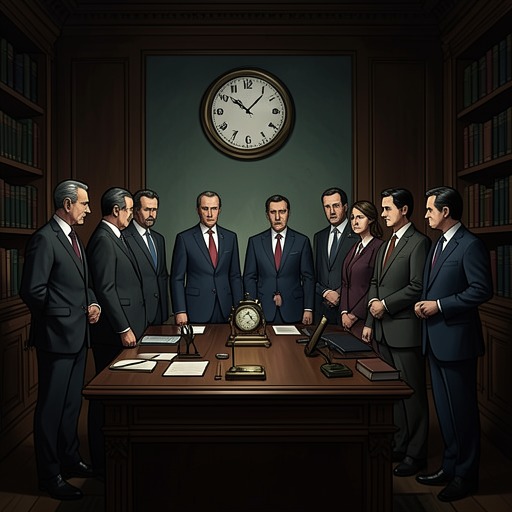
When the leaders assemble for the photograph associated with the agreement, Daladier stands beside Chamberlain, with Hitler and Mussolini completing the row. The description makes the group look awkward and unwilling, like guests at an arranged wedding; the moment the photograph is taken, they separate. The ceremony records a common diplomatic undertaking, but the strained tableau resists any suggestion of effortless unity. Daladier’s place in it is important: he is both a participant in the settlement and a representative of a country whose choices have helped shape it.
The account of the agreement’s preparation emphasizes how the documents allow contentious questions to be passed over or postponed so that a settlement can be reached in less than twelve hours. Daladier’s earlier acceptance of excluding a Prague representative belongs to that same pattern of urgency and deferral. His role is not reduced to either a simple stand for France or an uncomplicated endorsement of the outcome. Instead, the narrative traces a specific movement—from initial support for Czech proximity to willingness to proceed without it—and places that movement within a conference whose polished documents and formal photograph cannot conceal who was left waiting outside the talks.