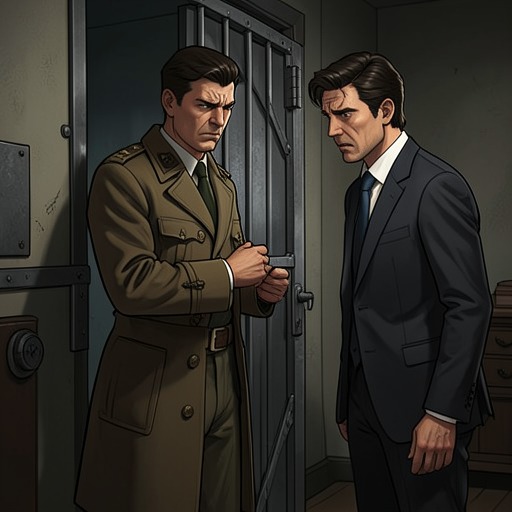
Lord Gort
MunichLord Gort is presented as both a celebrated military figure and a senior officer charged with describing the limits of Britain’s position as the Czechoslovak crisis deepens. His interventions turn the threat of war into concrete military judgments: Germany cannot be stopped from overrunning Bohemia by the pressure Britain and France can currently exert, and any attempt to restore Czechoslovakia’s integrity would require a prolonged, unlimited war.
Identity and Introduction
Gort appears at Downing Street as the Chief of the Imperial General Staff. Legat sees him beneath the brass lantern in the lobby, reading a telegram, his polished brown boots planted wide apart. The narration identifies him as an aristocrat, a war hero, and a holder of the Victoria Cross; clerks, secretaries, and typists find reasons to cross the lobby for a glimpse of him. His public stature contrasts with the grave business awaiting him inside.
When the front door opens amid photographers’ flashes, Air Marshal Newall and Admiral Backhouse arrive in turn. As Legat leads the senior officers inward, Gort asks whether Duff Cooper is coming. Backhouse replies that Neville Chamberlain thinks Duff Cooper leaks information to Winston Churchill, a brief exchange that places Gort among the government’s high-level military consultations and their political sensitivities.
Military Assessment
In the meeting with Neville Chamberlain, Gort presents a memorandum setting out the collective military view. Its conclusion is severe: no pressure Britain and France could apply by sea, land, or air would prevent Germany from overrunning Bohemia and decisively defeating Czechoslovakia. In the memorandum’s assessment, recovering Czechoslovakia’s lost integrity would be possible only through Germany’s defeat, after a prolonged struggle that would amount to unlimited war. Gort’s role is not to offer reassurance but to make the likely cost and scale of resistance explicit.
He then describes the immediate British commitment. Two divisions are to be sent to France to demonstrate solidarity; they could be in position within three weeks and ready to fight eighteen days later. The timetable is paired with a sobering account of French intentions: General Gamelin has made clear that France does not intend to mount more than token raids on Germany before the following summer, and Gort doubts even those will take place. He expects the French to remain behind the Maginot Line. Newall adds that the French are waiting until Britain arrives in greater strength, underscoring the gap between the show of solidarity and the forces actually ready for action.
Strategic Stakes and Narrative Role
Gort identifies the danger extending beyond the immediate contest in Central Europe. If the crisis becomes a world war, he warns, Britain could face Germany in Europe, Italy in the Mediterranean, and Japan in the Far East; in that event, the Empire’s very existence would be in grave jeopardy. His intervention widens the meeting’s focus from the fate of Czechoslovakia to the possibility of a conflict across several theaters and the vulnerability of Britain’s imperial position.
Across these assessments, Gort functions as a military voice within a political deliberation. He sets out what the armed forces can do, how long deployment would take, and what a broader war might threaten, without disguising the distance between a declaration of solidarity and effective military action. The combination of his conspicuous public prestige and his unsparing operational judgments gives his scenes their force: the decorated hero is also the officer who makes the cost of war difficult to ignore.