Sir Horace Wilson
MunichSir Horace Wilson is Neville Chamberlain’s special adviser and one of the central British intermediaries in the Sudeten crisis. His journey from a private meeting with Hitler to emergency discussions in London shows the dilemma facing the government: he warns that Britain may fight if France honours its treaty obligations, yet also urges concessions to prevent a wider war.
Position and Presence
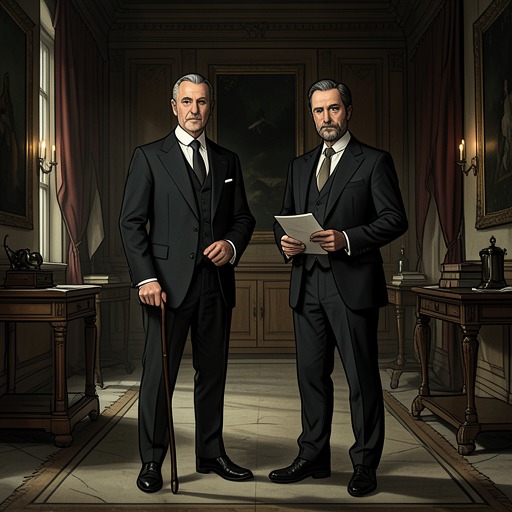
Wilson is an indispensable figure to Chamberlain, though his authority rests on proximity to the Prime Minister rather than a military role. A slight, almost emaciated man with a long nose and pendulous ears, he is usually polite and can be slyly charming. Before joining the crisis at Downing Street, he made his reputation at the Ministry of Labour dealing with trade-union leaders—a background that makes his sudden task of delivering an ultimatum to Hitler seem especially incongruous to Hugh Legat.
His arrival at Number 10 is staged amid newsreel cameras and onlookers. Hunched in the rear of a black Austin 10, Wilson cradles a briefcase and holds an umbrella between his knees. He gives Legat a weak smile, then hurries inside under the glare of the flashbulbs, leaving his fellow passenger to introduce himself. The contrast between Wilson’s slight, exposed figure and the gravity of the message he carries gives the diplomatic encounter a physical vulnerability.
The Berlin Warning
A typewritten account prepared by the German Foreign Ministry’s chief interpreter, Dr Paul Schmidt, records Wilson’s meeting with Hitler. The six-page document uses the oversized type Hitler preferred. Hartmann reads it in an unused entrance near the Foreign Ministry, where Erich Kordt has passed it to him; its restrained official language describes Wilson’s attempt to persuade Hitler that Britain will support France if France fulfils its obligations to Czechoslovakia.
The account also presents Wilson trying to manage the encounter through private reassurance and explicit warning. He praises Hitler’s Sportpalast reception and asks the other officials present to leave briefly so he can assure Hitler that London will continue to pressure the Czechs. But he also reads out a prepared statement about British support for France and asks Hitler to repeat his response, to prevent any misunderstanding. Hitler loses his temper, insists that Germany is prepared for war, and says that if Britain and France want war, they will get it. To Hartmann, the scene resembles an unarmed passer-by trying to persuade a madman to surrender his gun.
Wilson returns to Downing Street carrying the weight of that confrontation. Chamberlain tells his colleagues that Wilson warned Hitler privately and firmly, and that Hitler had said war would come by the following Monday. The Prime Minister expects Wilson to report back by five o’clock, before his planned national broadcast at eight. Wilson’s mission has therefore made the threat unmistakable, but it has not produced a retreat from Hitler.
Concession as a Way Out
At the Cabinet table, Wilson proposes a different course. He has drafted a telegram advising the Czechoslovak government to accept Hitler’s terms before the two o’clock deadline: withdraw from the Sudetenland and permit German occupation. He argues that this is the surest way to keep Britain out of a war that could grow enormously. If the Czechs refuse, he maintains, the United Kingdom would at least have done its best and would no longer carry the same moral obligation to intervene.
The proposal makes Wilson’s position distinct from the warning he delivered in Berlin. He had told Hitler that Britain might support France; now he advocates pressure on Czechoslovakia to avert the circumstances in which that commitment could be tested. Chamberlain raises the risk that even partial British mobilisation might provoke Hitler, while Wilson argues that a limited mobilisation could demonstrate that Britain is not bluffing. The exchange exposes the crisis’s central tension: a signal of resolve might deter Hitler, but it might also push him into war.
Reporting from the Munich Talks
When Wilson later briefs Chamberlain and the assembled officials, he describes the negotiations as a “Mad Hatter’s tea party.” He reports Hitler’s claims that Czechoslovakia threatens peace, that a quarter of a million refugees have fled the Sudetenland into Germany in recent days, and that the matter must be settled by Saturday. Hitler, Wilson says, demanded that Britain, France, and Italy guarantee the start of the evacuation on that day or face a German invasion. Wilson’s impression is that Hitler is not bluffing and that the crisis must be settled immediately to prevent war.
Wilson also recounts how Benito Mussolini produced an Italian draft agreement, which the Germans subsequently had translated. His report conveys the pressure of the suspended mobilisation deadline: Hitler repeatedly watched his own, as if measuring how much of the twenty-four-hour pause remained. Wilson’s role is thus not simply to carry warnings between governments. He becomes a witness and interpreter of a negotiation in which the deadline, the threat of invasion, and the proposed agreement continually alter the choices before Britain and its partners.