Erich Kordt
MunichErich Kordt is a German Foreign Ministry official and a discreet intermediary between Paul von Hartmann and Colonel Hans Oster’s circle. He brings Hartmann a confidential account of Sir Horace Wilson’s meeting with Adolf Hitler, relays Oster’s call for a secret gathering, and later reports that events are moving into action, with two loaded handguns on his desk. His part in these scenes is defined by the pressure between bureaucratic secrecy and the prospect of armed confrontation.
Identity and Position
Kordt is older than Hartmann and one grade senior to him. The narrative identifies him as a Rhinelander and gives him the manner of a cautious civil servant: he carries a briefcase, wears thick spectacles, and, before speaking privately with Hartmann, removes them to polish the lenses on his tie. The small, habitual gesture sits alongside the urgency of the information he carries.
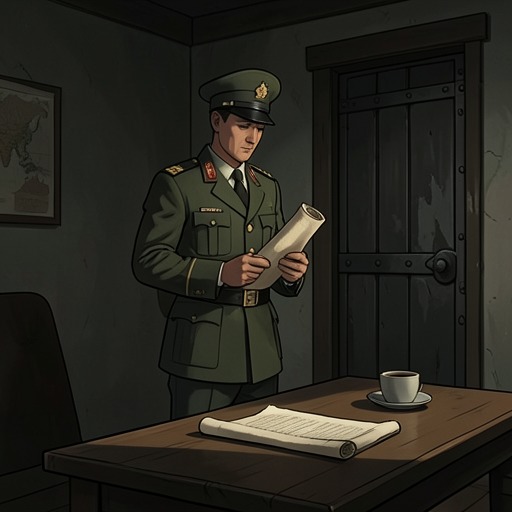
Although Joachim von Ribbentrop had become Foreign Minister, he continued to work from his former headquarters in the Prussian Ministry of State building across Wilhelmstrasse. Kordt has an office there. When Hartmann arrives, Kordt ushers him inside and locks the door; his secretary is absent, apparently sent away. The office becomes a place for confidential contact, set within an official building but separated from its ordinary routines.
The Report on Wilson’s Meeting
During the passage of military vehicles down Wilhelmstrasse, Hartmann phones Kordt, who tells him to come downstairs. Kordt joins him outside carrying his briefcase. Rather than speak openly on the street, he leads Hartmann to an unused entrance, where the two can meet out of public view.
Kordt produces a six-page typed account of Wilson’s meeting with Hitler that morning, written by interpreter Paul Schmidt, and hands it to Hartmann. The account describes Wilson praising Hitler’s previous evening’s speech at the Berlin Sportpalast and privately assuring him that London would continue pressing the Czechs. It also records a very different message: in the event of hostilities, Wilson declared that Britain would support France. Ribbentrop, Sir Nevile Henderson, and Ivone Kirkpatrick were present before Wilson asked them to leave for his private assurance. By passing on the document, Kordt gives Hartmann a detailed record of the competing signals at the heart of the crisis, without claiming authorship of the account himself.
Oster’s Meeting and the Turn to Arms
Kordt later tells Hartmann that Oster wants them to meet that night at number nine Goethe Strasse in Lichterfelde. Hartmann questions why the gathering is to take place so far away; Kordt offers no explanation, telling him instead to arrive as close to ten as possible and warning that the evening will be busy. He acts as the bearer of the invitation, but the exchange leaves its purpose unstated.
In a later scene, Kordt tells Hartmann that Oster has just visited and says that it is happening. Oster has given him two handguns. Kordt lays them carefully on the desk, and Hartmann takes one: a compact Walther pistol about fifteen centimetres long, which he tests by working its safety catch. Kordt confirms that it is loaded. The arrival of the weapons marks a sharp change in the character of their dealings: the clandestine network is no longer only circulating intelligence or arranging meetings but preparing for a dangerous confrontation.
Nerve and Narrative Role
Kordt’s response to the guns complicates any image of him as a practiced operative. He admits that he has never fired one and asks whether Hartmann has; then he giggles like a schoolboy, unable to believe the situation is real. The nervous laughter does not undo the seriousness of his actions—he has met Hartmann secretly, passed on a sensitive report, and accepted weapons from Oster—but it shows how abruptly political resistance has become physical and immediate. Across these episodes, Kordt functions as a careful but visibly unsettled link between information, conspiracy, and the prospect of action.