Derelict Halls
PiranesiThe Derelict Halls are the ruined eastern region of the House, where collapsed floors and fallen statuary make movement hazardous and cut off whole areas from the tides. They interrupt the House’s seemingly endless succession of halls with a landscape of broken architecture, difficult routes, and inaccessible spaces.
Location and Physical Condition
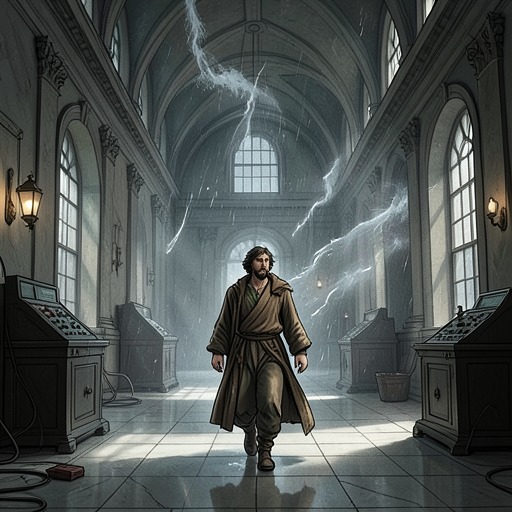
East of the First Vestibule, the House is derelict: masonry and statues from the Upper Halls have fallen through broken floors into the Middle Halls and Lower Halls, blocking doorways. In places, floors and even walls have collapsed, and shafts of grey light divide the dimness. The damage is not merely visual. Fallen masonry alters which halls can be reached and how a traveller must move through them.
The derelict region includes an area of perhaps forty or fifty halls that the tides cannot reach. Sea water drained from these spaces over time, and rain filled them instead, forming still, dark freshwater lakes. Half-submerged windows and masonry-blocked openings leave the halls shadowy; cut off from the tides, they are unusually silent. These are the Drowned Halls, enclosed within the wider eastern zone of dereliction. Their edges can be shallow and tranquil, with water lilies on the surface, while the central waters are deep and treacherous, crowded with broken masonry and drowned statues. Most are inaccessible, though some can be entered from the Upper Halls.
Routes and Risks
The damage turns travel into a problem of access and bodily risk. The Drowned Halls contain plentiful fish, making them a refuge when Piranesi is hungry and less afraid of their still water. But dereliction surrounds them, so reaching them requires climbing to the Upper Halls and descending through wreckage, great rents, and gashes in the floor. The monumental staircases add another obstacle: their steps are almost twice the height comfortable for Piranesi. On one journey, after going two days without food, he climbed to an Upper Hall intending to descend toward the Drowned Halls, only to find it filled with clouds that obscured the way.
The broken ground also extends beyond the eastern ruins into routes connecting distant parts of the House. The path toward the One-Hundred-and-Ninety-Second Western Hall passes through the Seventy-Eighth Vestibule, where tides scatter debris from the Lower Halls. Jagged fragments of broken marble can cut bare feet and create a risk of infection. Piranesi explains that the journey remains possible, but requires careful steps and takes time; what has changed is that he no longer has shoes. The House’s damaged architecture therefore imposes different costs depending on a traveller’s condition and equipment.
Exploration and Meaning
Piranesi has explored the derelict halls of the East as part of a determined effort to see as much of the World as he can. From doorways in the places he has reached, he has found no sign that the World is ending: only further halls and passageways receding into the distance. That sense of continuation sits uneasily beside the eastern region’s visible collapse. The House may stretch beyond sight, yet its routes are fractured, and not every part of it is safely or readily accessible.
The ruins also sharpen the contrast between absence and abundance that runs through Piranesi’s account of the House. Statues occupy nearly every available surface, while collapsed architecture hides or blocks doorways and leaves some spaces unreachable. Even an empty niche or bare patch amid the statuary carries mystery; in the East, absence becomes material and structural, taking the form of missing floors, blocked passages, and halls severed from the tides.
In a letter addressed to a possible living reader, Piranesi describes the halls to the East as derelict and offers a practical orientation to the region: he may be found in halls to the North, West, and South. The description makes the eastern ruins a boundary in his mental map as well as a physical condition of the House. Later, while trying to protect 16 from a trap he believes The Other has set, Piranesi reasons that the safest way to find her is to look for The Other, though he hopes to reach her first. The House’s routes and dangers frame this search: knowledge of where a person may travel, and what barriers lie between halls, can determine whether help arrives in time.
The eastern ruins do not mark the end of the House, but they limit movement within it. Their broken floors, drowned interiors, and scattered debris make the House’s vastness more than a matter of distance: it is a network of passages whose hazards determine who can cross, where shelter or food may be found, and how much time a journey demands.