First Western Hall
PiranesiThe First Western Hall is the site where preparations for the Flood turn into an armed confrontation. Its statues and concealed recesses shape the action: Piranesi first discovers the Other’s boat and gun there, later hides in a niche while waiting for 16, and finally faces the Other as the rising waters close in. The hall brings the novel’s practical struggle for safety into the same space as the breakdown of trust between its two inhabitants.
Setting and statues
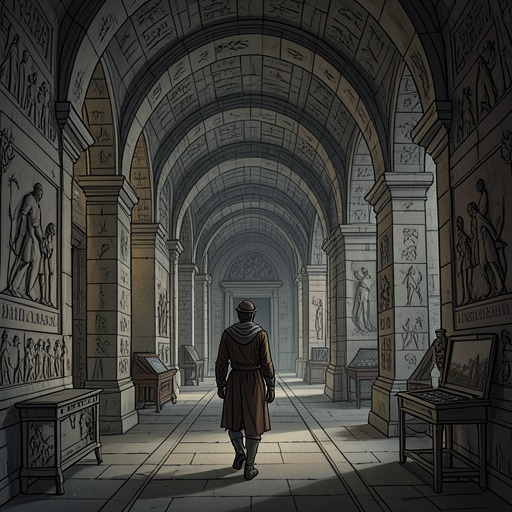
Piranesi passes through the First Western Hall while carrying plastic bowls from the Fourteenth South-Western Hall toward the Third Northern Hall. It is recognizable by its Statues of the Horned Giants: vast figures appear to struggle out of the walls on either side of the Eastern Door, their faces contorted. The hall is thus already marked by images of bodies caught in a forceful passage, an architectural detail that gains urgency when it becomes the setting for flight and violence.
The boat and gun
Near the hall’s North-Eastern Corner, Piranesi discovers a large grey fabric bag and two black canvas objects. The bag, approximately 80 centimetres long, 50 centimetres wide, and 40 centimetres deep, is secured with canvas straps and metal buckles. Its contents include a gun, while the other equipment resolves, on inspection, into an inflatable boat: two extendable black rods accept four paddle-shapes, a pump forces air into the folded material, and the inflated craft is about four metres long and one metre wide. The two strapped canvas objects appear to belong to the boat, although Piranesi cannot determine their purpose.
The discovery seems at first to offer the means of surviving the Flood, but its contents make that hope suspect. Piranesi considers whether the House has sent him a boat, then rejects the idea: previous floods brought no such gift, and he cannot imagine the House sending a gun. He recognizes the weapon as a sign of ownership and identifies the equipment as the Other’s. In the hall, a possible refuge and a threat arrive together.
A meeting in the rising water
On the day the Flood begins, the Other enters the First Western Hall wearing jeans, an old jumper, sneakers, and a harness that Piranesi takes for a life-jacket. Piranesi follows unseen and hides in a niche near the door. The Other goes directly to his bag and begins unpacking the boat, while Piranesi waits, still hoping to intercept 16. Water is already filling the Second and Third South-Western Halls, and the waves strike their walls with a dull thud.
Piranesi realizes that 16 may be watching and waiting for the Other just as he is. He leaves the niche rather than remain hidden, and approaches while the Other continues pumping air into the boat. The Other scowls and demands to know where Piranesi has been, referring to the missed Tuesday meeting and his uncertainty about whether ten rooms or a hundred will flood. He says that Raphael is coming and insists they will finish what they began. The exchange turns the hall into a meeting ground for competing plans: the Other is preparing to escape by boat, while Piranesi has been trying to find 16 and warn those in danger.
Gunfire and danger
As the Tides rise through the Vestibules, Piranesi and 16 climb onto a cornice about seven metres above the floor. The Other has not yet boarded his boat. Instead, he runs to the Northern Wall to retrieve his gun and fires at them. Piranesi initially mistakes the sharp reports for signs that the hall itself may be collapsing under the water’s weight and vibration. The danger is not only the Flood: the Other’s gun makes the hall’s height and statues inadequate shelter. A shot strikes a statue above Piranesi and 16, and a fragment wounds Piranesi’s forehead. The same room that first held the possibility of rescue thus becomes the site of an attack, as the Other chooses violence even while Piranesi urges him to get into the boat before it is too late.
Narrative significance
The First Western Hall concentrates the novel’s crisis into a sequence of changing uses: a passage on an ordinary errand, a place of discovery, a hiding place, a confrontation, and finally a firing position beneath the Flood’s rising waters. The practical objects found there—the pump, boat, gun, and straps—make the conflict materially specific. They also expose the difference between preparation for survival and willingness to protect another person: the Other has a boat but turns back for his weapon, while Piranesi’s warning is directed at the man attacking him. The hall’s immense, contorted statues frame that reversal without resolving it; human danger unfolds beneath their fixed struggle as the waters continue to rise.