First Vestibule
PiranesiThe First Vestibule is a vast, shadowed chamber dominated by eight colossal Minotaur statues and marked by a cold draught that carries the smell of rain, metal, and petrol. Piranesi chose it as the origin of his system for numbering the halls, although he cannot remember why he felt so strongly connected to it. The Vestibule repeatedly draws together the House’s mapped interior, its human traces, and a fleeting passage toward another world; in the end, it becomes the threshold Piranesi and Raphael cross together.
Position and Architecture
The First Vestibule is larger and gloomier than most vestibules. Eight Minotaurs, each about nine metres high, loom above its pavement, their massive horns jutting into empty air and their solemn, inscrutable animal faces darkening the chamber. Its scale makes it an unmistakable landmark, but its importance is not merely architectural: Piranesi made it the starting point from which his numbering system reckons the House’s halls. He recognizes the choice as evidence of an old attachment, even though the reason for that attachment has slipped from memory.
That lapse troubles him. The First Vestibule is a place he rarely visits, despite having made it the origin of his spatial order. His own puzzlement at the contradiction gives the chamber a double function: it anchors the map, yet also exposes what the map cannot restore. Remembering its position is not the same as remembering why it once mattered.
Sensory Threshold and Traces of the Outside
The Vestibule differs from its surrounding halls in temperature as well as atmosphere. It is several degrees colder, and a draught carries the smell of rain, metal, and petrol from an uncertain source. Piranesi has noticed these sensations before but says that he usually forgets them almost immediately. When he deliberately follows the scent along the southern wall, the space between the two Minotaurs at the south-eastern corner appears to recede into a corridor. A patch of misty light seems to contain flickering, moving lights; from that direction come the draught, the smell, and faint sounds like vibration and irregular waves.
The impression briefly sharpens into an apparent opening onto another environment. Piranesi hears footsteps and fragments of conversation, including a complaint about what someone had been hired to do. He recoils, then cautiously looks again. The shadows have returned to their ordinary appearance; the lights and sounds have disappeared, though the cold draught and the smell remain. The episode makes the Vestibule a sensory boundary that can disclose signs of elsewhere without providing a stable passage or an explanation.
Its relationship with the outside is also registered in discarded objects. Crisp packets, fish-finger packets, and sausage-roll wrappings have appeared on the pavement, and Piranesi gathered and burned the litter so it would not mar the House’s beauty. He found a dirty, foul-smelling sleeping bag beneath the marble sweep of the staircase, washed it, and put it to use. Later, four crisp packets blow across the pavement; the last proves to be a crumpled note asking Piranesi for directions to a statue. Such remnants bring an unaccounted-for human presence into a place otherwise organized by marble, statues, and tides.
Routes, Danger, and Refuge
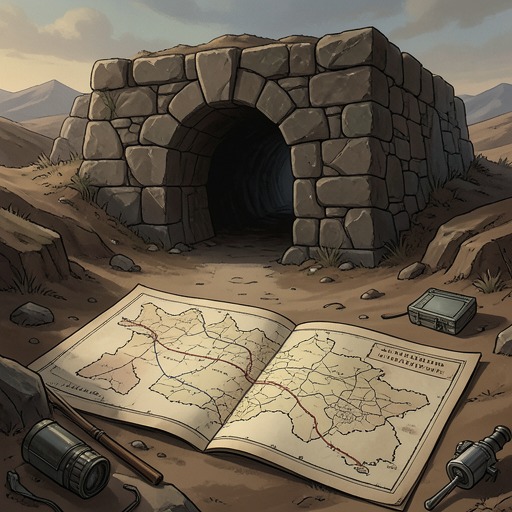
The First Vestibule is part of a network that demands practical knowledge as well as a map. One route to the One-Hundred-and-Ninety-Second Western Hall passes through the Seventy-Eighth Vestibule, where tides scatter debris from the Lower Halls. Jagged broken marble can cut bare feet and risk infection, making the passage possible but laborious. When Piranesi explains why he cannot simply make the journey as before, he reveals that the decisive change is the loss of his shoes. The route’s danger is therefore not abstract: its cost depends on the condition of the traveller’s body and equipment.
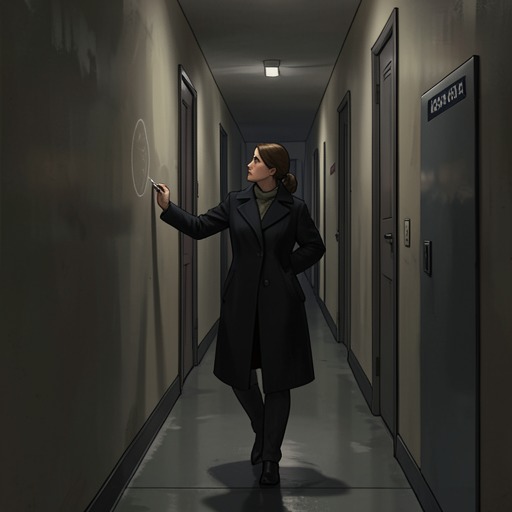
Routes through the House can also be followed through deliberate marking. When Piranesi traces 16’s directions back from the Sixth North-Western Hall to the First Vestibule, he finds yellow chalk marks below his own eye level, estimates that 16 is shorter than he is, and notes how carefully the directions have been copied beneath each doorframe in case a tide or accident destroys one set. The Vestibule is thus connected to a practical system of passage and communication, one in which a route can be preserved redundantly against a changing environment.
During the rising water, Piranesi returns to the First Vestibule while looking for 16 and waits in the grey rain. He searches nearby halls, then walks repeatedly between the Vestibule and the Sixth North-Western Hall along her marked path, without finding her. The location provides a point from which to search, but not certainty or safety: the tide is already ascending elsewhere, and the water begins to wash across surrounding pavements. Later, after the flood, Piranesi and Raphael reach the Vestibule and climb its Great Staircase above the water. Sitting together on a step, soaked but out of reach of the flood, they watch birds gather on the statues and banisters. The same chamber that serves as a route marker becomes temporary shelter.
The Passage and Departure
The Vestibule’s most consequential threshold is formed by the shadows between the two Minotaurs at its south-eastern corner. Piranesi first sees them suggest a distant corridor, accompanied by unfamiliar lights and sounds; when he returns with Raphael, the shadows shimmer and once again outline an alley-like passage with dim walls and moving colours beyond his ability to interpret. The correspondence between these appearances makes the corner a recurring point of contact with the world outside the House, though it remains visually uncertain until the final crossing.
Before leaving, Piranesi retrieves the ornaments he had hidden in a small cardboard box marked AQUARIUM, originally the box for shoes given to him by Dr Ketterley. He spends hours restoring seashells, coral beads, pearls, tiny pebbles, and fishbones to his hair, preparing to look his best in the New World. Raphael is astonished by his appearance. He takes his messenger bag, containing his journals and favourite pens, and walks with her toward the Minotaurs. After one last look at the House, he shivers; Raphael takes his hand, and together they enter the corridor.
The departure gathers the Vestibule’s earlier functions into one decisive scene. Its statues remain a landmark within the House, its shadows become an actual passage, and the journal-keeping traveller who once used it to order the halls carries his records through the threshold. The First Vestibule does not explain the world beyond or erase the uncertainty that has surrounded its strange signs. Instead, it turns the House’s most familiar point of orientation into an exit, with Raphael beside Piranesi as they cross.