First North-Eastern Hall
PiranesiThe First North-Eastern Hall is where Piranesi encounters 16 and hears the old scholar explain how he came to the House. The hall’s shafts of light and Wall of Statues give this meeting an almost ceremonial setting, but the conversation turns from wonder to rivalry, from cosmology to the human cost of remaining in the House. It becomes the place where 16 identifies the House as a Distributary World and warns that prolonged residence can destroy memory and mental coherence.
Setting and First Encounter
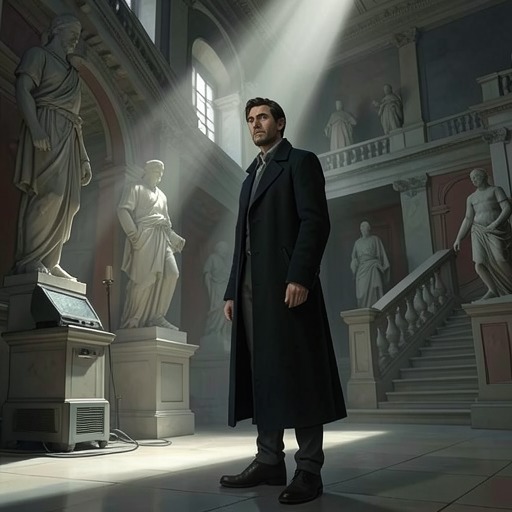
From the windows of the First North-Eastern Hall, shafts of light descend toward the Wall of Statues. Piranesi sees a man standing within one of them, still and gazing upward. The man is not The Other: he is thinner and somewhat shorter. Piranesi recognizes him as 16, whom he has unexpectedly encountered after entering through one of the western doors.
The setting makes the meeting a confrontation with the House’s scale and its inhabitants at once. 16 is framed against the statues rather than introduced through action: he stands motionless, looking up, while Piranesi approaches and circles him to take in his appearance. The hall is not simply a backdrop to their exchange; its monumental environment is already the subject of the stranger’s attention and soon becomes the object of his theory.
Piranesi describes 16 as an old man, with dry, papery skin, thick clotted veins in his hands, large dark eyes under hooded lids, and a long, mobile mouth. His Prince of Wales check suit is old and worn but fits his thin frame. The details register the difference between the visitor Piranesi had imagined and the person who has appeared: Piranesi had expected 16 to be young, like himself. He greets the stranger out of curiosity about his voice, and their encounter begins in a moment of deliberate approach rather than flight.
16’s Account of the House
In the hall, 16 describes The Other as a former student and dismisses him as a charlatan whose intellectual manner conceals a lack of original ideas. He claims that The Other’s ideas were his own, and presents himself as the scholar who theorized that the House existed, worked out how to reach it, and brought other people there. His account turns the meeting into an assertion of intellectual priority: the person Piranesi knows as The Other is, in 16’s version, a secondary figure who has taken precedence only in name and circumstance.
16 also describes secrecy as part of his work. He says he kept the discovery secret and required those he brought to the House to do the same. Although he says he was not strongly governed by conventional morality, he claims to have refused to cause civilization’s collapse, adding that he had a sentimental streak. The juxtaposition complicates his self-portrait: he speaks as a man willing to cross ordinary ethical boundaries, yet defines one large-scale catastrophe as a limit he would not cross.
He explains that discovering the House led him to suspect that other places and worlds existed, prompting him to search for them. He calls the House a Distributary World: a world created by ideas flowing out of another world and unable to have existed without that prior world. He does not know whether the House remains dependent on the continued existence of its originating world. He says the theory is set out in his book, which Piranesi has not read, and recommends it as a work the younger man would like.
Statues, Knowledge, and the Limits of Theory
Piranesi asks whether the Statues exist because they embody ideas and knowledge that flowed from the other world into the House. 16 responds with genuine pleasure and calls the suggestion intelligent, admitting that he had not considered it. He agrees that it is highly likely and imagines that statues of obsolete computers might be coming into being in a remote part of the labyrinth.
The exchange makes the hall’s Wall of Statues more than scenery: it is the visible prompt for a theory about how ideas take material form in the House. Yet the conversation also distinguishes 16’s established account from Piranesi’s contribution. 16 presents himself as the originator of the Distributary World theory, but here Piranesi supplies a further possibility that the older scholar immediately adopts. The Hall’s statues thus stand at the intersection of observation and speculation, where the House can be contemplated without being fully explained.
Lingering and the Hall’s Warning
16 knows that remaining in the House for too long carries severe consequences, naming amnesia and total mental collapse. He compares Piranesi’s coherence with James Ritter’s condition near the end of his stay, saying Ritter could barely put a sentence together despite having spent less time there. The warning gives the conversation a practical urgency: 16 says he cannot stay long, and his account of the House’s marvels is inseparable from knowledge of its damaging effects.
As he turns to the reason he came, 16 grips Piranesi’s hand with a cold, bony, papery one and jerks him sharply toward himself. Piranesi notes the smell of paper and ink, a finely balanced perfume of violet and aniseed, and an underlying trace of something unclean. In the intimacy of this physical gesture, the lecture on worlds and statues gives way to a personal warning: someone is looking for Piranesi. Piranesi asks whether the person is 16, leaving the identity of the pursuer unresolved in this exchange.
Narrative Significance
The First North-Eastern Hall concentrates the meeting’s contrasts: light and stillness, the apparent permanence of statues and the fragility of human memory, scholarly claims and ideas that remain open to revision. The Wall of Statues first draws 16’s gaze, then becomes the subject of Piranesi’s question about the passage of knowledge between worlds. In this way, the Hall anchors the conversation in something Piranesi can see while the speakers debate realities that exceed their immediate surroundings.
The location also stages a collision between two accounts of authority. 16 asserts that he discovered the House and originated the ideas associated with it, while his response to Piranesi shows that he can still be surprised by what the House suggests. His warning about mental collapse, grounded in James Ritter’s decline and his own awareness of the danger of lingering, prevents his cosmological explanation from becoming detached from consequence. The Hall’s significance lies in holding these dimensions together: it is a place of encounter, a visual prompt for speculation, and the setting for a warning that makes knowledge of the House inseparable from the risks of inhabiting it.