Lyme Regis garden
PiranesiThe Lyme Regis garden is the childhood setting where Laurence Arne-Sayles first believed the world was fluid and responsive, and the place he later returned to in search of a door into other worlds. Its importance lies in the discovery that remembering his childhood there can cleanse his vision: the garden does not merely provide a route to the House, but becomes the threshold through which his earlier sense of possibility is recovered and acted upon.
Childhood Place and the Search for a Door
In an extract from The Half-Seen Door, Arne-Sayles explains that the first discovery of a door is the difficult one. His theory is that a person must cleanse their vision by returning to the geographical place where they last believed the world to be fluid and responsive. For him, that place is the garden of the house where he grew up in Lyme Regis: the site of a childhood perception he associates with freedom from the grip of modern rationality.
By 1979, the house had passed through several hands. Its then-owners refused Arne-Sayles’s request to stand in the garden for hours performing an Ancient Celtic ritual. He responded by finding out from a friendly milkman when the owners would be away on holiday and returning to break in. The garden is thus reached not through permission or a completed ceremony, but through a deliberate act of trespass prompted by his pursuit of the door.
The Garden Recalled
The day Arne-Sayles entered was cold, rainy, and grey. On the lawn, in the pouring rain, he stood among roses planted by his mother. The beds had since been made to share space with flowers he regarded as vulgar, but behind the rain he saw masses of colour: white, apricot, pink, gold, and red. The setting brings together a present marked by weather and change with a remembered garden whose colours and associations remain vivid to him.
Arne-Sayles concentrates on his childhood in that garden, recalling the last time he believed both the world and his own mind to be unfettered. He remembers standing before the roses in a blue wool romper suit, holding a metal soldier with peeling paint. The objects are modest and particular, but in his account they anchor the crucial act of remembering: rather than relying on a complicated ritual, he finds that recollection itself is potent enough to free his mind and cleanse his vision.
From Memory to the House
As Arne-Sayles remembers, he no longer sees or feels the rain. He experiences himself as standing in the clear, strong sunlight of early childhood, while the roses’ colours appear supernaturally bright. The passage does not describe the garden as physically transformed; instead, the remembered place alters how he sees, and that change makes the doors perceptible.
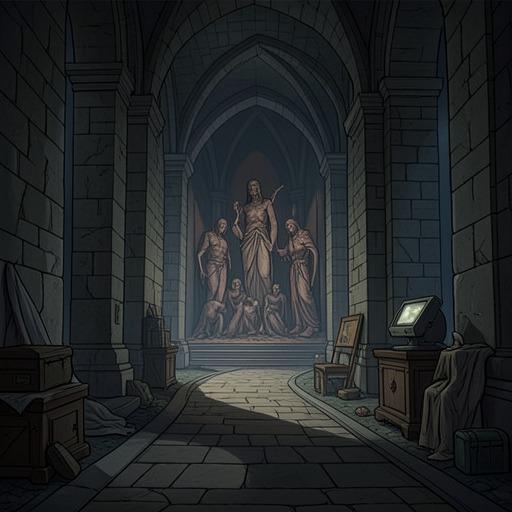
Doors into other worlds begin appearing around him. Arne-Sayles knows which one he seeks: the door into which everything forgotten flows. He describes its edges as frayed and worn by the passage of old ideas leaving this world. The door is located in a gap between the Antoine Rivoire and the Coquette des Blanches, and he steps through it. Beyond it lies a vast marble chamber surrounded by eight different, massive statues of minotaurs, with a great staircase rising to a height and descending to a disorienting depth; a sound like a sea fills his ears. The garden is therefore the point of departure for his entrance into the House, while memory supplies the perceptual passage that his prepared ritual had failed to guarantee.
Place, Perception, and Consequence
The episode gives the garden a double significance. It is a concrete childhood location, marked by the roses his mother planted and the small objects Arne-Sayles remembers holding, but it is also the last place where he can recover an earlier, unfettered way of perceiving the world. His return makes the garden a threshold not because it ceases to be an ordinary garden, but because recollection changes what he can see within it.
That threshold has consequences beyond the garden itself: the door leads Arne-Sayles into the House, where his account encounters the scale, marble, statues, staircase, and sea-like sound of another world. The scene also establishes the method he later sets out in The Half-Seen Door: the remembered place matters because it restores a way of seeing, and the decisive opening comes when that vision is cleansed. In the wider story, Piranesi calls the House home, even amid its waters and dripping statues, and chooses to leave with Raphael rather than remain alone. His attachment confirms how radically the House can become a home; Arne-Sayles’s account of the garden supplies a distinct earlier route into that world, grounded in a recovered childhood perception.