Lower Halls
PiranesiThe Lower Halls are the tidal level of the House, where the ocean’s changing reach governs access, risk, and subsistence. Though often frightening and difficult to cross, they provide fish, crustaceans, sea vegetation, and the recurring sound of water that accompanies Piranesi through his life in the labyrinth.
Position and Environment
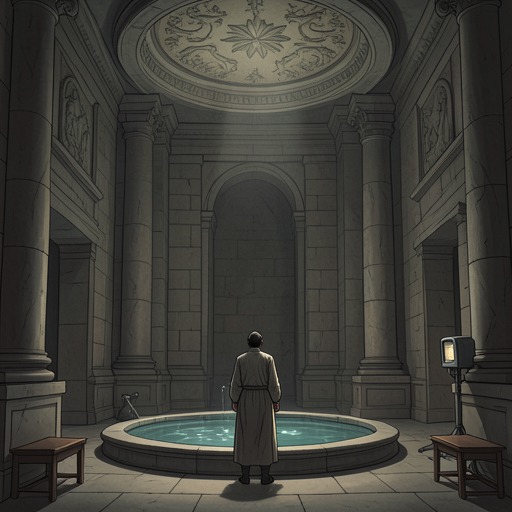
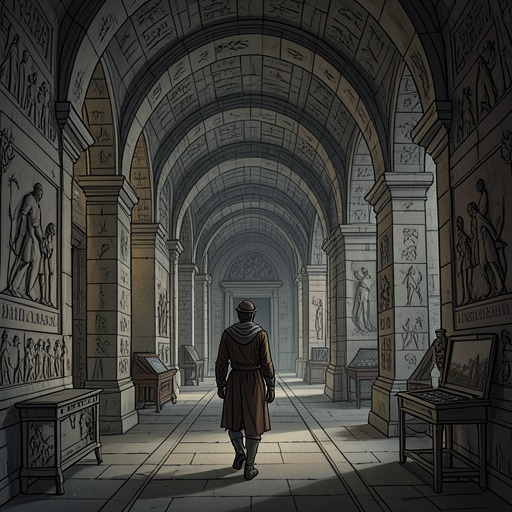
The House has three levels. The Lower Halls belong to the Tides; from across a Courtyard, their windows appear grey-green with restless water and white with foam. They supply fish, crustaceans, and sea vegetation, while the Middle Halls are the domain of birds and people and the Upper Halls the domain of clouds. The House’s ordered levels therefore distinguish not simply regions but different conditions for living.
The Lower Halls meet the larger network through staircases descending from Vestibules. Their state can change dramatically with the Tide: when the water retreats, a hall may be left entirely dry, exposing a pavement scattered with seaweed, pebbles, starfish, and shells. Such a rare low-water interval also makes the force of the wind and the exposed remnants of the sea part of the landscape Piranesi must work within.
Survival and Risk
Piranesi initially feared the Tides and tried to remain in dry halls, where statues were not covered with seaweed or shellfish. Fresh water could be found in many halls, but food required him to descend to the Lower Halls and approach the ocean. Hunger repeatedly forced him to make that journey despite his fear of the waves.
His early observations taught him that the Tides were predictable enough to record, but not uniform in what they left behind. He began a Table of Tides in hopes of anticipating their movements, yet at first he treated one Tide as much like another. The mismatch between a Tide he expected to bring plentiful food and one that proved bright, clean, and empty showed that recording timing alone did not amount to understanding the Tides’ different natures.
The House’s geography also makes access to food a matter of route knowledge. Piranesi found fish in the Drowned Halls, whose still waters were less frightening, but those halls were encircled by dereliction. Reaching them meant travelling up to the Upper Halls and then descending through wreckage and openings in the collapsed floors. The Lower Halls are thus both a direct resource and part of a wider, hazardous system of movement.
Tides, Routes, and Exposure
Tidal changes affect passage well beyond the shore. On the route to the One-Hundred-and-Ninety-Second Western Hall, debris carried up from the Lower Halls is scattered through the Seventy-Eighth Vestibule and its surrounding halls. Though the path may be dry at a particular moment, broken material makes crossing it laborious and risky; Piranesi explains that he once had shoes to protect his feet but no longer has them. The water’s effects persist after it has receded, turning the wider House into an extension of the tidal zone.
The same environmental system can alter the House over longer periods. After the ceilings of the Twentieth and Twenty-First North-Eastern Halls collapsed, clouds began drifting into the Middle Halls, making that region colder and greyer. These changes connect the condition of the building to weather and movement between levels: the House is not a fixed backdrop, but an environment whose damage and waters reshape where its inhabitants can go and what they must endure.
Home and Meaning
The Lower Halls’ sound is more than a warning of danger. In the dark One-Hundred-and-Ninety-Second Western Hall, Piranesi steadies himself by listening to the sea in the Lower Halls, whose water laps against the walls of countless chambers. The familiar sound helps him fall asleep. Its repetition gives the immense and disorienting House a dependable rhythm, even in a distant hall where he feels watched by unknown statues.
That sense of belonging persists when the halls are flooded. When Sarah Raphael suggests that they go to her house and then take him home, Piranesi answers that he is already home. With the waters lapping at the walls and the statues dripping around them, the statement makes clear that home is not, for him, a dry refuge outside the labyrinth. The Lower Halls embody the House’s double character: they threaten his safety and demand work, yet their cycles provide sustenance, orientation, and the sounds of the place to which he belongs.