Drowned Halls
PiranesiThe Drowned Halls are a region of freshwater lakes formed in the derelict eastern part of the House, where collapsed floors and blocked passages have shut out the tides. They are at once a refuge and an obstacle: fish are plentiful in their still waters, but the surrounding wreckage makes them hard to reach, and their central depths conceal broken masonry and drowned statues. Their geography turns environmental change into a practical condition of life, determining where food can be found and which routes remain passable.
Formation and Setting
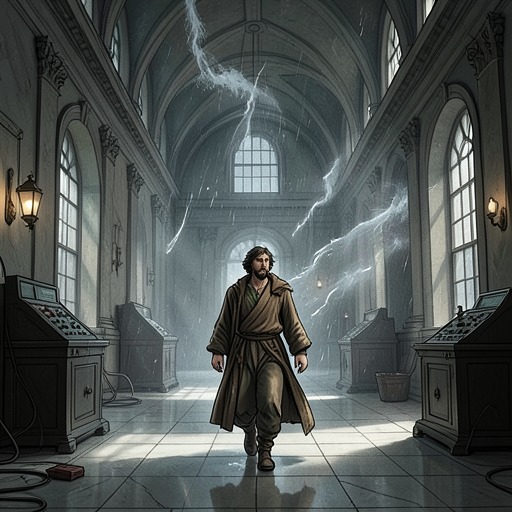
East of the First Vestibule, the House is derelict. Masonry and statues from the Upper Halls have fallen through broken floors into the Middle and Lower Halls, blocking doorways. Across an area estimated at forty or fifty halls, the tides can no longer enter. Sea water has drained away over time, and rain has filled the enclosed spaces, creating dark, still freshwater lakes. Windows are half-submerged or obstructed by masonry, leaving the halls dim; cut off from the tides, they are unusually silent.
The region is not uniformly dangerous. Along its periphery, the water is shallow and tranquil, with water lilies covering the surface. Toward the centre it becomes deep and hazardous, crowded with broken masonry and drowned statues. Most of the Drowned Halls cannot be entered, although some are accessible from the Upper Halls. This uneven accessibility makes the region a fragmented landscape rather than a single open refuge: its edges offer calmer water, while its interior carries greater risks and is harder to approach.
Statues and Resources
Among the features of the lakes are immense statues of men with curly hair and beards, straining out of the walls and extending their upper bodies over the dark water. One leans so far that its broad back forms a nearly horizontal platform about half a metre above the surface. The narrator uses this unlikely architectural projection as a fishing place. The statues are therefore not only objects to observe: their position in the built environment can provide practical access to food.
Fishing is best at night, when fish gather in patches of moonlight and can be seen more easily. The Drowned Halls supply an important food source for the narrator, who discovers that their fish are plentiful and their still waters less frightening than other parts of the House. Their usefulness contrasts with the difficulty of getting there: their resources are available only through routes shaped by collapsed architecture and inaccessible boundaries.
Routes and Survival
The Drowned Halls are surrounded by dereliction. To reach them, the narrator must travel through the Upper Halls and descend by way of wreckage, passing through large rents and gaps in the floors. Hunger makes this hazardous journey necessary. On one occasion, after going two days without food, the narrator sets out for the lakes in an enfeebled state. The staircases themselves impede him: their steps are nearly twice the height comfortable for him, built on a scale that suggests a House intended for giants.
The route can also be blocked by weather. From an Upper Hall above the Nineteenth Eastern Hall, the narrator plans to descend toward the Drowned Halls but finds the hall filled with clouds, a cold, grey obstruction. Elsewhere, he describes having explored these freshwater halls and notes the white water lilies on their dark waters. The contrast between a known source of food and a route that may be cut off makes survival dependent not just on discovering resources but on continually judging access.
A Changing and Connected Environment
The Drowned Halls belong to a House whose three levels distribute conditions for life unevenly. The Lower Halls are the domain of the tides and provide fish, crustaceans, and sea vegetation; the Upper Halls are the domain of clouds and supply fresh water as rain and streams. Between them, the Middle Halls are associated with birds and people. The Drowned Halls’ freshwater state results from this larger environmental system meeting architectural collapse: rain remains in an area from which the sea has been excluded.
The House’s conditions can change across regions and over time. After the ceilings of the Twentieth and Twenty-First North-Eastern Halls collapse, clouds drift into the Middle Halls where they normally do not go, making that region colder and greyer. Strong wind likewise alters the tides elsewhere: when the narrator gathers seaweed in a Lower Hall, the high tides are unusually violent and the low tide has receded so far that the hall is almost never entirely dry. These changes place the Drowned Halls within a wider pattern in which weather, tides, and damage to the building affect food, movement, and exposure.
Narrative Significance
The Drowned Halls make the House legible through its hazards and resources. Their still freshwater, abundant fish, and water lilies might suggest a secluded sanctuary, but the route to them runs through wreckage, and the central lakes remain treacherous. A statue’s back can become a fishing platform; a fallen floor can seal off whole halls; a cloud-filled passage can frustrate a journey made necessary by hunger. In this way, the region’s physical arrangement governs what the narrator can eat, explore, and safely reach, while its transformed waters record the lasting consequences of the House’s decay.