One-Hundred-and-Ninety-Second Western Hall
PiranesiThe One-Hundred-and-Ninety-Second Western Hall is a dark, windowless chamber distinguished from the House’s otherwise seemingly endless sequence of halls. Its single doorway frames the night sky, and under a full moon its statues appear as a crowd gathered to look outward. The encounter gives Piranesi a decisive insight: the House does not need to yield secret knowledge to possess value. Its beauty and presence are sufficient in themselves.
A singular chamber in an immense world
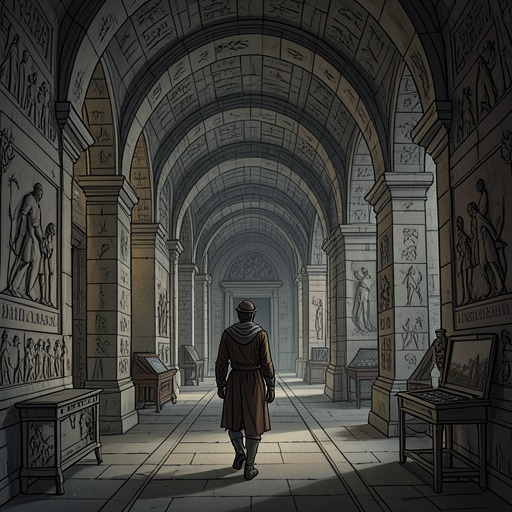
Piranesi has explored the House with the intention of seeing as much of the World as his lifetime permits. He has travelled west to the Nine-Hundred-and-Sixtieth Hall, north to the Eight-Hundred-and-Ninetieth Hall, and south to the Seven-Hundred-and-Sixty-Eighth Hall. His journeys have taken him into the cloud-drifted Upper Halls, the lily-covered waters of the Drowned Halls, and the ruined eastern halls, where collapsed ceilings, floors, and walls leave shafts of grey light. From doorways he has looked ahead and seen no sign that the World ends, only halls and passageways continuing into the distance.
Against this vast continuity, the One-Hundred-and-Ninety-Second Western Hall is remarkable because it has only one doorway and no windows. Piranesi has seen it only once before. He describes it to The Other as majestic and mysterious, with a difficult-to-explain sense of presence, and agrees when The Other compares it to a temple. The other man immediately wants to see it, but Piranesi’s explanation of the route makes clear that reaching it is not simply a matter of distance.
From the First Vestibule, the Hall is 20 kilometres away, a journey of 3.76 hours without rest. The path passes through the Seventy-Eighth Vestibule, a flood-prone region where tides scatter debris from the Lower Halls. Jagged fragments of broken marble can cut bare feet and risk infection; a traveller must pick a careful, laborious way through. Piranesi has crossed the rubble before, but now he has no shoes. That difference, made painfully visible beside The Other’s neat suit and shining shoes, turns the expedition into a measure of how differently the two men inhabit the same world.
The journey and the threshold
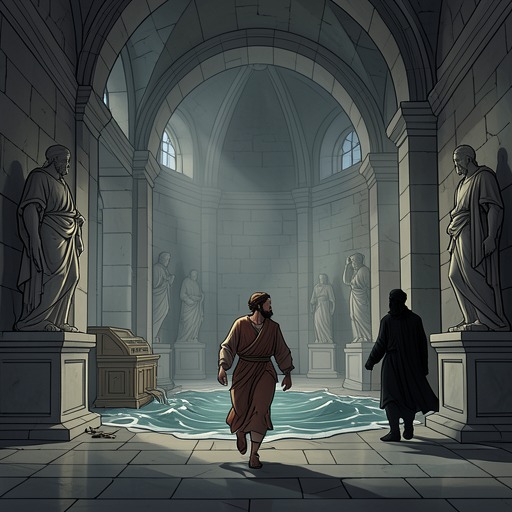
When Piranesi reaches the Seventy-Eighth Vestibule, scattered rubble becomes an uneven floor of jagged stones, with a thin sheet of water running beneath it and broken statues heaped in the corners. The route also passes through the Eighty-Eighth Western Hall, where nesting herring gulls attack his intrusion, beating their wings and trying to peck him as he waves and shouts them away. The journey is thus made up not of abstract map-work but of bodily hazards, animal territory, and the need to proceed carefully.
At the destination, the surrounding halls are filled with soft blue twilight, but the One-Hundred-and-Ninety-Second Western Hall is dark. A faint draught comes from its single doorway. Piranesi cannot answer The Other’s question about which stars are visible from the entrance simply by consulting his star maps: the opening is about four metres wide and eleven metres high, too small against the vast sky to determine what it frames. He realizes he will have to spend the night inside and see for himself.
On a later visit, Piranesi enters the Hall and walks about twenty metres in before turning toward the single doorway, which aligns with a window in the corridor outside. He wraps himself in his blanket and sits. The darkness and the unseen statues unsettle him; unlike the Third Northern Hall, where he usually sleeps amid birds and their small nighttime sounds, this chamber seems to have no birds at all. To settle himself, he listens to the sea in the Lower Halls, whose sound accompanies him through his days and nights. He falls asleep with that familiar sound as his point of safety.
A crowd turned toward the moon
Piranesi wakes to a full moon positioned in the middle of the doorway, its light reaching into the dark chamber. The statues on the walls seem to have turned toward the opening, their marble eyes fixed on the moon. They are unlike the isolated figures found in other halls: here, the sculptures represent a crowd, connected by gesture and attention. Two figures have their arms around one another; one person lays a hand on another’s shoulder to pull forward for a better view; a child holds its father’s hand. A dog, indifferent to the moon, stands on its hind legs with its paws on its master’s chest, asking for attention.
On the rear wall the crowd is dense and disordered rather than arranged in tiers. At its forefront, a young man stands in moonlight, elated, holding a banner. The figures do not merely decorate the chamber: their shared orientation makes the doorway a scene of collective looking. Piranesi, who believes himself to be one of only two living humans in the World, is struck by the possibility of thousands. For a moment he almost forgets to breathe, sensing what it might mean for human life not to be solitary.
As the full moon sinks westward, its light fades and the constellations become clearer in the window opposite the doorway. Piranesi records the stars and constellations he can see. At dawn he sleeps for a few hours, then begins the journey home. The Hall has answered the observational question that brought him there, but the greater consequence of the visit is not a new piece of astronomical data. The moonlit crowd has altered the meaning of the House and the purpose of his work within it.
The House as an end in itself
On the return journey, Piranesi reconsiders the Great and Secret Knowledge, which The Other says will grant strange powers. He no longer believes that finding it is worth pursuing. He does not claim certainty that such knowledge does not exist; he recognizes that it might or might not. Either way, it no longer matters enough to spend his life seeking it.
The realization comes as a revelation before Piranesi can retrace the reasoning behind it. His mind returns to the One-Hundred-and-Ninety-Second Western Hall in moonlight: its beauty, its calm, and the reverent expressions of the statues as they face the moon. He understands that the quest for secret knowledge has encouraged him and The Other to treat the House as a riddle or a text to decode—as if discovering its answer would extract its value, leaving only scenery behind. The vision makes that way of thinking seem absurd. The House is valuable because it is the House; it is not merely a means to some further end.
This change also sharpens Piranesi’s unease about the powers The Other associates with the Knowledge, including the power to control lesser minds. Piranesi rejects the premise: there are no lesser minds in their world, only himself and The Other, both intellectually lively, and even the hypothetical existence of such a mind would not explain why anyone should want to control it. Abandoning the quest frees him to imagine a different science, one that follows whatever paths the evidence suggests rather than serving an anticipated prize. The Hall’s significance therefore extends beyond its unusual architecture and celestial view: it becomes the place where Piranesi’s attention shifts from mastering the House to recognizing its independent worth.
Routes, messages, and return
The Hall remains connected to the House not only by difficult passage but also by the knowledge needed to move through it. When Piranesi later follows 16’s directions from the Sixth North-Western Hall toward the First Vestibule, he retraces the marked route through the doorways, finding yellow-chalk directions written beneath each doorframe. Their position below his eye level suggests that 16 is shorter than he is, and the repeated instructions show deliberate care: if a tide or accident destroys one mark, the others may remain. The mapped House is a record of another person’s passage as well as a practical route through an immense environment.
Much later, when Piranesi’s overriding concern is to find 16 and keep her safe, he suspects The Other has set a trap by promising to meet her and reveal how she can find Matthew Rose Sorensen. Looking for The Other may therefore be the surest way to find 16, but it also means approaching the danger Piranesi would prefer to avoid. The route through the House is again inseparable from questions of trust, access, and risk.
The One-Hundred-and-Ninety-Second Western Hall also belongs to the larger pattern of Piranesi’s departure. When he finally leaves the Eternal House with Raphael, he carries his journals and favourite pens toward the two Minotaurs in the south-eastern corner, where the shadows suggest a passageway leading to lights and moving colours. He takes one last look at the House; Raphael takes his hand, and they enter the corridor together. The Hall’s moonlit crowd has shown him a world of human togetherness he could scarcely imagine, while his final passage outward preserves the House as more than a puzzle left behind: it is a place whose value he has learned to recognize without needing to possess or explain it.